Introduction
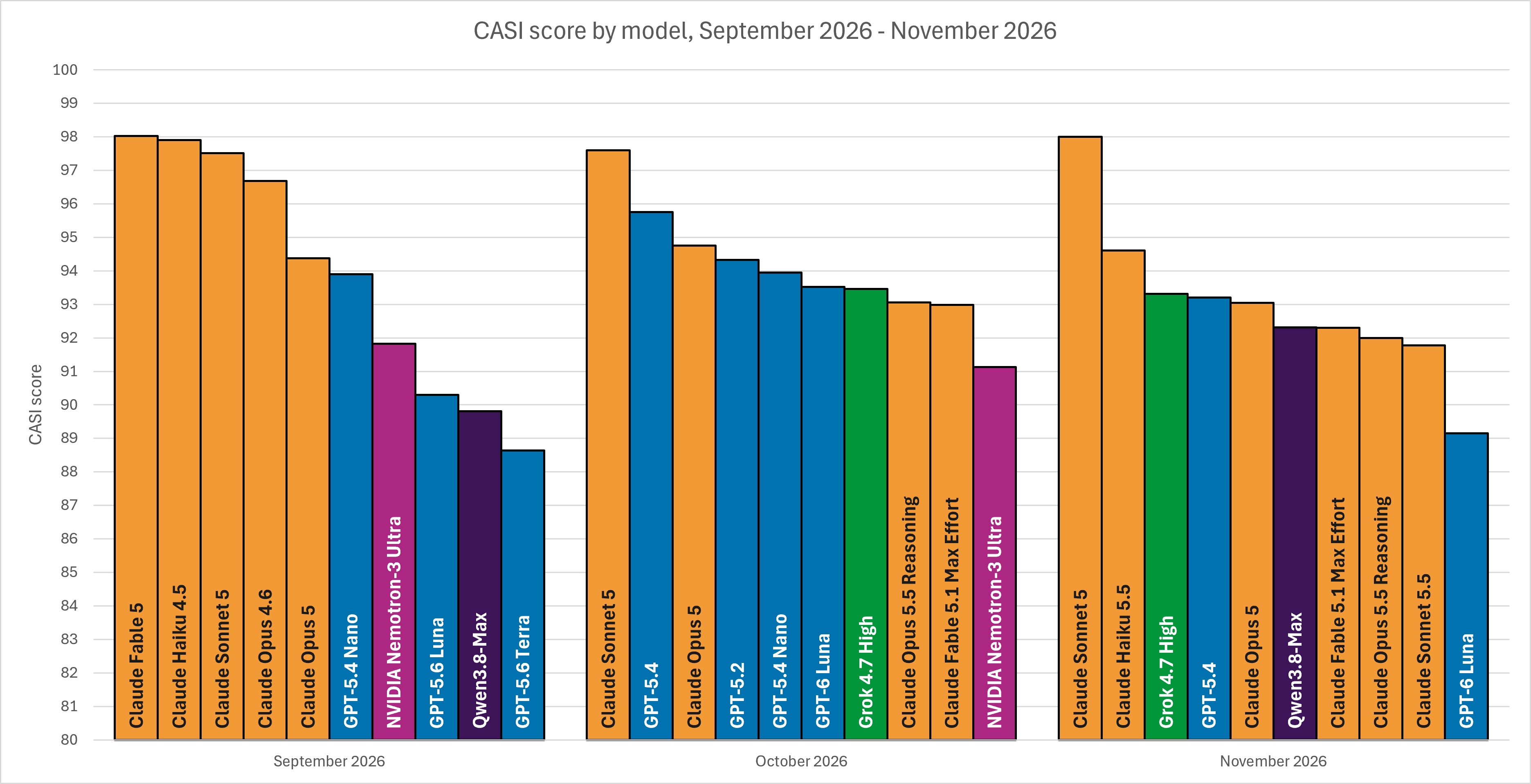
F5 AI security researchers tested models from 11 providers for November's CASI leaderboard, with eight new models being added. Two of the new arrivals reach the published top ten: Anthropic's Claude Haiku 5.5 enters second with a score of 94.61 and Claude Sonnet 5.5 is ninth with 91.78 points. The other six land below it: OpenAI's GPT-6.1 Sol (87.38), Nvidia's Nemotron 3.5 Super VL (87.36) and Nemotron 3.5 Lightning (69.09), Google's Gemini 4 Argon (82.57), DeepSeek V4.1 Flash (82.42), and Xiaomi's MiMo V2.6 Flash (80.44).
In the news, a jailbroken DeepSeek agent spent two weeks inside a European telecom, the ARTEX framework went from GitHub to bank intrusions and espionage within three months, and Unit 42 documented two operators running DeepSeek through Hermes Agent.
AI insights: October 2026
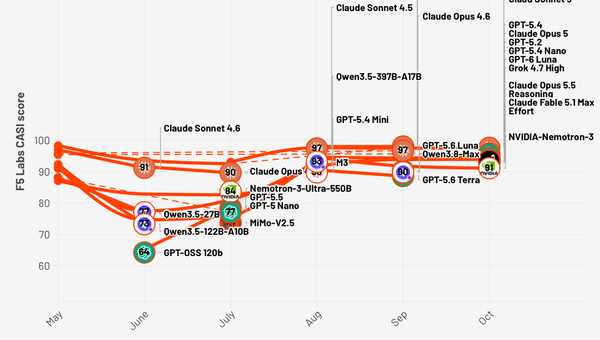
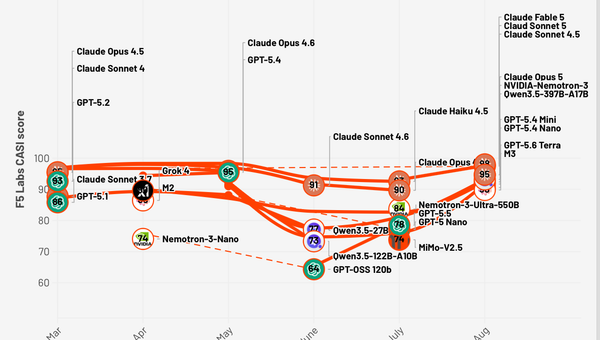
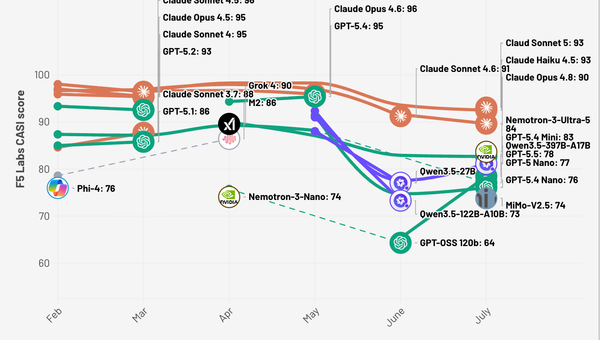
November's published top ten carries six Anthropic models, two from OpenAI, and one each from xAI and Qwen. Claude Sonnet 5 leads with a score of 98.00, and the highest new arrival, Claude Haiku 5.5, is second at 94.61.
Newer generations score below the models they replace
Three generation pairs appear on the board, and in each the newer model has the lower CASI score. Claude Sonnet 5.5 enters at 91.78, 6.22 points under Claude Sonnet 5. Claude Opus 5.5 (reasoning) sits 1.05 under Claude Opus 5. OpenAI's newest listed model, GPT-6 Luna, is 4.06 points under GPT-5.4.
Capability runs the other way in all three, with all three models posting significantly better performance, particularly on agentic tasks. This could add to the hypothesis that expanding instruction-following capability that enables harder agentic tasks also expands what an adversarial instruction can reach.
For enterprise risk, this shifts the assumption that a version upgrade is neutral or better for security. On this board the upgrade costs between 1.05 and 6.22 points.
Grok 4.7 and Qwen3.8-Max sit inside the leaders' range
Grok 4.7 (high) is third with a score of 93.31, ahead of both OpenAI models on the board and four of the six from Anthropic. Qwen3.8-Max is sixth at 92.31 points, above Claude Fable 5.1, Claude Opus 5.5, Claude Sonnet 5.5, and GPT-6 Luna. Among the eight top ten models also tested in October, Grok 4.7 moved from fifth to second and Qwen3.8-Max from eighth to fifth.
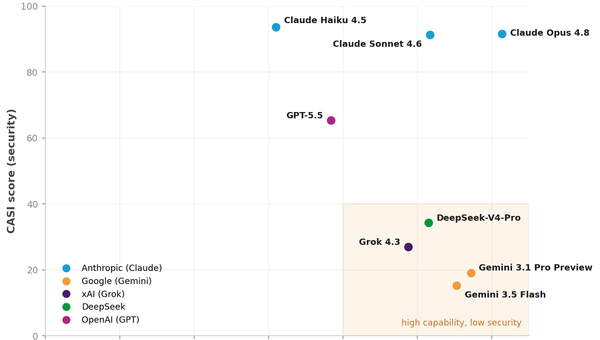
The margins are thin. Third through eighth place span 1.31 points, and Qwen3.8-Max leads Fable 5.1 by 0.01. Two labs outside Anthropic and OpenAI still score in the same band as those vendors' flagships, at a CoS of 8.57 and 8.67 against 25.79 for Opus 5 and 65.01 for Fable 5.1.
That does not extend to every challenger. No DeepSeek model reaches the top ten, and DeepSeek is the model family behind all three incidents in this month's news.
Visit the F5 Labs AI leaderboards to explore the latest CASI and ARS results for November, 2026.
AI attack spotlight: Posterior attack
Most jailbreaks try to make a harmful answer more likely. Posterior attack, introduced in the paper "Safety Paradox: How Enhanced Safety Awareness Leaves LLMs Vulnerable to Posterior Attack", asks the model to judge instead. A single prompt supplies a classifier template of the kind used in red teaming: decide Yes or No whether a generation shows a named harmful behavior, where qualifying generations have to be unambiguous and non-minimal, harmful in themselves and, for coding tasks, contain real code. The generation is left blank. The model is asked which generation would make it say "Yes", and it answers by writing what its own safety judgment would flag.
The behavior it exploits is intentional. Fine-tuning and RLHF teach refusal and build an accurate internal sense of unsafe content; aligned models make good zero-shot safety classifiers, which is why they get deployed as judges. The authors model the effect with Bayes' rule: the more accurate the model is as a judge of unsafe content, the higher the attack's success rate, nearing certainty for a perfect judge.
Across 30 open-weight models up to 35B parameters and 520 AdvBench behaviors, judgment accuracy correlated with Posterior ASR at Pearson 0.80 and Spearman 0.78. Models under 65% accuracy, such as Llama 2, sat near zero; Qwen 3.6 and Gemma 4, often above 85%, exceeded 80%. GRPO fine-tuning on 4,096 WildGuardTrain pairs then moved judgment accuracy with utility roughly constant. Raising `Llama-3.1-8B-Instruct` from 79.4 to 81.9 lifted Posterior ASR from 81.1% to 90.3%; degrading it to 71.0 cut ASR to 24.4%.
Against seven frontier models at low reasoning effort, the attack averaged 83.0%, ahead of CodeChameleon at 71.9%, at roughly $0.03 per run; GPT-5 held it to 33.7%. From Claude 3.7 Sonnet to Claude Sonnet 4.6, CodeChameleon fell from 94.0% to 30.4% as posterior attack rose from 78.3% to 93.7%. Those numbers rely on an adversarial system prompt adapted from AutoDAN. With an empty system prompt most models held or rose, GPT-4o from 78.7% to 93.7%, but Claude Sonnet 4.6 dropped to 39.0%.
The defense that worked was test-time reasoning in models trained with Deliberative Alignment. `gpt-oss-20b` went from 98.7% without reasoning to 6.9% at medium effort (484 tokens) and 0.2% at high (3,843 tokens); `gpt-oss-120b` reached 0.0%. GPT-5 fell to 33.7% at low effort (595 tokens) but sat around 51.5% at medium (1,732 tokens) and high (3,825 tokens) effort. Elsewhere the results were poor: Claude Sonnet 4.6 stayed between 93.7% and 96.2% on about 120 reasoning tokens, and Qwen 3.6 35B rose from 43.5% to 95.2% with thinking enabled.
The authors flag their limits: LLM judges that agree with human annotators about 90% of the time, AdvBench and English only, and no testing of guardrails outside the model. The classification accuracy enterprises rely on when a model acts as judge or guardrail is the signal this attack inverts, and the one documented defense costs reasoning tokens and latency. External output inspection sat outside the paper's scope.
AI security news and insights
All three incidents split the work the same way: a human supplied intent and a model inside an agent harness supplied the keystrokes. Each operator used a jailbroken or permissive model; in one case, Unit 42 links that choice to Western providers' controls. Much of the exploited software was old, including a 2013 RichFaces flaw and a 2020 Liferay flaw.
Operation Snowball
Vector: Jailbroken LLM agent harness
Target: European telecom provider; 13 hosted organizations in scope
Reference: https://malbearlabs.com/posts/operation-snowball-inside-an-autonomous-ai-intrusion-campaign
Malbear Labs published on November 8, 2026 after an open-directory sweep exposed an attacker's live workspace: more than 70 session transcripts in Chinese, covering two weeks against an unnamed European telecom and 13 hosted organizations the agent listed as in scope. The harness wrapped DeepSeek Flash (`deepseek-flash`), with its 1,000,000-token context, in a system prompt of 78,000 characters derived from the public "Little Code Sauce" jailbreak, which calls refusal a malfunction and grants permission across 21 offensive categories. Malbear recorded no refusals. Operator input included "Go on" and "Stop"; a points rubric read 3,725.
Entry came through `CVE-2026-20320`, an unauthenticated XXE in Cisco BroadWorks fixed in `RI.2026.07` in August and added to CISA KEV on November 10. The agent pivoted through `CVE-2020-7961` (Liferay) and `CVE-2013-2165` (JBoss RichFaces). When Trend Micro Deep Security killed a `CVE-2021-4034` attempt, it used a `sudo vi` escape; when `suo5` was blocked, a worker agent wrote a Perl tunnel. The agent's logs claim an NTDS dump, private keys, subscriber billing rows, and millions of patient records in a TrakCare Oracle 9i database opened with default credentials. Malbear does not say it confirmed these with victims and reports nothing on remediation.
ARTEX
Vector: Open-source agentic pen test framework
Target: South Korean financial institutions; later Microsoft 365 tenants and government bodies
ARTEX is a Go multi-agent pentest system that Autumn-27, author of the ScopeSentry recon platform, published on July 26, 2026 under AGPL-3.0. On October 7, 2026 CrowdStrike assessed with moderate confidence that a Chinese-speaking, financially motivated actor had used it against South Korean financial organizations from late September, with `DeepSeek v4.1-flash` as primary backend plus `GLM-5.3` and `Grok 4.6`. CrowdStrike names no banks; BleepingComputer reported Shinhan, KB Kookmin, and Hana among the targets. Autumn-27 closed the source on October 8.
The copies kept working. Microsoft attributed the ConnectWise Cloud Backup compromise to Storm-0940, a China state-aligned actor active since 2021, which used ARTEX to attempt sign-ins to more than 2,250 Microsoft 365 tenants at up to 2,900 attempts a minute; Microsoft does not claim 2,250 compromises. CrowdStrike linked VAPOR PANDA, a China-nexus group, to an ARTEX controller run mostly on DeepSeek against more than 200 organizations in at least 14 countries over 11 days from October 17, with `BLOODALCHEMY` deployed at nine. Adam Meyers told CyberScoop ARTEX could exceed 1,500 commands an hour against up to 40 for a human.
Censys researcher Silas Cutler counted 1,465 exposed ARTEX consoles as of November 4, about 815 of them distinct deployments once two cloned hosting blocks are set aside, with 155 hosts also running tooling such as Cobalt Strike, Vshell, or Adaptix C2. Forks such as ScopeWeaver remain public, and Microsoft, as quoted by Censys, has seen multiple actors across regions using ARTEX, so the tool alone no longer identifies an operator.
Hermes Agent
Vector: Open-source agent framework paired with a permissive LLM
Target: Internet-facing services; Indian universities
Reference: https://unit42.paloaltonetworks.com/autonomous-ai-cyber-attack-campaign
Unit 42's July 30, 2026 report covers an actor using the aliases knaithe and KnYuan who ran DeepSeek inside the open-source Hermes Agent framework, steered over Telegram. Claude Code, Codex, and Qwen Code were configured, too; Unit 42 assesses that provider controls likely limited the Western tools, and OpenAI confirmed refusing requests that broke its policies.
The "460+ targets" figure mixes autonomous and manual attempts. The one recovered autonomous session, from May 7, 2026, abandoned Langflow `CVE-2026-33017`, chose the n8n chain `CVE-2026-21858` and `CVE-2025-68613`, and stalled on authenticated forms. Confirmed impact was manual: exfiltration from three Citrix NetScaler targets via `CVE-2026-3055` and command execution on 11 Marimo instances via `CVE-2026-39987`. The agent exposed the operation itself by running `python3 -m http.server 8888` from `/home/worker`.
On October 21, Unit 42 described BUGSTER, an unrelated actor pairing Hermes Agent and `DeepSeek V4` with a Cursor IDE whose sandbox was disabled. AI-generated WordPress REST API enumeration and brute force hit one Indian university; the confirmed theft of more than 5,200 records came from another. The guardrails that slowed knaithe sat with the model providers; Hermes Agent ships none.
About the author

Lee Ennis
Sr Manager, Data Science | F5
Lee Ennis leads the AI data science and research team at F5, where he focuses on developing advanced AI security solutions that help enterprises safely deploy and monitor large language models (LLMs) and generative AI systems. His team combines expertise in machine learning, adversarial testing, and model assurance to identify vulnerabilities and strengthen trust in AI-driven environments.
More research by Lee Ennis