With the end of the year came the traditional spate of predictions and forecasts from trade publications, pundits, and analysts alike. Among these were the number-laden forecasts for IT budgets in 2016.
None of which were particularly impressive. While the consensus seems to be that IT budgets are at least beginning to show some signs of forward (upward) progress, it still remains true that many view budgetary constraints as a barrier.
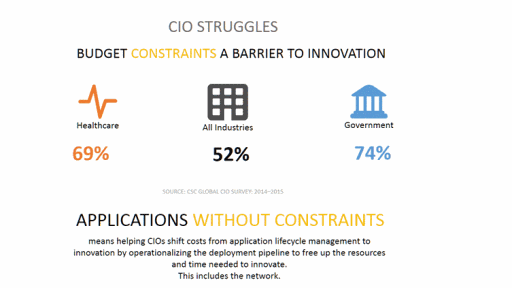
We’ve seen this truism in action ourselves as customers responding to our latest State of Application Delivery survey noted security budgets being too small (41%) as one of their top five security challenges. More than half of CIOs, as well, declared in the latest CSC survey that budget constraints are a general barrier to innovation.
This constraint needs to be relieved, of course, in order to open the flood-gates of innovation and help IT realize its goal of making money for the business, rather than simply consuming it in support of it.
But as the old saying goes, that’s easier said than done.
To achieve this, the CIO needs to enable an environment (embrace a culture) that can optimize core areas of the budget, like operations, security, and app deployments. Such optimization can either reduce costs, enabling savings to shift toward projects focused on innovation (that make money) or mitigate the need to increase spending at all, allowing increases in the budget to focus on innovation.
This ultimately means embracing DevOps, which includes all the Dev(insert IT silo here)Ops.
- Optimize Operations
One of the catch phrases associated with DevOps is “infrastructure as code.” This can – nay, it should – include the network infrastructure delivering the average 10 app services 60% of organizations rely on to ensure apps are fast, secure, and available. The availability of APIs and templates can be used to enable the automation and management of app services to lower costs and improve stability that reduces costly downtime. Those savings can be shifted to innovation. - Optimize Security
A key concern across cloud and on-premises continues to be security. Security budgets are on the rise, but continue to be a source of frustration for professionals who are trying valiantly to maintain governance of increasingly hybrid environments. Increasingly disjointed security controls, policies, and services are wreaking havoc with IT’s ability to maintain a positive secure posture without driving up costs due. One way to optimize security and address rising security costs is by consolidating on a shared platform with standardized policy templates that can be used on-premises as well as in the cloud. Doing so reducing costs associated with training, management, and the double (and triple) review required to make sure policies designed in disparate environments actually comply with corporate policies. - Optimize App Deployments
Lastly, one of the benefits of many of the application-centric app services available can be to alleviate the need to design, architect, and develop the same services. Scalability, app security, identity management, and even many performance-enhancing services can be shifted from dev to ops (into the network infrastructure) to let dev focus on dev and ops focus on delivery. Reinventing the wheel can be – but rarely is – necessary. By taking advantage of existing services available on existing platforms, both operational and dev costs can be reduced and the savings shifted again to innovation.
Budgetary constraints on innovation are a growing concern, but we all know that the day-to-day “keep the lights on” costs are not going to get any lower unless we actively seek to find ways to optimize the budget we have right now. Devops, shared platforms, cloud, and standardization can be valuable tools in the CIOs war chest as they take a serious swipe at reducing costs through optimization in order to enjoy the spoils of victory: bigger budgets for innovation.
About the Author

Lori MacVittie is a Distinguished Engineer and Chief Evangelist in F5’s Office of the CTO with deep expertise in application delivery, automation strategy, and infrastructure. She is known for turning complexity into clarity whether she’s defining guardrails for AI agents, dissecting brittle multicloud architectures, or probing the limits of scalable systems. She brings more than thirty years of industry experience across application development, IT architecture, and network and systems operations. Before joining F5, she served as an award-winning technology editor. MacVittie holds an M.S. in Computer Science and is a prolific author whose publications span security, cloud, and enterprise architecture. She is also an avid tabletop and video gamer with unapologetically strong opinions about cheese.
More blogs by Lori Mac VittieRelated Blog Posts

A new path to technical excellence for F5 partners
Introducing F5 Partner Foundations, a structured learning curriculum to build F5 partner engineer expertise with a clear pathway to specialization.

Secure-by-design storage for agentic AI: Why runtime visibility plus traffic control matters
Learn how F5 is collaborating with NVIDIA to help protect agentic AI with secure-by-design AI infrastructure, runtime visibility, and traffic control.

Why sub-optimal application delivery architecture costs more than you think
Discover the hidden performance, security, and operational costs of sub‑optimal application delivery—and how modern architectures address them.

Architecting for AI: Secure, scalable, multicloud
Operationalize AI-era multicloud with F5 and Equinix. Explore scalable solutions for secure data flows, uniform policies, and governance across dynamic cloud environments.
AppViewX + F5: Automating and orchestrating app delivery
As an F5 ADSP Select partner, AppViewX works with F5 to deliver a centralized orchestration solution to manage app services across distributed environments.

F5 NGINX Gateway Fabric is a certified solution for Red Hat OpenShift
F5 collaborates with Red Hat to deliver a solution that combines the high-performance app delivery of F5 NGINX with Red Hat OpenShift’s enterprise Kubernetes capabilities.