Et si je vous disais que « les mainframes traitent chaque jour plus de transactions que Google (1,3 million par seconde sur CICS contre 68 542 par seconde sur Google), dont 55 % de l’ensemble des transactions des entreprises » ? (Forbes)
Cela vous surprendrait-il ? Cela ne devrait pas. Si les entreprises à très grande échelle comme Facebook, Netflix et Google occupent généralement le devant de la scène lorsqu’il est question de transformation numérique et d’économie des applications, la réalité est que cette dernière repose tout autant — voire davantage — sur les milliers et les milliers d’applications que personne ne voit ni n’évoque jamais. Les mainframes ne sont pas les seuls à passer inaperçus. C’est également le cas des services applicatifs, de l’infrastructure, des intergiciels et des sources de données habilement dissimulés sous l’interface attrayante de la toute dernière application ou du tout dernier appareil.
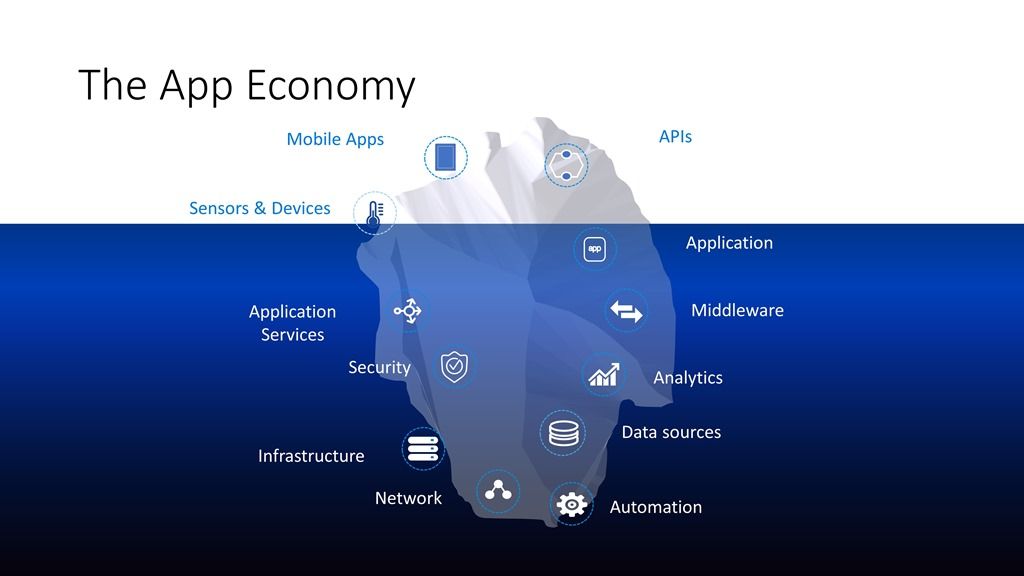
En réalité, la transformation numérique concerne davantage la manière dont nous interagissons avec la technologie qu’une quelconque métamorphose spectaculaire de la technologie elle-même. Les API, les capteurs et les appareils n’ont rien de nouveau. Les écrans tactiles et la commande vocale n’ont rien de particulièrement extraordinaire. Toutes ces technologies existent sous une forme ou une autre depuis déjà un certain temps. Et dans certains cas, ce n’est vraiment qu’un simple habillage cosmétique.
Vous ne pouvez pas passer à l’échelle sans service d’équilibrage de charge. Vous ne pouvez pas protéger les applications sans services de sécurité applicative. Vous ne pouvez pas connecter les applications sans middleware ni API. Et aucun de ces éléments ne présente grand intérêt sans les données qu’il gère.
L’économie des applications repose davantage sur ce que nous ne voyons pas que sur ce que nous voyons. Il est donc impératif que l’informatique ait une place – et son mot à dire – à la table du numérique. Cette place est importante, que les applications soient déployées dans un cloud public ou sur site, dans un cloud privé. Elle est importante, que les applications soient encore monolithiques ou qu’elles prennent la forme de microservices conteneurisés. Cette place est importante. Point final.
Cette place symbolise la collaboration et les changements culturels nécessaires pour faire passer l’informatique d’un rôle de soutien à un rôle stratégique.
La dimension stratégique de l’automatisation informatique
L’une des décisions les plus stratégiques qu’un DSI puisse prendre aujourd’hui concerne l’automatisation. Sachant que 55 % des organisations ont recours à l’automatisation dans le cadre de leur transformation numérique, son impact stratégique ne peut être négligé. Tout comme le choix des langages de programmation et des plateformes de développement d’applications revêt un caractère stratégique, il en va de même pour les ensembles d’outils, les langages et les plateformes choisis pour soutenir les initiatives d’automatisation.
Il serait insensé de considérer ces décisions comme sans importance. La dette technique et la dette architecturale s’accumulent rapidement et sont aussi difficiles à éliminer du budget que les kilos pris à Thanksgiving. La dette architecturale repose sur le principe de la « dette technique » en développement logiciel. Il s’agit d’une métaphore : la complexité et les choix architecturaux vous empêchent d’entreprendre de nouveaux travaux, car vous consacrez tout votre temps aux systèmes existants (dépannage, maintenance, etc.). Lorsque votre dette est élevée, elle vous empêche d’affecter vos ressources financières à d’autres priorités, car vous les consacrez entièrement au paiement des intérêts. Cette dette fait grimper le coût des nouveaux services et ralentit la cadence de prestation nécessaire pour saisir les occasions d’améliorer les résultats, qu’ils soient mesurés en termes de productivité ou de bénéfices.
C’est ce qui fait de l’automatisation informatique un investissement stratégique. Dans l’entreprise, les choix que vous faites aujourd’hui concernant la mise en œuvre de l’automatisation auront autant de répercussions que ceux effectués il y a des années en matière de développement d’applications.
Par exemple, dans notre enquête de l’année dernière 65 % des professionnels DevOps ont indiqué que la mise à disposition de fonctionnalités en libre-service avait influencé leur décision de « contourner » le service informatique et de rechercher des solutions cloud ou open source. Contourner le service informatique revient à contourner les mesures de sécurité, ce qui met en péril l’entreprise et les autres systèmes.
Choisir le mauvais langage peut générer sa propre dette, car, au fil du temps, il devient impossible de maintenir les systèmes sans disposer des compétences adéquates. Ne pas choisir de langage peut semer le chaos et transformer les scripts d’automatisation et les systèmes en éléments nécessitant une attention et un entretien constants. Le budget est alors réorienté vers les interventions correctives et la maintenance, au détriment de l’innovation.
L’automatisation informatique est une démarche stratégique qui doit être abordée en tenant soigneusement compte de facteurs similaires à ceux pris en considération dans les architectures d’applications d’entreprise :
- Prise en charge sur l’ensemble de la chaîne d’outils
Aujourd’hui, la quasi-totalité des fournisseurs informatiques prennent en charge l’automatisation et l’intégration avec les autres acteurs de la chaîne de production. Compte tenu de la complexité des réseaux actuels et de la diversité des fournisseurs qui composent cette chaîne, il est indispensable de disposer d’une assistance, qu’elle soit traditionnelle ou communautaire. Une documentation complète, des exemples de code et une communauté active sont autant d’atouts précieux. - Disponibilité des talents et/ou des formations
Si vous ne pouvez pas former votre personnel ou recruter des talents capables de travailler avec les plateformes, les systèmes et les langages que vous souhaitez adopter, revenez à la première étape et recommencez le processus de sélection. Si vous n’êtes pas en mesure d’assurer la pérennité des systèmes que vous allez mettre en place, mieux vaut conserver des processus manuels jusqu’à ce que vous le puissiez. - Préparation au multicloud
La prise en charge des entreprises multicloud est une exigence relativement récente, mais elle n’en demeure pas moins indispensable. L’automatisation ne se limitera pas à un centre de données sur site. Les initiatives d’automatisation devront inclure au moins un cloud public, et presque certainement plusieurs. Dans le cadre de votre initiative d’automatisation, vous devrez donc examiner attentivement la compatibilité des plateformes et la portabilité des politiques entre les différents environnements. - Impératif ou déclaratif
Je sais que vous en avez probablement assez d’entendre parler de ce sujet, mais ce choix est vraiment très important. Les méthodes impératives (reposant uniquement sur des API) sont plus rapides à développer et nécessitent moins d’adaptation de la part du service informatique, mais elles engendrent une dette technique importante en liant l’automatisation à des appareils et fournisseurs spécifiques. Les méthodes déclaratives (reposant sur des artefacts) peuvent nécessiter davantage de temps — et de travail d’architecture — en amont, mais elles réduisent le couplage étroit entre les processus et les produits, ainsi que la dette technique.
L’automatisation informatique est l’une des décisions technologiques les plus stratégiques qu’un DSI puisse prendre. Et puisque l’essentiel de l’économie des applications repose sur des systèmes placés sous la responsabilité de la DSI, c’est aussi l’une des décisions les plus stratégiques sur le plan commercial qu’un DSI puisse prendre aujourd’hui.
Choisissez judicieusement.
À propos de l’auteur

Lori MacVittie est ingénieure émérite et évangéliste en chef au sein du bureau du directeur technique de F5. Elle possède une expertise approfondie dans la fourniture d’applications, les stratégies d’automatisation et les infrastructures. Elle est réputée pour sa capacité à rendre la complexité intelligible, qu’elle définisse des garde-fous pour les agents d’IA, analyse des architectures multicloud fragiles ou explore les limites des systèmes évolutifs. Elle cumule plus de trente ans d’expérience dans le secteur, couvrant le développement d’applications, l’architecture informatique ainsi que l’exploitation des réseaux et des systèmes. Avant de rejoindre F5, elle a été rédactrice spécialisée dans les technologies et a reçu plusieurs distinctions. MacVittie est titulaire d’un master en informatique et est une autrice prolifique dont les publications couvrent la sécurité, le cloud et l’architecture d’entreprise. Elle est également une passionnée de jeux de société et de jeux vidéo, et assume pleinement ses avis bien tranchés sur le fromage.
Autres articles de Lori Mac VittieArticles de blog associés

F5 NGINXaaS pour Google Cloud : des applications résilientes et évolutives
Découvrez comment NGINXaaS s’intègre à Google Cloud pour renforcer les performances et la sécurité, et préparer vos applications critiques à un avenir propulsé par l’IA.

L’intégration de F5 Web Application Firewall (WAF) à AWS est disponible dès aujourd’hui
En faisant appel à un partenaire de déploiement AWS WAF tel que F5, vous pouvez renforcer la sécurité de vos applications web grâce à des règles personnalisées qui bloquent les schémas d’attaque courants, comme les injections SQL ou les attaques par scripts intersites (XSS).
Appliquer le principe de Peter Parker à l’inspection TLS
« Un grand pouvoir implique de grandes responsabilités. » Si l’on en trouve des échos chez Voltaire et Churchill, cette citation est surtout connue grâce aux bandes dessinées Spider-Man, où elle est attribuée à l’oncle Ben. Bien entendu, si cette phrase est si répandue dans la culture populaire, c’est notamment parce qu’elle peut s’appliquer à une multitude de situations et de sujets, y compris à l’inspection TLS.
Le NetOps a besoin de défenseurs, pas d’adversaires
Il est important de reconnaître que les équipes NetOps ne sont pas toujours celles qui font obstacle au déploiement de la dernière nouveauté, application ou service. Les freins à la rapidité sont souvent dus au fait que les organisations n’adoptent pas tous les principes du DevOps lorsqu’elles cherchent à transformer leurs opérations informatiques.
Mise à jour des services applicatifs : sécurité, rapidité et visiteurs suspects
Il est de nouveau temps de nous pencher sur les services applicatifs que les entreprises utilisent réellement pour rendre leurs applications plus rapides et plus sûres. On constate notamment une hausse du recours aux services de protection contre les bots, ainsi que la progression lente mais régulière de HTTP/2. Bien qu’il ne s’agisse pas d’une application…
Les templates prennent le contrôle du cloud
Les modèles s’imposent dans le cloud. Lisez le blog de F5 pour découvrir comment l’infrastructure en tant que code et les API déclaratives automatisent la mise à disposition des applications.