Blog posts on SSL/TLS
SSL/TLS blog posts(18)

Excellence at Scale: Transforming AI Infrastructure with F5 and MinIO’s Secure Data Delivery
Discover how F5 and MinIO are revolutionizing data storage with innovative solutions that enhance performance, scalability, and security.
By Ahmed Dessouki
Setting the Stage: Why Does PQC Matter?
All businesses are at risk once a quantum computer that can break modern encryption emerges. Learn how industries can better balance readiness and agility.
By Byron McNaught
Ransomware in Healthcare: The Application Threat Vector
The healthcare industry remains a favorite target of attackers—notably by targeting vulnerabilities and compromised credentials in ransomware campaigns.
By Byron McNaught
Choosing the Right Load Balancer and Application Delivery Controller as a Service for Azure
Explore when to use default Azure tools and third-party native cloud services like F5 NGINXaaS for Azure for scalable, flexible, and secure application delivery.
By Brian Ehlert, Ilya Krutov
Back to Basics: Web Traffic Encryption with SSL/TLS and NGINX
Encrypting HTTP traffic with Transport Layer Security (TLS) prevents tampering and eavesdropping. Learn all about implementing TLS with NGINX in our on-demand webinar.
By Robert Haynes
Announcing NGINX Plus R28
NGINX Plus R28 introduces TLS metrics for handshake errors and certificate verification failures, support for PROXY protocol v2 in cloud private services, and more.
By Robert HaynesAutomating Certificate Management in a Kubernetes Environment
Simplify cert management by providing unique, automatically renewed and updated certificates to your endpoints.
By Jason SchmidtAnnouncing NGINX Plus R27
NGINX Plus R27 introduces keepalive connections for health checks, support for Kernel TLS, more TLS metrics, custom error codes for JWT validation failures, and more.
By Prabhat DixitUpdate: Using Free Let’s Encrypt SSL/TLS Certificates with NGINX
Learn how to use the Let’s Encrypt client to generate RSA certificates and automatically configure NGINX to use the newly issued certificates.
By Amir Rawdat
Sampling Requests with NGINX Conditional Logging
With NGINX conditional logging, you can log a subset of requests which have defined characteristics. This blog uses it to solve a real-world customer use case: the need to reject obsolete and insecure...
By Owen Garrett
Protecting SSL Private Keys in NGINX with HashiCorp Vault
The second post of our series about protecting SSL private keys shows how to set up HashiCorp Vault to store the passwords that protect private keys, and to configure NGINX to retrieve the passwords. ...
By Owen GarrettAnnouncing NGINX Plus R18
NGINX Plus R18 introduces dynamic loading of SSL/TLS certificates, enhances our OpenID Connect reference implementation, and supports port ranges for virtual servers. It also includes enhancements to ...
By Liam Crilly
Secure Distribution of SSL Private Keys with NGINX
We describe three progressively more secure ways to protect SSL private keys when configuring NGINX to handle HTTPS traffic: allowing read access only to the root user, encrypting keys with separately...
By Owen GarrettAnnouncing NGINX Plus R17
NGINX Plus R17 introduces support for two-stage rate limiting and TLS 1.3, the latest version of the Transport Layer Security protocol. Configuration of OpenID Connect is simpler and NGINX ModSecurity...
By Liam Crilly
Running SSL and Non-SSL Protocols over the Same Port with NGINX 1.15.2
The $ssl_preread_protocol variable introduced in NGINX 1.15.2 allows you to distinguish between SSL/TLS and other protocols when forwarding traffic using a TCP proxy. This is useful if you want to avo...
By Faisal Memon
10 Tips for 10x Application Performance
Improve web app performance by 10x using NGINX features such as our reverse proxy server, high availability load balancer, content cache, HTTP/2, and more.
By Floyd SmithAnnouncing NGINX Plus R6 with Enhanced Load Balancing, High Availability, and Monitoring Features
Learn about the enhanced features in NGINX Plus Release 6, including full‑featured TCP load balancing, high availability, and a new status dashboard.
By Owen Garrett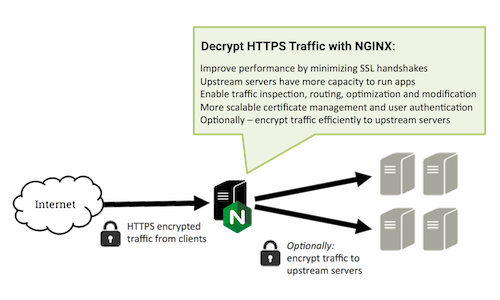
SSL/TLS Offloading, Encryption, and Certificates with NGINX and NGINX Plus
Learn about the different use cases for SSL/TLS how to use NGINX to meet your SSL/TLS needs
By Rick Nelson