Diverse operating environments and distributed apps have become commonplace. If you’re like 94% of respondents to the F5 2025 State of Application Strategy Report, you operate applications in a hybrid multicloud deployment model that can include a mix of on-premises data centers, co-location facilities, and a median of four public cloud vendors—resulting in significant complexity and visibility gaps.
This visibility challenge creates a major barrier to efficient, scalable operations, which is F5's vision for XOps and the ultimate goal for NetOps, SecOps, application owners, platform teams, and basically anyone with a vested interest in ensuring overall application health. Simply put, without holistic visibility it’s impossible to improve application performance, proactively address security vulnerabilities, maintain policy consistency, or find improvement opportunities. These gaps can ultimately lead to unanticipated outages—which, according to Cockroach Labs 2025 State of Resilience report, are estimated to cost enterprises anywhere from $100,000 to $1 million per instance.
Despite this need, a highly fragmented approach to visibility is the status quo. In Dynatrace’s 2024 State of Observability, it was determined that enterprises rely on 10 different visibility and monitoring tools, often creating pockets of intelligence that complicate troubleshooting, stifle collaboration, and hinder proactive issue resolution. The inability to synthesize and act on this data in real time not only impacts operational efficiency, but also jeopardizes the overall user experience.
What’s needed to address this complexity is a single-platform approach that consolidates solution sprawl and emphasizes holistic visibility. Enter the F5 Application Delivery and Security Platform (ADSP) and F5 Insight for ADSP. Now generally available, F5 Insight for ADSP helps teams unlock actionable intelligence and clear, AI-generated operational narratives about overall application health, security posture, and the underlying infrastructure.
F5 Insight provides teams with 30 years of application delivery and security expertise built into the tool—enabling teams to see the most important telemetry, query their data, and get clear recommendations on what actions to take to improve.
In this blog, I offer a deep dive into the use cases of this all-new visibility solution and explore the six critical questions that Insight for BIG-IP can help you answer.
F5 Insight overview
F5 Insight is the visibility foundation for F5 ADSP that unlocks a wealth of telemetry and operational intelligence—combining holistic visibility, anomaly detection, and F5 expertise and guidance in a unified solution.
Made up of open-source components (but able to meet HA requirements and enterprise support SLAs), it can be provisioned and deployed in your F5 BIG-IP environments quickly and easily. The solution includes:
- An expertly curated collection of Grafana dashboards for displaying application performance, security, and infrastructure KPIs and metrics
- A VictoriaMetrics timescale database instance for storing and making BIG-IP data and syslogs available
- An OpenTelemetry Collector instance that scrapes BIG-IP data in regular intervals using the iControl REST endpoint for near real-time visibility
So what are six questions this solution can answer to help teams ensure application uptime, performance, security, and bottom-line impact?
1 - Are my applications available, healthy, and performing well?
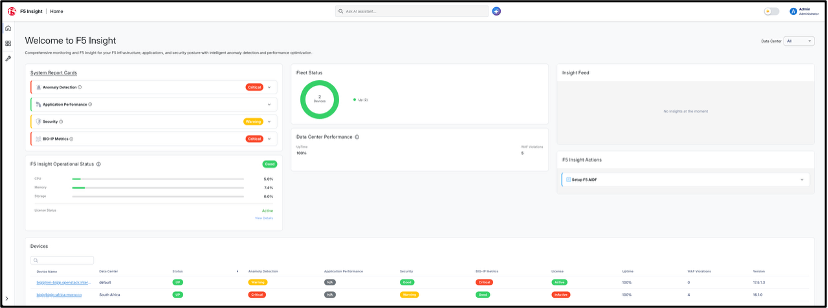
This is the most fundamental question that Insight can answer. The screenshot above provides key telemetry of BIG-IP instances, overall status, security posture, performance metrics, and anomalous traffic. Insight collects, aggregates, and updates data that spans pools and pool member status, active pool members, availability, change logs, request/response time metrics, pool connections, and more to provide these high-level views.
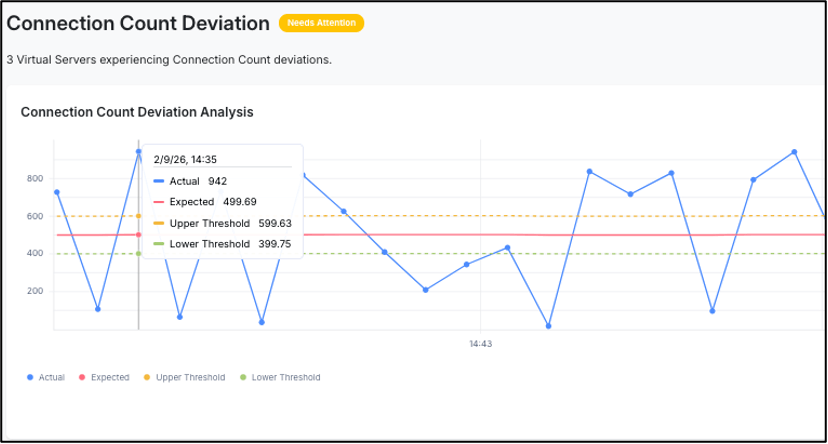
Insight also provides application health KPIs like connection count, response time, error rates, virtual server availability, SSL metrics like handshakes and traffic in/out, DNS packets, and HTTP requests that illustrate performance bottlenecks that need to be actioned—saving time and effort when trying to determine if an application is available and performing as expected.
And because Insight dashboards are built by F5 experts, they surface the telemetry that matters most—with views that align to different roles—effectively democratizing visibility and fostering better collaboration between historically disparate teams. This enables network operations teams, application owners, network analysts, and IT ops teams to work together to quickly determine overall app health, find and address outages, and ensure a great end user experience.
2 - What actions do I need to take to improve?
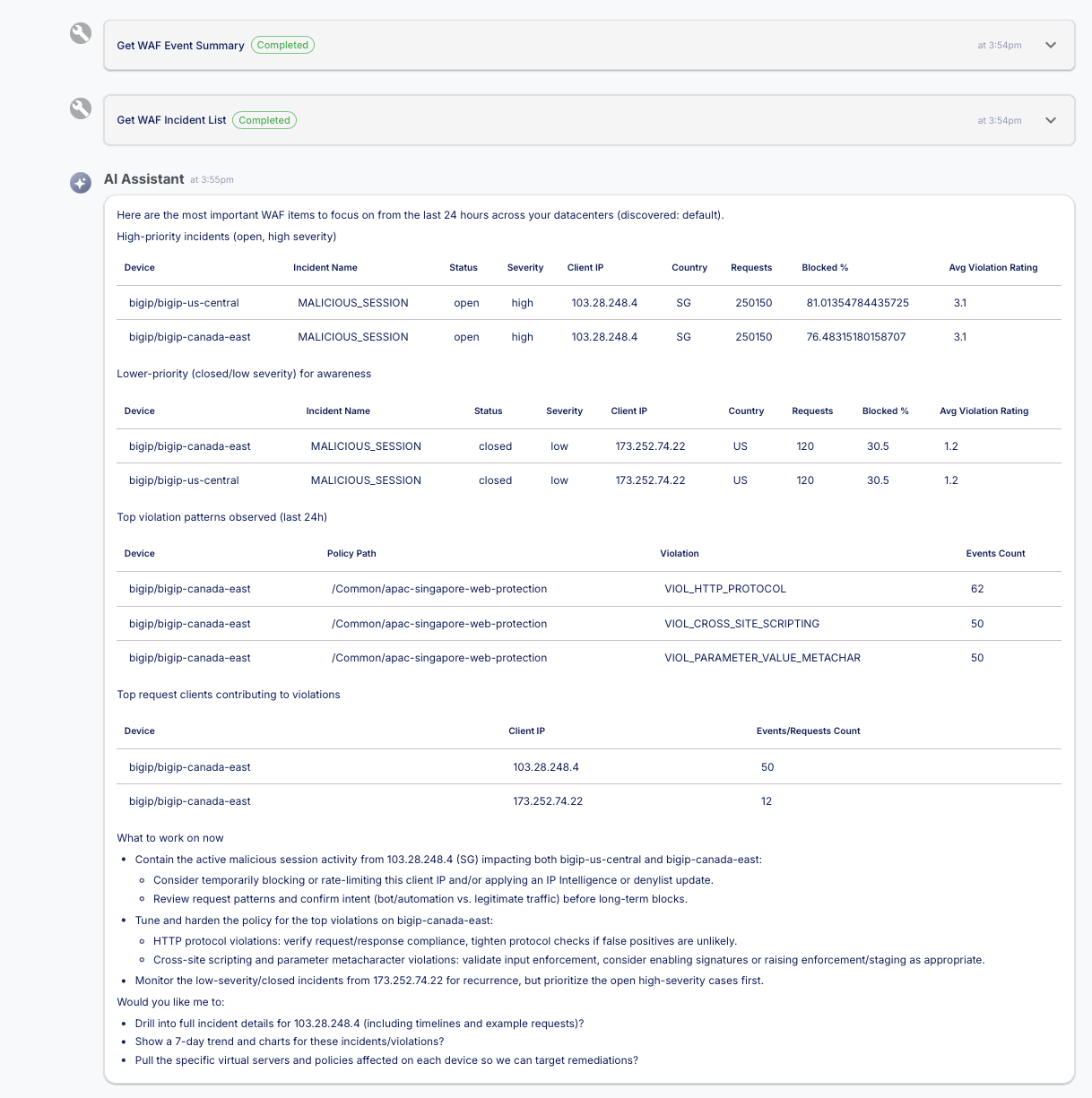
The unfortunate reality is that network, security, and application operators each have miles-long to-do lists of (often competing) action items. Adding to that challenge is each team needing to sift through mountains of logs, metrics, and other sources of intelligence to get to the most pressing issues. And this is all on top of any fire drills that may arise along the way.
Through native model context protocol (MCP) functionality and built-in integrations with popular large language models (LLMs), teams can turn app and infrastructure telemetry into actionable intelligence. Using MCP and default or custom prompts, teams can query Insight data, surface meaningful visibility, andget clear, natural language remediation suggestions and prioritized action items to streamline and improve BIG-IP operations.
In short, F5 Insight helps teams focus on what matters most, surfaces the most critical issues, delivers at-a-glance statuses and report cards, and provides clear recommendations on what’s causing problems and—more importantly—what to do about them.
3 - Are infrastructure issues impacting the performance of my apps?
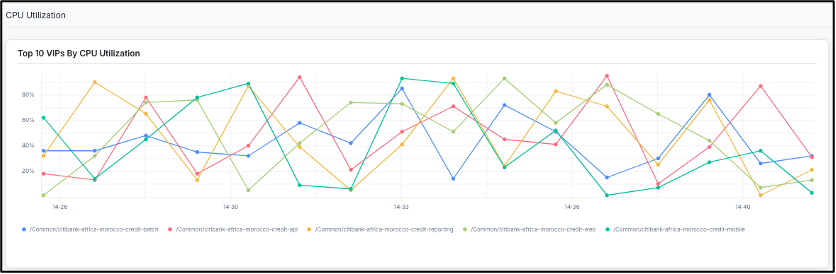
Insight provides powerful infrastructure visibility, enabling teams to gain an end-to-end view of system health. while pinpointing factors affecting application performance. Insight leverages telemetry from BIG-IP and network resources to produce critical infrastructure metrics such as CPU, memory, and disk utilization, network traffic, and connection states to assess the operational status of devices and associated components. With this level of visibility, NetOps teams, ITOps teams, and network analysts can identify bottlenecks, resource saturation, or degraded components that might be causing application performance dips—effectively correlating infrastructure-level inefficiencies with application-level impacts.
This level of visibility empowers teams to pinpoint root causes and address issues rapidly, reducing downtime (and minimizing the fallout), while improving mean-time-to-repair (MTTR)—an important KPI for measuring the success of operations teams.
4 - Are my applications and infrastructure secure?
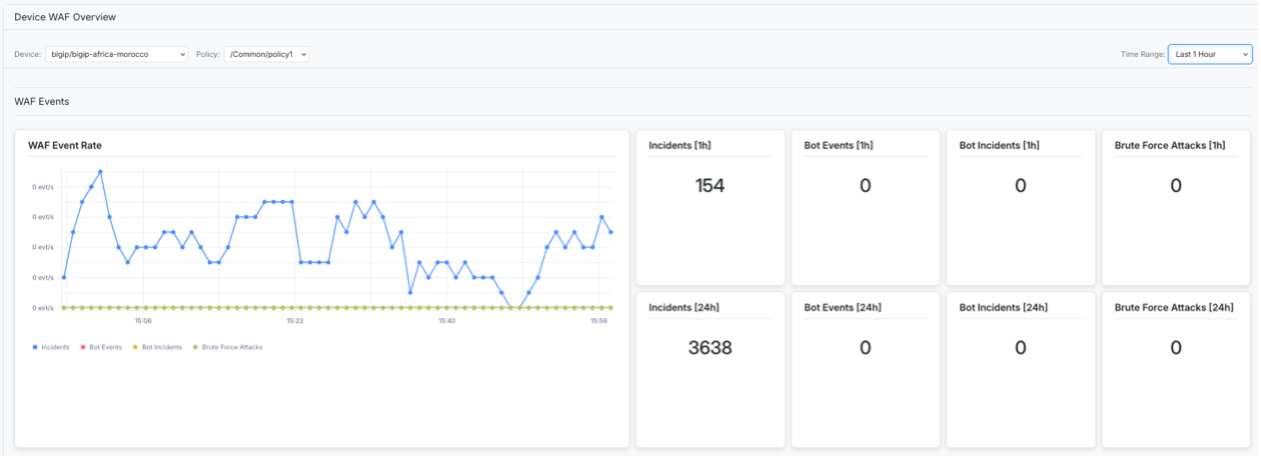
Securing a distributed application can present a significant challenge. Attempting to secure an enterprise-level portfolio of applications—without deep visibility—is likely impossible. IBM and Penomon Institute’s 2024 Cost of a Data Breach Report discovered that it takes an average of 258 days for IT and security teams to discover and contain a data breach, which now costs $4.88 million for every incident. Compounding that cost is the loss of trust, brand prestige, and future earnings potential that comes with a data breach.
That’s why holistic security must be a top concern for organizations of all sizes. However, this is easier said than done even with cybersecurity spending expected to surpass an estimated all-time high of $377 billion by 2028.
Insight enables teams to get the most out of their F5 security investments by surfacing, consolidating, and correlating critical security metrics, policy enforcement data, and threat indicators. To drive clarity, it can present this data via “Top 10” dashboards that can include stats like bot traffic and denial-of-service events, attack signature counts, brute force attacks, state of WAF and other security modules, and other important security information. This level of unified visibility helps shift SecOps teams from reactive attack response to proactive threat defense.
5 - How much value am I getting from my F5 BIG-IP investment?
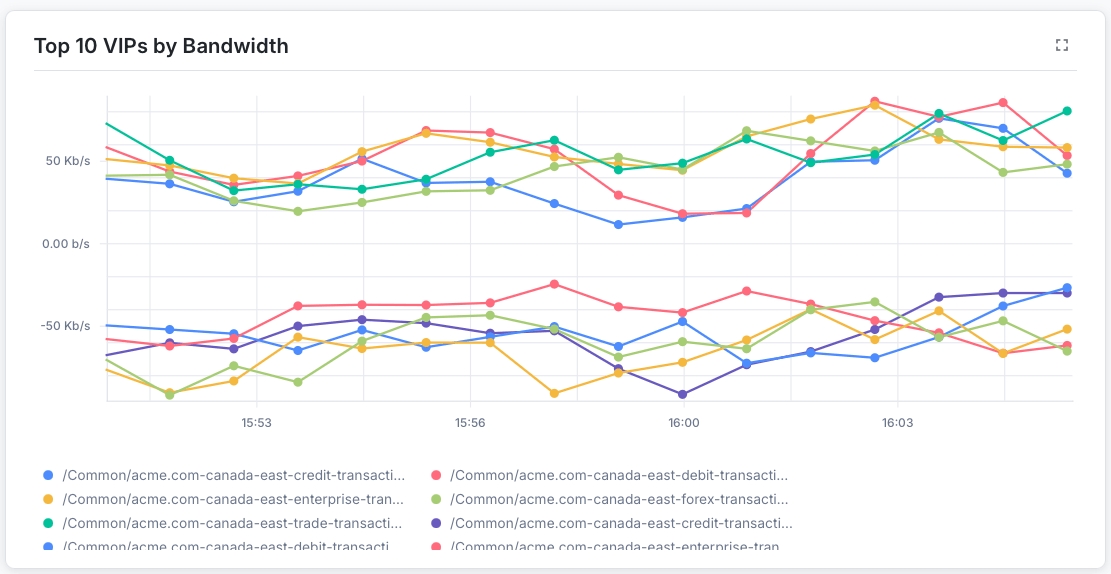
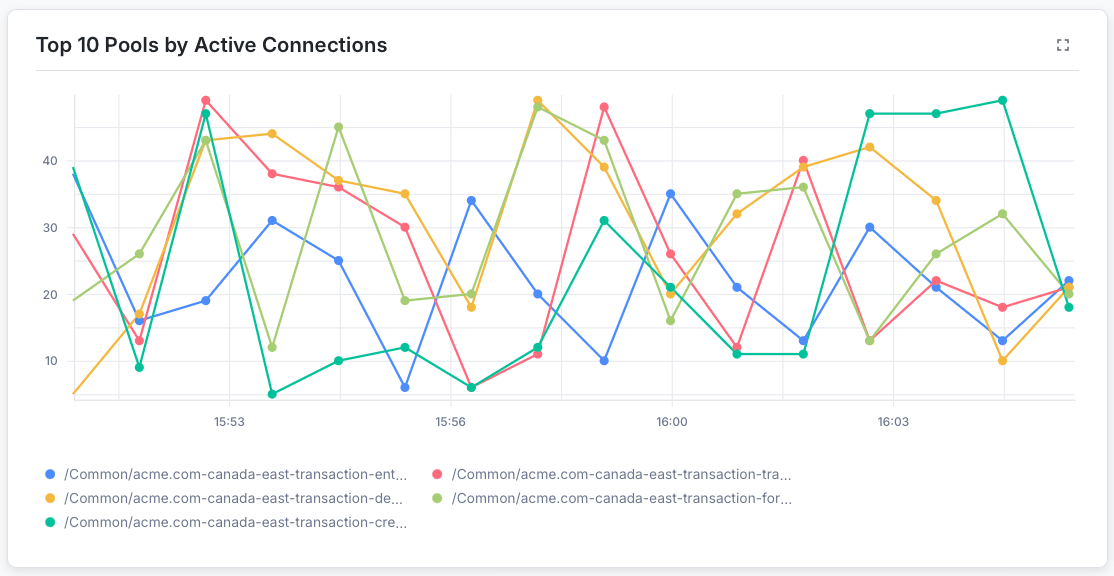
One of the most important considerations for any technology purchase is ROI. For applications—the lifeblood of the modern enterprise—that means investing in solutions that ensure the health, performance, availability, and security of apps and ultimately provide end users with a great digital experience. Visibility into strategic metrics for application delivery and security can help teams determine if their investments are fulfilling that mandate.
Insight helps teams assess the ROI and overall value of their BIG-IP investments. It tracks critical metrics such as pool availability, virtual server CPU utilization, and system memory usage, allowing teams to monitor how BIG-IP ecosystems are facilitating application delivery and maintaining high availability.
With Insight, teams correlate operational improvements and cost savings directly to their BIG-IP investments. For example, tracking metrics like requests, bandwidth utilization, and connection stability allows teams to demonstrate how BIG-IP devices are supporting application throughput, minimizing performance bottlenecks, and enabling scalability across hybrid and multicloud environments. Teams can then translate that operational telemetry into a narrative around reduced downtime and mean-time-to-repair (MTTR), showcasing the reliability and resilience BIG-IP brings to mission-critical applications.
6 - How can I optimize resources and improve IT operational efficiency?
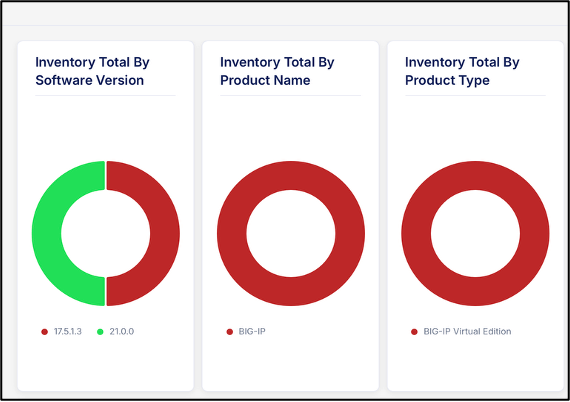
Convincing C-level executives to funnel operating dollars into tech budgets can be challenging as they seek to understand the potential ROI of these decisions. According to McKinsey, enterprise technology spending in the United States has increased by 8% per year since 2022. However, when taking into consideration the rising price of products and services, that spending increase looks almost flat.
Insight delivers comprehensive visibility and actionable intelligence that empowers teams to use data to optimize resource allocation, reduce operational costs, make migration decisions, and strengthen the business case for additional resources.
With detailed telemetry on system utilization, such as CPU, memory, and network traffic, teams can identify inefficiencies or underutilized resources to avoid waste. Metrics like virtual server CPU utilization and pool availability allow teams to assess performance trends and adjust workload distribution, improving scalability, and preventing overprovisioning. Additionally, teams can use metrics such as bandwidth usage and connection stability to project operational cost reductions resulting from more strategic resourcing practices.
Basically, Insight can drive better alignment between technical metrics and business objectives.
Holistic visibility and actionable intelligence
As deploying and operating hybrid multicloud applications remains a strategic initiative for enterprises, it’s clear that the need for holistic visibility and actionable intelligence will be of paramount importance.
F5 Insight for ADSP—now generally available—unlocks the valuable telemetry contained within your F5 deployments (currently limited to BIG-IP only), ensures teams can keep their finger on the pulse of their applications, democratizes the story this data tells, enables teams to collaborate more effectively, and helps them achieve better outcomes for their areas of responsibility.
It’s our mission to help our customers see deeper into their application estates and use this level of visibility to drive operational excellence. Click here to learn more about how F5 Insight can help.
Want to see F5 Insight for ADSP firsthand? Join us on March 26 at 10am PT for an in-depth webinar: Move from Firefighting to Operational Excellence. In this 45-minute session that includes a demo, we’ll explore how to use F5 Insight to:
- Address visibility gaps and minimize blind spots
- Prioritize tasks with holistic ops narratives
- Surface optimization opportunities and recommended actions using natural language interactions
We hope to see you there!
About the Author

Related Blog Posts

How are customers using the F5 AI Security Platform?
See why customers are turning to the F5 AI Security Platform for strong, out-of-the-box protection plus the customization they need to meet their specific security needs.
Cloud-native modernization for the AI and 5G/6G era
See why 5G/6G, Kubernetes maturity, and AI are accelerating cloud-native modernization, and how F5 BIG-IP Cloud-Native Edition improves efficiency.
Who can you trust in the age of AI agents?
New features for F5 Distributed Cloud Bot Defense enable organizations to distinguish between trusted and fraudulent AI traffic.

From dashboard fatigue to operational excellence: Why XOps needs F5 Insight for ADSP
Learn how F5 Insight for ADSP lays the visibility foundation for XOps—turning fragmented signals across applications and infrastructure into actionable intelligence.

Govern your AI present and anticipate your AI future
Learn from our field CISO, Chuck Herrin, how to prepare for the new challenge of securing AI models and agents.

F5 recognized as one of the Emerging Visionaries in the Emerging Market Quadrant of the 2025 Gartner® Innovation Guide for Generative AI Engineering
We’re excited to share that F5 has been recognized in 2025 Gartner Emerging Market Quadrant(eMQ) for Generative AI Engineering.