Workflows versus APIs

F5 Ecosystem | April 16, 2018

Today I have a job for you. I want you – yeah, you right there – to deposit a check at the bank. You have to get in the car, drive to the bank, go inside, and do that thing with the teller, and then go back home.

Irritated? You should be, especially when you could just use your mobile banking app to do it without all the extra steps.

And that, my friends, is the difference between a workflow (a process) and an API.

There is a very real thing (I made up the name, but not the existence) called an API tax. That’s the time and technical debt incurred by executing complex processes using individual API calls. It’s like physically going to the bank instead of using your mobile app to make that deposit.

This tax grows as processes expand. If you have a lengthy process that requires ten or twenty different API calls, the code (scripts are code, too) gets increasingly complicated which impacts troubleshooting and makes it more difficult to change in the future. Ossifying processes through individual API calls is the opposite of agility. It’s fragility that freezes opportunity to improve efficiency through optimization.

Workflows are basically pre-defined processes for commonly executed tasks. Most business (and even operational) processes fall into this category. They’re the commands you use to login in, navigate to the right part of the system, change the access control on the port, and then commit the change. Every time you do this task, it is the same. It’s a commonly executed process that could easily be codified. There are many such processes in operations, and by wrapping them up as a workflow we can not only eliminate the API tax but improve the quality and sustainability of the scripts that invoke them.

That’s because using workflows instead of APIs means less complex code that’s easier to manage and easier to change. They are more agile and less fragile.

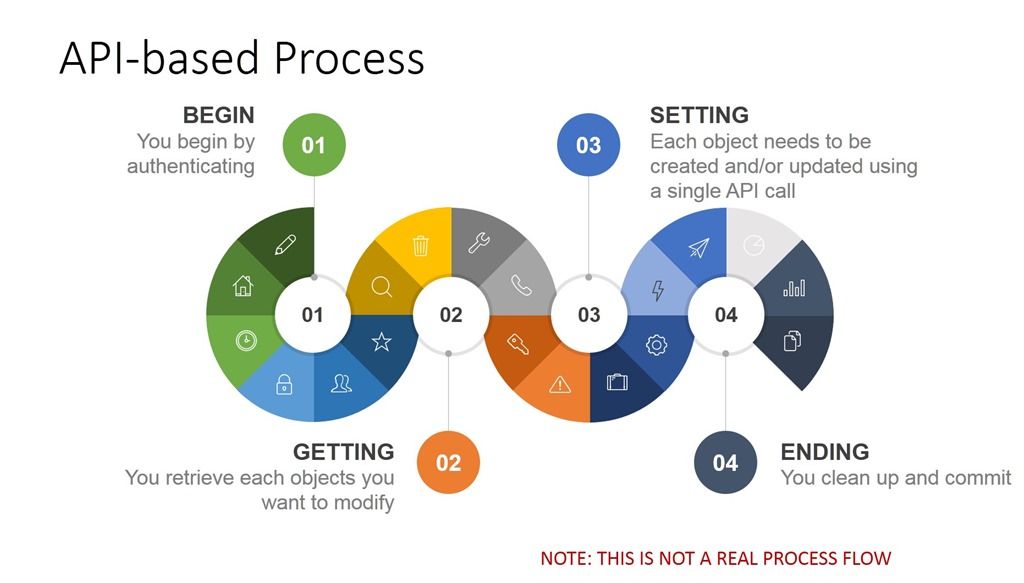
Consider this completely made up example. In the first, you have an API-based approach. Every single step in that process represents an API call. That means a script with nearly twenty different calls has to be developed, tested, and maintained over time. That’s technical debt. It’s tied to the API version of the system it’s working with at the time it was written. If one of those calls changes, the script has to change, too.

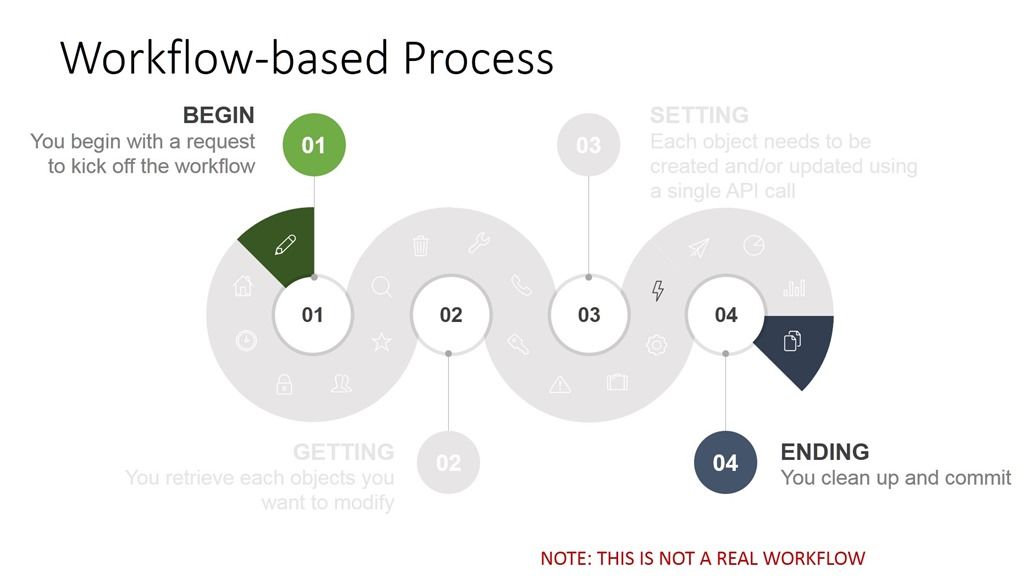
On the right you have a workflow-based approach. You can still initiate the process via an API call (likely preferable in many organizations) but the actual steps of the process are executed based on the parameters (variables) sent with the initial call. You might have to clean up and commit, but still you’ve reduced the code necessary to two or less interactions.

That’s not to say that using APIs and templates is a bad thing. It’s not. But it is often the case – particularly in the network world – that the use of APIs requires knowledge specific to the system and to networking in general. That makes it hard for DevOps or developers to work with the APIs. A workflow approach removes the assumption of knowledge or expertise, which means DevOps will be comfortable using them and NetOps retains job security.

In environments where automation is taking hold (and maybe even taking over), a workflow-based approach can offer substantive relief to NetOps by enabling DevOps with the ability to invoke tasks without requiring a ton domain-specific knowledge.

And hey, they can also avoid those pesky API taxes. And who doesn’t like avoiding taxes?

Share
Tags: 2018

About the Author

Lori Mac Vittie
Lori Mac VittieDistinguished Engineer and Chief Evangelist

More blogs by Lori Mac Vittie

Related Blog Posts

Architecting for AI: Secure, scalable, multicloud
F5 Ecosystem | 01/20/2026

Architecting for AI: Secure, scalable, multicloud

Operationalize AI-era multicloud with F5 and Equinix. Explore scalable solutions for secure data flows, uniform policies, and governance across dynamic cloud environments.

Rein in API sprawl with F5 and Google Cloud
F5 Ecosystem | 01/20/2026

Rein in API sprawl with F5 and Google Cloud

Find out how F5 and Google Cloud can help you secure and manage your ever-increasing API integrations.

Nutanix and F5 expand successful partnership to Kubernetes
F5 Ecosystem | 01/09/2026

Nutanix and F5 expand successful partnership to Kubernetes

Nutanix and F5 have a shared vision of simplifying IT management. The two are joining forces for a Kubernetes service that is backed by F5 NGINX Plus.

AppViewX + F5: Automating and orchestrating app delivery
F5 Ecosystem | 12/19/2025

AppViewX + F5: Automating and orchestrating app delivery

As an F5 ADSP Select partner, AppViewX works with F5 to deliver a centralized orchestration solution to manage app services across distributed environments.

F5 NGINX Gateway Fabric is a certified solution for Red Hat OpenShift
F5 Ecosystem | 11/11/2025

F5 NGINX Gateway Fabric is a certified solution for Red Hat OpenShift

F5 collaborates with Red Hat to deliver a solution that combines the high-performance app delivery of F5 NGINX with Red Hat OpenShift’s enterprise Kubernetes capabilities.

Phishing Attacks Soar 220% During COVID-19 Peak as Cybercriminal Opportunism Intensifies
F5 Ecosystem | 12/08/2020

Phishing Attacks Soar 220% During COVID-19 Peak as Cybercriminal Opportunism Intensifies

David Warburton, author of the F5 Labs 2020 Phishing and Fraud Report, describes how fraudsters are adapting to the pandemic and maps out the trends ahead in this video, with summary comments.

Deliver and Secure Every App
F5 application delivery and security solutions are built to ensure that every app and API deployed anywhere is fast, available, and secure. Learn how we can partner to deliver exceptional experiences every time.
Connect With Us
Workflows versus APIs | F5