Reduce exposure while remediation is underway
As vulnerability timelines compress and patch windows close, organizations need protection against exploits while permanent fixes are being developed, tested, and deployed. Virtual patching helps reduce exposure by providing runtime protection during the remediation process.
The patch window is disappearing
Traditional vulnerability remediation—discovering, developing, testing, and deploying patches—can no longer keep pace with modern exploit speeds. Business-critical systems, legacy software, and third-party dependencies require rigorous, often lengthy testing and change-control procedures to prevent operational disruption, which naturally delays patch deployment.
Meanwhile, AI-driven vulnerability discovery and exploit automation allow attackers to identify and weaponize weaknesses almost instantly. This compression of the timeline between vulnerability disclosure and active exploitation leaves applications and underlying infrastructure exposed while engineering and operations teams navigate standard patching pipelines.
Virtual patching mitigates this exposure window by deploying runtime protection anywhere. This immediately blocks exploit attempts on live traffic while development teams safely write, test, and roll out permanent code fixes. Rather than replacing traditional patching, virtual patching provides a critical, temporary defensive layer that maintains business continuity and buys engineering teams the time they need to secure the underlying code.
“Virtual patching helps you reduce risk immediately at the edge while a permanent solution for any existing or new vulnerability is developed and tested before being put into production.”
Protect applications while remediation is underway
To minimize exposure without relying on emergency code releases or rushed deployment cycles, organizations must integrate vulnerability discovery with runtime protection. F5 coordinates scanning and active enforcement, allowing security teams to identify vulnerable assets, assess risk, and apply targeted virtual patches while development teams write and test permanent code fixes. AI-powered risk scoring further helps security teams identify the requests most likely to exploit vulnerable applications, improving detection coverage while reducing false positives and manual policy tuning.
F5 Distributed Cloud Web App Scanning continuously discovers and catalogs web application vulnerabilities. It maps exposures to standard vulnerability categories, prioritizes remediation efforts based on risk, and directly exports findings to update security policies inside F5 WAF for BIG-IP.
F5 WAF for BIG-IP enforces these virtual patches. By applying defenses at the network edge, it blocks exploit attempts, hardens exposed application components, and shields the environment while developers navigate standard testing, deployment, and change-control processes. F5 Agentic Threat Intelligence complements this process by correlating emerging threat activity and actively exploited CVEs with application telemetry, helping security teams prioritize the vulnerabilities and exploit paths most relevant to their environment. Continuous scanning then validates these edge defenses, refines policies, and ensures consistent application protection until developers deploy permanent fixes.
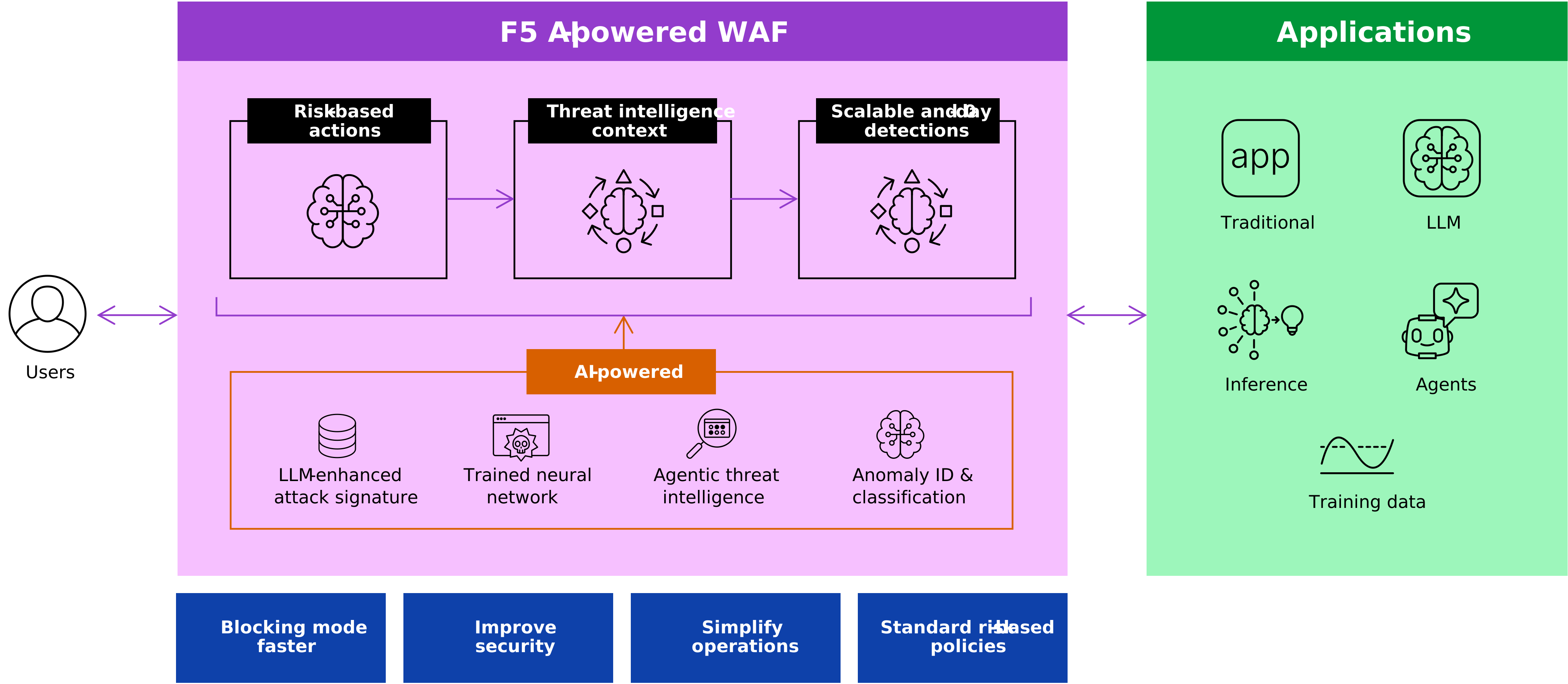
Virtual patching secures applications as exploit timelines shrink
With the window between vulnerability discovery and active exploitation rapidly closing, security teams must mitigate threats before development teams can complete code remediation. Virtual patching secures these exposures inline while developers build, test, and roll out permanent software fixes. This defense does not replace source-code remediation; instead, it maintains business continuity and buys essential operational time for engineering teams.
Integrating vulnerability scanning from F5 Distributed Cloud Web App Scanning with inline enforcement in F5 WAF for BIG-IP allows security teams to identify vulnerable applications, deploy targeted defenses, and instantly verify risk reduction. This integration establishes a repeatable, automated workflow that bridges security operations and development teams, accelerating response speeds to emerging threats.
A mature virtual patching strategy reduces overall risk, shortens time-to-mitigation, and secures critical applications while permanent code updates move through standard development and change-control pipelines.
KEY BENEFITS
Reduce exposure during remediation
Virtual patching helps reduce risk immediately by providing runtime protection while development teams build, test, and deploy permanent fixes.
Strengthen runtime defense
AI-powered runtime security, agentic threat intelligence, and enforcement help security teams confidently block exploit attempts while maintaining application availability and reducing operational burden.
Maintain business continuity during remediation
Protect vulnerable applications without waiting for emergency code releases, helping teams maintain normal testing, deployment, and change-control processes.
Accelerate time-to-mitigation
Use vulnerability findings from F5 Distributed Cloud Web App Scanning to inform WAF protections and quickly reduce exposure while underlying code fixes are implemented.
Enable confident threat enforcement
Agentic threat intelligence and AI-powered risk scoring provide the context needed to help security teams prioritize and respond to the risks that are most critical.
KEY FEATURES
Identify vulnerable applications
F5 Distributed Cloud Web App Scanning continuously discovers application vulnerabilities and maps findings to OWASP Top 10 categories for web apps and LLMs.
Apply targeted runtime protections
Vulnerability findings can be imported into F5 WAF for BIG-IP to help create and refine security policies that reduce exposure to known exploit techniques.
Validate and monitor mitigation
Ongoing scanning and WAF visibility help verify exposure reduction and confirm protections remain effective as applications evolve.
Enforce protections at the edge
F5 WAF for BIG-IP provides a centralized enforcement point that can block exploit attempts while permanent fixes are being developed and deployed.
Continuously assess risk
Repeated scanning and runtime visibility help organizations track remediation progress and confirm vulnerable applications remain protected.