
Protect against the ever-changing threat landscape
Automated attacks, API sprawl, fragmented controls, and looming quantum risk. The threat landscape keeps shifting, but the exposure gaps remain the same. F5 protects every app, API, and AI model with one consistent set of security controls, with distributed enforcement in the data path, everywhere you operate.
When the patch window is zero, runtime is your line of defense
Attackers have industrialized. Automated tooling, now accelerated by AI, finds and weaponizes flaws faster than patch cycles can close them, and every new app, API, and integration adds another point to defend. Meanwhile, most organizations protect their hybrid multicloud estate with a patchwork of tools and policies, and the seams between them have quietly become the attack surface.
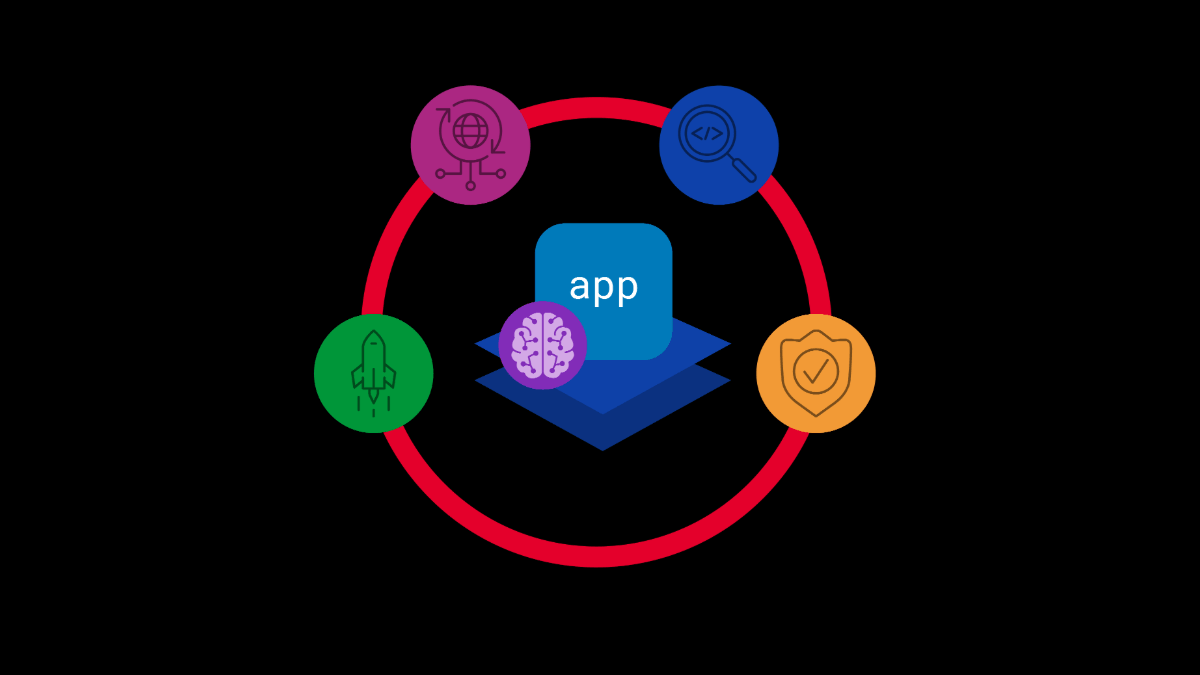
The F5 Application Delivery and Security Platform (ADSP) delivers consistent enterprise cybersecurity enforcement across every application data path—on premises, in the cloud, at the edge, and in Kubernetes environments. By operating directly in the path of application traffic, F5 blocks exploits before they reach vulnerable code, virtually patches live applications while teams build permanent fixes, and enforces a single security policy for every app, API, and AI model, wherever it runs.
The risk surface is expanding faster than the tools built to defend it
88%
of organizations have faced at least one AI-related security or operational challenge1
93%
of organizations operate across hybrid multicloud environments1
90%
of organizations say agentic AI in production introduces new security challenges1
Explore enterprise cybersecurity solutions
Web app and API protection
Every app and API is an entry point, including the ones you don't know you have. F5 converges WAF, continuous API discovery and protection, bot management, and DDoS mitigation into one line of defense that stops exploits, automated fraud, and business logic abuse, in any environment, including air-gapped.
Explore WAAP solutions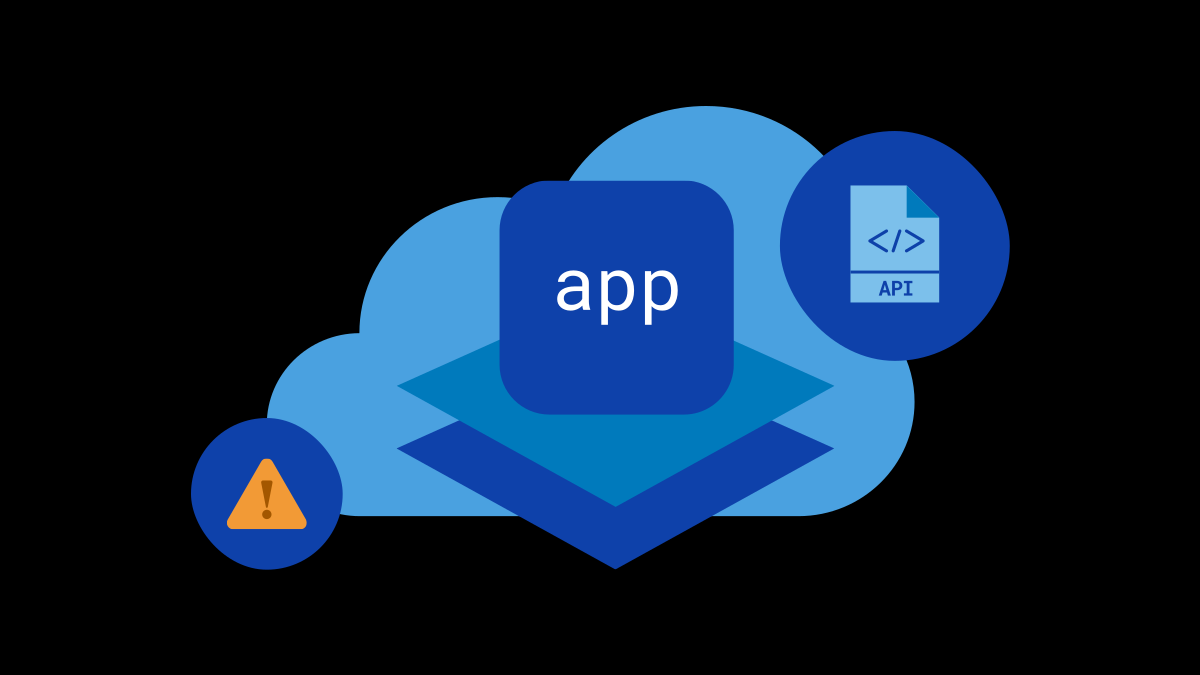
AI security
AI adoption is outpacing governance, and shadow AI puts sensitive data in motion beyond your visibility. F5 secures AI apps, models, and agents at runtime by blocking prompt injection and data leakage, uncovering vulnerabilities before attackers do, and extending zero trust access to agents and MCP servers. Adoption doesn't have to mean exposure.
Explore AI security solutions
Zero trust architectures
A single compromised credential shouldn't become a breach. F5 applies Zero Trust principles where attackers most often gain access: your applications and APIs. Identity- and context-aware access, granted per app and per user, contains east-west movement and shrinks the blast radius of any compromise, while full encrypted-traffic visibility eliminates blind spots.
Explore zero trust architecture solutions
Post-quantum cryptography readiness
"Harvest now, decrypt later" attacks are already underway, any data with a long shelf life is already at risk. F5 delivers crypto-agility without a forklift upgrade, enabling NIST-standardized post-quantum algorithms across the data plane while preserving complete traffic visibility through the transition.
Explore PQC readiness solutions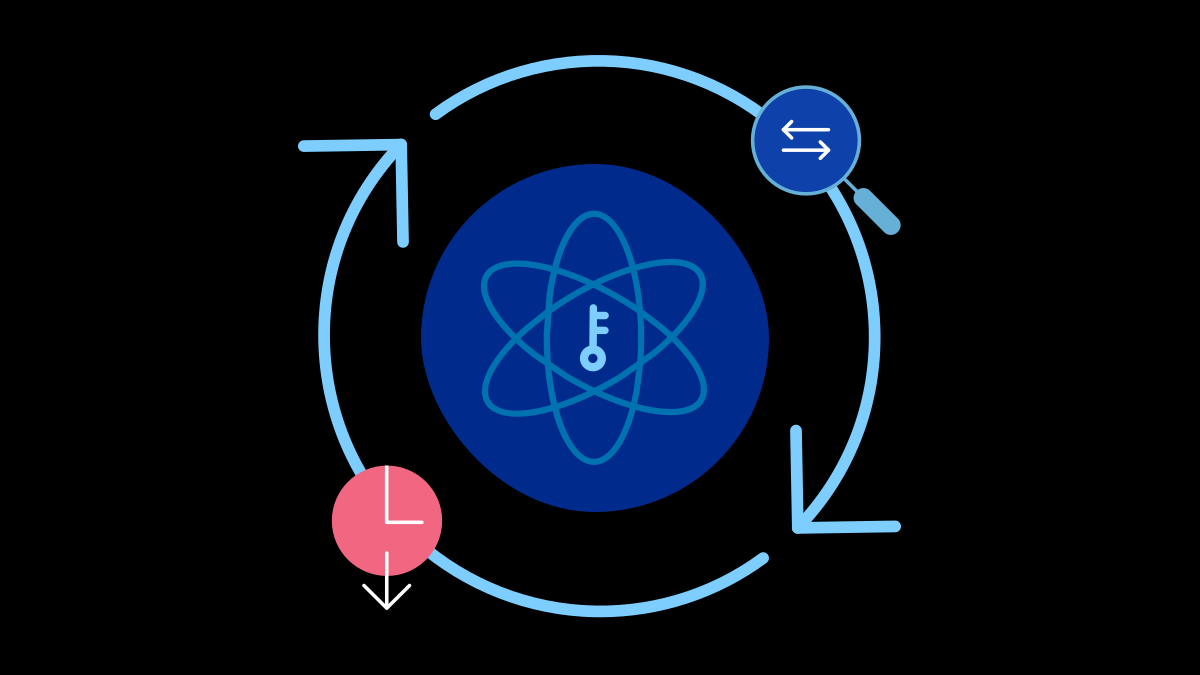
Security that works the way a CISO must
One policy, every environment.
Different tools and policies for each environment create the gaps attackers exploit. F5 enforces a single, consistent security policy across hybrid multicloud.
AI that defends, not just detects.
F5 puts AI to work for the defender with an AI-powered WAF that risk-scores every request, automated virtual patching that shields live apps the moment a scan finds a flaw, and a platform continuously hardened by frontier AI models.
Fewer tools. Fewer surprises.
Every additional point product is another integration and another blind spot. By converging delivery and security, F5 lowers total cost of ownership and removes the seams between products.
Proven, not promised.
In independenttesting, F5 WAAP with F5 AI Guardrails earned a 97.09% total security score, and F5 AI Guardrails achieved a 98.36% overall score across 20,000 adversarial test cases—including 99.3% effectiveness against prompt injection.
Integrated with the security ecosystem you already run
F5 works with leading security and technology vendors to close the gaps no single product can. Together, we address customers' hardest problems: protecting data wherever it moves, stopping threats before they spread, and securing modern workloads at runtime, so organizations can modernize with confidence.


Trending topics


Industry perspectives
Banking and Financial Services
Safeguard financial data and customer trust
AI is industrializing financial fraud. Attackers now fabricate synthetic identities to open new accounts and deploy deepfakes and stolen credentials to take over real ones, moving through the same apps and APIs your customers use. In financial services, successful cyberattacks bring fraud losses and data breaches, with regulatory exposure, bottom-line impact, and brand damage that outlasts the incident.
F5 meets AI-driven threats with AI-powered defense, analyzing AI, app, and API traffic across hybrid multicloud to detect and stop malicious activity without adding friction for legitimate account holders or slowing the applications they depend on.
Public Sector
Keep missions running, breaches contained
Zero Trust architectures have become the foundation of cybersecurity for governments. As agencies adopt AI to accelerate decision-making and service delivery; AI agents, service accounts and APIs, drive a growing share of access to mission systems, acting autonomously and at machine speed.
F5 provides security aligned to the NIST Cybersecurity Framework across the mission-critical applications, APIs, and AI systems agencies depend on, enforcing Zero Trust on every request, human or machine, from hybrid multicloud to air-gapped environments, and blocking lateral movement so a breach stays contained.
Healthcare
Ensure ePHI data security and compliance
Healthcare organizations—from providers running Epic and other EHR platforms to health insurers, and pharmaceuticals—depend on access to critical applications, and portals. Attackers are using advanced bots and AI-driven campaigns to launch credential stuffing and application-layer attacks and a single compromise can escalate into ePHI/PII exposure, IP loss, and ransomware.
F5 addresses security with advanced app/API protection across hardware, software, and SaaS—without re-architecture to continuously monitor and block credential abuse and protect web and API traffic.
Retail and Ecommerce
Deter eCommerce fraud and bot abuse
Cybercriminals continue to increase in sophistication, and with the power of AI, are quickly able to weaponize their campaigns. From vulnerability exploits, business logic abuse, client-side risks, and automated bot attacks—eCommerce web apps, mobile apps, and APIs are under constant threat.
F5 delivers unfied security to protect every retail app and API with continuous and consistent security—from the data center, across clouds, to the edge.
Resources
Recent News
Blogs
eBooks & reports
Frequently asked questions
The time between a vulnerability becoming known and a working exploit appearing has collapsed. Attackers now automate discovery and weaponization at machine speed, which means the traditional sequence of disclose, develop a patch, test it, schedule a maintenance window, deploy, now leaves applications exposed for the entire interval. Virtual patching closes that gap at the runtime layer. F5 links web application and API discovery and vulnerability scanning directly to F5 WAF products, so when a scan finds an exploitable flaw, a protective rule is applied to the live application automatically. The vulnerability still gets fixed in code, but the application is shielded in the meantime, which buys developers the time to build, test, and deploy a real patch without that time becoming a window of exposure. When the patch window is effectively zero, blocking the exploit at runtime stops being a nice-to-have and becomes the primary line of defense.
AI security has to defend the AI system itself, not just the infrastructure around it, and nearly every AI threat travels through an API into the model, which is why the right place to enforce protection is a runtime control point rather than something retrofitted application by application. F5 secures and governs AI apps, models, agents, APIs, and data at runtime across several disciplines. Runtime guardrails inspect inputs and outputs to block prompt injection and sensitive-data leakage and to keep interactions aligned to policy and regulation; in independent SecureIQLab testing across 20,000 adversarial cases, F5 AI Guardrails achieved a 98.36% overall security score, including 99.3% against direct prompt injection, 99.0% against sensitive-data leakage, and 98.7% against excessive agency. Red teaming probes the AI attack surface before deployment and explains, in natural language, exactly how a vulnerability was exploited and why. F5 API Security delivers continuous discovery, monitoring and vulnerability detection across the OWASP API Top 10, plus critical protection and enforcement functionality. Zero Trust access secures authentication and authorization to MCP servers and agents. And because people adopt AI whether it's sanctioned or not, the same controls help surface and contain shadow AI before it leaks PII, PHI, or proprietary code.
Zero Trust is often described at the network level, but the threats that matter most travel through applications and APIs, so the controls have to live there too. Application-centric Zero Trust applies the principles — never trust, always verify, continuously monitor — to every app and API rather than to a network perimeter. In practice that means identity- and context-aware access granted per application and per user, and, increasingly, identity-aware controls on machine-to-machine API traffic and on AI tools like MCP servers and agents. The reason this matters is lateral movement. Most damaging breaches don't stop at the initial foothold; the attacker pivots from one system to the next. Per-app-request access limits that movement and shrinks the blast radius of any single compromise. Consolidating these access controls onto one data plane also removes the cost and complexity of stitching together siloed point solutions, which is exactly where misconfigurations and gaps tend to appear.
Post-quantum cryptography (PQC) refers to a new generation of encryption algorithms designed to withstand attacks from quantum computers, which will eventually be able to break much of the public-key cryptography protecting data today. The threat is not purely a future one. In a "harvest now, decrypt later" attack, an adversary captures encrypted sensitive data today and simply stores it, betting that quantum computing will mature enough to decrypt it later — so any data with a long shelf life is already at risk. F5's approach is crypto-agility rather than a forklift upgrade. F5 enables NIST-standardized algorithms like ML-KEM across the data plane without disruptive architectural overhauls. Deploying hybrid cryptography, pairing ML-KEM with established elliptic-curve cryptography, lets organizations begin mitigating harvest-now-decrypt-later risk immediately, while BIG-IP SSL Orchestrator preserves full traffic visibility through the transition.
The best-of-breed instinct is reasonable, but it carries a hidden cost: every additional point product is another console to operate, another integration to maintain, and another stream of telemetry that may never reach the tools that need it. When defenses don't share data, visibility fragments, the security posture becomes hard to reason about, and the seams between products turn into the attack surface, precisely what coordinated, multi-stage attacks exploit. Consolidating onto the F5 Application Delivery and Security Platform converges application delivery and security and enforces one consistent policy across hybrid multicloud, on-premises, cloud, edge, and containerized environments. The benefits compound: centralized visibility, lower total cost of ownership, fewer blind spots, and the ability to enforce protection wherever a workload runs, including air-gapped and sovereign environments. The goal isn't to own every box on the diagram; it's to remove the gaps that appear between them.