We are thrilled that Intel has named F5 as a 2019 Leaders Board partner in the Intel® Network Builders program. Our strategic partnership with Intel has, for more than 15 years, enabled F5 to use Intel technology to deliver optimized, highly performant application services for both enterprises and service providers. More recently, F5 has worked extensively on the integration with Intel® QuickAssist Technology (Intel® QAT) on enabled server platforms which has led to this recognition. The Intel Network Builders program recognizes the reality that superior application performance begins with a high-performance network.
The result is that a BIG-IP Virtual Edition (VE) running on your hardware can now improve performance by offloading cryptography and compression functions to Intel QAT. This frees up resources on the CPUs and allows it to focus on processing data and responding to requests.
That means great customer experiences that start at the network layer because a fast, efficient network is the first step to delivering a fast, efficient application. Integration of Intel QAT is one of the ways we are enabling service providers and enterprises alike to accelerate their network and, in doing so, accelerate the application services and applications that depend on it.
This architectural axiom is often overlooked in today's application-centric and API-driven economy. We tend to hear 'ecosystem' and think of applications, not those that focus on the transformation of the network like that of Intel Network Builders.
Integration into both these ecosystems is important for application services today because application services continue to provide critical functions like acceleration, security, and scale for the applications powering the age of app capital.
Traditionally, those app services have been delivered by purpose-built infrastructure - such as an application delivery controller (ADC) - due to the capacity and performance required by customers. But increasingly app services are distributed across a widening set of insertion points that spans infrastructure from web and app server to intermediate proxies to cloud-based services. We see application services being delivered as plug-ins to application platforms, like NGINX. We see them delivered as-a-service atop a cloud infrastructure. And we see them delivered in container environments on-premises and off. The common thread is that a significant percentage of these application services are deployed on off-the-shelf hardware.
This shift does not eradicate the need for the boost to performance that comes from dedicated hardware. We see that reality in the gaming industry, where powerful GPUs boost graphic performance to give competitive players an edge. It's also showing itself in the burgeoning data-driven business trend, where specialized computing capabilities embedded in hardware are democratizing machine learning and enabling more and more businesses to take advantage of the technology.
It is not the use of hardware to improve capacity and performance that is changing, it's merely where that hardware lives.
In the past, that hardware has been embedded in network infrastructure itself. But that is changing thanks to industry leaders like Intel that are embedding acceleration technology right into their boards and chipsets.
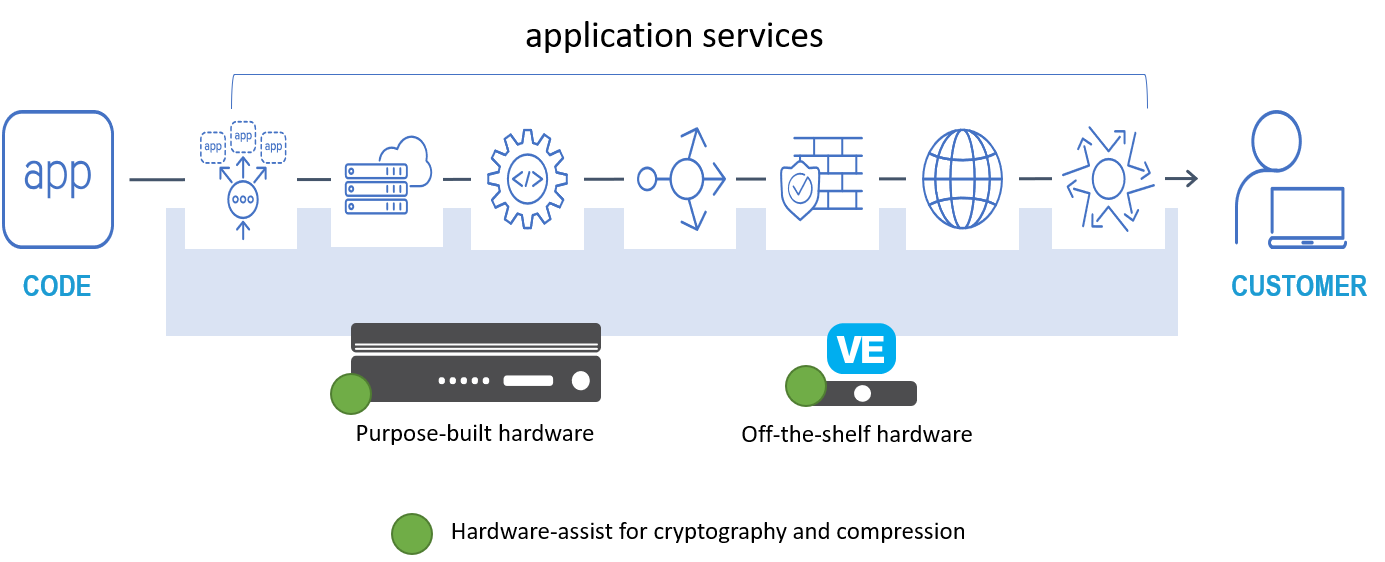
That means that here at F5 we've been able to transfer our expertise with Intel QAT from our own hardware to any off-the-shelf system enabled with the technology. This results in increased performance for application services delivered by a VE perform and that ultimately translates to a better customer experience for users.
About the Author

Lori MacVittie is a Distinguished Engineer and Chief Evangelist in F5’s Office of the CTO with deep expertise in application delivery, automation strategy, and infrastructure. She is known for turning complexity into clarity whether she’s defining guardrails for AI agents, dissecting brittle multicloud architectures, or probing the limits of scalable systems. She brings more than thirty years of industry experience across application development, IT architecture, and network and systems operations. Before joining F5, she served as an award-winning technology editor. MacVittie holds an M.S. in Computer Science and is a prolific author whose publications span security, cloud, and enterprise architecture. She is also an avid tabletop and video gamer with unapologetically strong opinions about cheese.
More blogs by Lori Mac VittieRelated Blog Posts

A new path to technical excellence for F5 partners
Introducing F5 Partner Foundations, a structured learning curriculum to build F5 partner engineer expertise with a clear pathway to specialization.
Secure-by-design storage for agentic AI: Why runtime visibility plus traffic control matters
Learn how F5 is collaborating with NVIDIA to help protect agentic AI with secure-by-design AI infrastructure, runtime visibility, and traffic control.

Why sub-optimal application delivery architecture costs more than you think
Discover the hidden performance, security, and operational costs of sub‑optimal application delivery—and how modern architectures address them.

Architecting for AI: Secure, scalable, multicloud
Operationalize AI-era multicloud with F5 and Equinix. Explore scalable solutions for secure data flows, uniform policies, and governance across dynamic cloud environments.
AppViewX + F5: Automating and orchestrating app delivery
As an F5 ADSP Select partner, AppViewX works with F5 to deliver a centralized orchestration solution to manage app services across distributed environments.

F5 NGINX Gateway Fabric is a certified solution for Red Hat OpenShift
F5 collaborates with Red Hat to deliver a solution that combines the high-performance app delivery of F5 NGINX with Red Hat OpenShift’s enterprise Kubernetes capabilities.