Networking for Kubernetes solutions
From lightweight microservices to advanced centralized governance, deliver and secure Kubernetes apps at scale.
Deliver, secure, and scale applications, APIs, and AI workloads on Kubernetes
Kubernetes solves core operational challenges, but it does not control how traffic behaves. As organizations manage multiple clusters, tenants, and teams, this control can lead to fragmented tooling, inconsistent security, limited end-to-end visibility, and systems that are harder to operate. The F5 Application Delivery and Security Platform (ADSP) extends enterprise-grade solutions for networking, security, and observability into modern Kubernetes environments. With a centralized control layer, teams can standardize Kubernetes networking, support AI inference workloads, and scale securely without operational overhead.
Standardize Kubernetes application delivery
Standardize across environments on a proven, enterprise-grade platform trusted by Platform and DevOps teams.
Extend ADC investments to Kubernetes
Bridge traditional ADC environments with Kubernetes to preserve investments while enabling modern application delivery.
Ensure AI-readiness
Power AI workloads with AI-optimized application delivery on Kubernetes, the leading platform for AI apps.
Govern at scale
Apply consistent traffic management and security policies to achieve end-to-end visibility across clusters, tenants, teams, and environments.
Traffic control across Kubernetes architectures
F5 delivers Kubernetes traffic control through complementary, Kubernetes-native solutions that fit different architectures and operating models.
F5 NGINX
NGINX is a lightweight reverse proxy, load balancer, and API gateway that is deeply embedded in cloud-native architectures for delivering lightweight microservices in Kubernetes. With F5 NGINX Ingress Controller and NGINX Gateway Fabric, it supports both Ingress and the emerging Gateway API standard, enabling teams to deliver services, route traffic, enforce policies, and secure APIs and AI workloads using Kubernetes-native workflows. Best suited for organizations where platform engineering and DevOps teams own and operate Kubernetes.
F5 BIG-IP Next for Kubernetes
BIG-IP Next for Kubernetes is designed for organizations that need advanced capabilities across deterministic control of ingress and egress, microsegmentation and strict multi-tenancy, and high-performance traffic handling for large-scale or latency-sensitive workloads. Best suited where NetOps extends control into Kubernetes environments, it brings a proven, high-performance data plane with consistent security and policy enforcement into the traffic path, enabling centralized governance and predictable control across clusters, teams, and environments.
F5 BIG-IP Container Ingress Services (CIS)
BIG-IP CIS equips NetOps teams extend existing BIG-IP Application Delivery Controller investments into Kubernetes. By connecting Kubernetes resources to BIG-IP, BIG-IP CIS allows organizations to manage ingress traffic, enforce consistent application delivery and security policies, and support containerized applications using familiar BIG-IP operational models. Well suited for enterprises where BIG-IP remains the standard control point and Kubernetes adoption needs to align with existing NetOps practices.

Gold membership in the Cloud Native Computing Foundation
F5 is committed to fostering and supporting cloud native Kubernetes innovation within the CNCF, including resources for complex AI inference workloads.
Learn moreExplore Kubernetes networking use cases
Ingress for Kubernetes
Ingress for Kubernetes
As organizations standardize on Kubernetes for production applications, they require ingress that’s proven, secure, and production-ready. F5 delivers enterprise-grade ingress through F5 NGINX Ingress Controller and BIG-IP Container Ingress Services, combining open-source flexibility with commercial support and long-term stability.
Teams secure apps, APIs, and AIs at ingress with Kubernetes-native WAF protection, enabling consistent policy enforcement across the enterprise. BIG-IP users can seamlessly extend existing traffic management and security into Kubernetes—preserving operational models while enabling cloud-native modernization.
F5 NGINX Ingress Controller
Proven, trusted, production-ready ingress solution.
F5 WAF for NGINX
Enforce and scale app and API security across distributed architectures and hybrid environments.
F5 BIG-IP Container Ingress Services
Extend BIG-IP traffic management and security into Kubernetes.
F5 BIG-IP Next for Kubernetes
Scalable, multi-tenant ingress and egress control for Kubernetes clusters.
F5 NGINXaaS for Azure
Supports consistent app delivery across Azure-hosted Kubernetes environments.
F5 NGINXaaS for Google Cloud
Supports consistent app delivery across Google Cloud Kubernetes environments.
Gateway API
Gateway API
Modern Kubernetes platforms require a single gateway to deliver applications, APIs, and AI workloads—eliminating tool sprawl and complexity. NGINX Gateway Fabric implements a conformant Gateway API solution to provide a consistent, extensible connectivity model built on Kubernetes-native APIs and CRDs.
Enable advanced routing, traffic splitting, weighted load balancing, and policy-driven governance while cleanly separating platform and developer responsibilities. The same gateway delivers API, app, and AI inference traffic with visibility and control.
F5 NGINX Gateway Fabric
Production-grade Gateway API with support for model-aware routing.
F5 WAF for NGINX
Secure modern apps and APIs running on F5 NGINX with Kubernetes-ready WAF
AI factory load balancing
AI factory load balancing
Scaling AI inference and training workloads requires more than traditional load balancing. GPU-intensive prompts consume memory and compute unpredictably, creating contention, cache pressure, and uneven utilization across clusters.
F5 delivers high-performance L4–L7 traffic management purpose-built for Kubernetes-based AI environments, including GPUaaS and on-prem deployments. By continuously evaluating memory availability, KV cache pressure, request queue depth, and backend health, F5 intelligently routes traffic to balance GPU load, reduce latency, improve stability and maximize infrastructure efficiency.
F5 BIG-IP Next for Kubernetes
Scalable, multi-tenant ingress and egress control for Kubernetes clusters.
F5 NGINX Gateway Fabric
Production-grade Gateway API with support for model-aware routing.
Multi-cluster and multi-tenancy
Multi-cluster and multi-tenancy
As Kubernetes expands to multi-cluster, hybrid, and multicloud deployments, teams need a consistent application connectivity layer for ingress, security, and observability. Without it, ingress sprawl leads to policy drift, inconsistent TLS, duplicated tools, and poor visibility.
An enterprise-grade traffic and security plane integrated with Kubernetes automation solves this. Using declarative CRDs and orchestration events, teams can automate routing, load balancing, TLS, DNS steering, and policy per cluster—ensuring multi-tenant isolation, HA/DR, and end-to-end telemetry without new silos.
F5 BIG-IP Container Ingress Services
Extend BIG-IP traffic management and security into Kubernetes.
F5 BIG-IP Next for Kubernetes
Scalable, multi-tenant ingress and egress control for Kubernetes clusters.
F5 NGINX Gateway Fabric
Production-grade Gateway API with support for model-aware routing.
F5 NGINX Ingress Controller
Proven, trusted, production-ready Ingress solution
F5 NGINXaaS for Azure
Supports consistent app delivery across Azure-hosted Kubernetes environments.
F5 NGINXaaS for Google Cloud
Supports consistent app delivery across Google Cloud Kubernetes environments.
Egress for Kubernetes
Egress for Kubernetes
AI workloads often require multi-tenant Kubernetes clusters to maximize GPU investments and infrastructure ROI. As AI apps integrate sensitive data, secure access becomes critical.
While Kubernetes namespaces provide logical separation inside a cluster, true zero trust security demands the separation is maintained in the network segmentation beyond it.
Organizations need a Kubernetes-aware solution that maps namespaces and policies to network-level controls—enforcing isolation, protecting data, and securing AI environments end to end.
F5 BIG-IP Next for Kubernetes
Scalable, multi-tenant ingress and egress control for Kubernetes clusters.
Observability for Kubernetes
Observability for Kubernetes
Kubernetes workloads are dynamic and ephemeral, making consistent visibility into app performance difficult.
Telemetry is often fragmented across logs, metrics, and traces, slowing troubleshooting across hybrid and multicloud clusters.
A modern observability strategy uses OpenTelemetry for standardized data pipelines and eBPF-based telemetry for low-overhead, kernel-level insight—without app changes. Combined with automation, teams gain real-time visibility into traffic, latency, errors, and dependencies, enabling proactive performance and policy management at scale.
F5 NGINX Gateway Fabric
Production-grade Gateway API with support for model-aware routing.
F5 NGINX Ingress Controller
Ensure consistent protection across distributed apps and environments with SaaS WAF
F5 BIG-IP eBPF Observability
Extends BIG-IP Cloud-Native Edition with real-time, kernel-level visibility into Kubernetes traffic without sidecars or app-level instrumentation.
F5 BIG-IP Container Ingress Services
Extend BIG-IP traffic management and security into Kubernetes.
Reference architecture
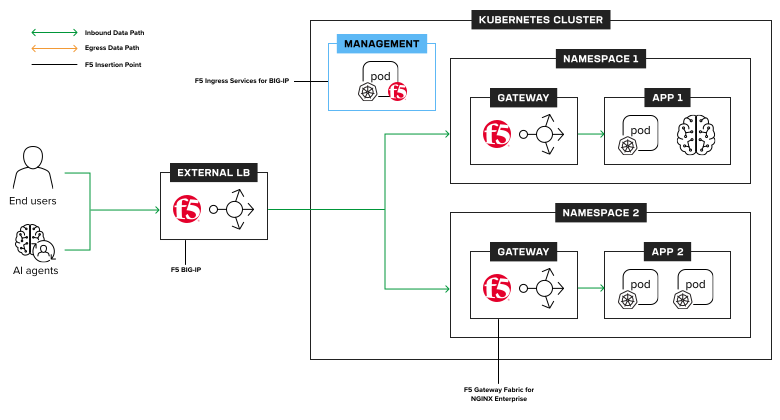
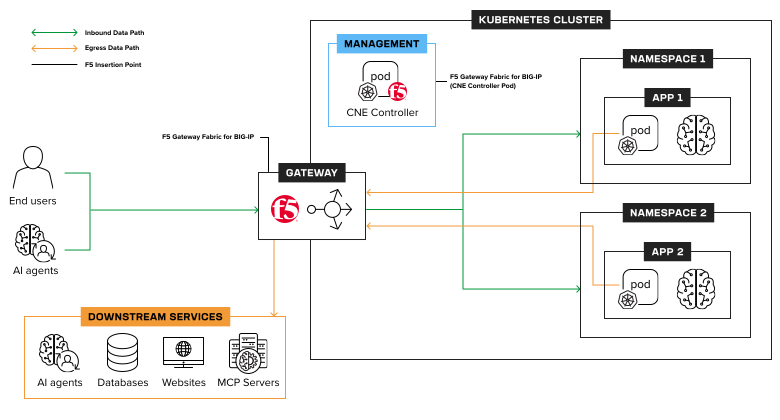
The following set of reference architecture diagrams are designed to help you understand application delivery in Kubernetes.
Networking in Kubernetes
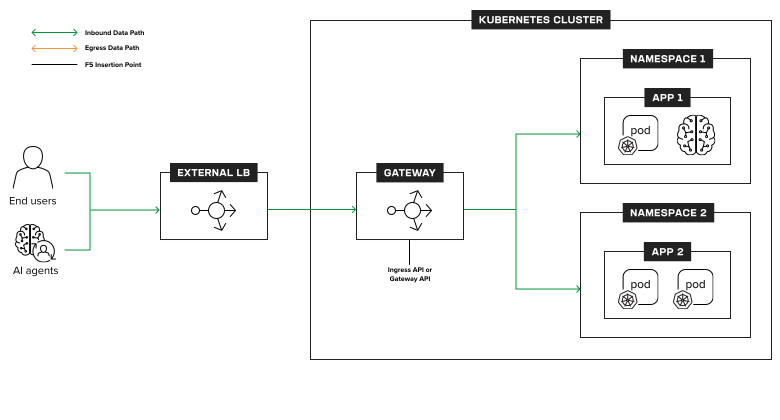
Production-grade Networking for Kubernetes
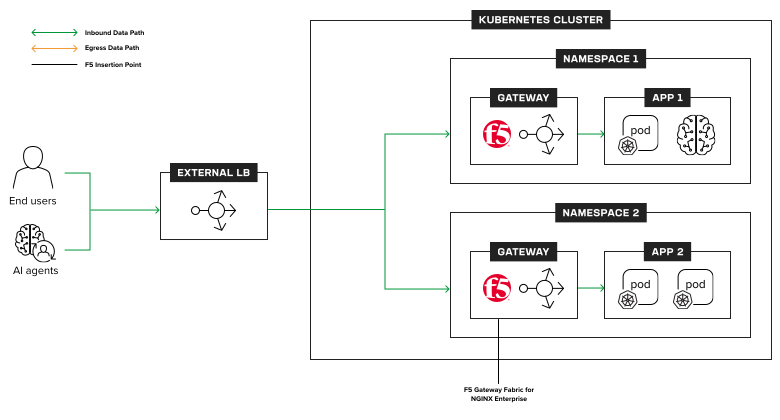
Enterprise-grade Networking for Kubernetes
Strategic Networking for Kubernetes
Technology alliances



Resources
Articles & eBooks
Recent news
Videos
Frequently asked questions
Kubernetes is an open-source container scheduler and orchestration platform that automates the deployment, scaling, networking, and lifecycle management of containerized applications. It provides abstractions such as pods, services, and ingress to decouple applications from underlying infrastructure, enabling portability across on-prem, cloud, and edge environments. Kubernetes is widely used to run microservices, APIs, and increasingly AI/ML workloads due to its scalability, resilience, and ecosystem support. The Kubernetes project is hosted by the Cloud-Native Computing Foundation (CNCF), a subsidiary of the non-profit Linux Foundation. In addition, there are many different software and SaaS vendor distributions of Kubernetes available.
Cost-effective Kubernetes starts with controlling operational overhead. A primary operational focus should be on standardizing networking, traffic management, and security rather than layering point tools per cluster or cloud. Organizations reduce operational cost by reusing a consistent ingress and Gateway API architecture, templating deployments, and improving utilization through intelligent load balancing and observability. Performance is preserved by using production-grade networking that supports high throughput, low latency, and automation via Kubernetes-native APIs and GitOps workflows.
F5 optimizes Kubernetes networking for AI/ML by providing intelligent traffic management that goes beyond basic round-robin load balancing. F5 supports model-aware routing, high-throughput L3–L7 traffic handling, and deterministic performance required for GPU-backed inference and training workloads.
As organizations expand their use of Kubernetes, it can be easy to create cluster sprawl and Kubernetes cloud service sprawl. This typically creates fragmentation across networking, security, and observability. Different ingress controllers, cloud load balancers, and policy models lead to configuration drift, inconsistent security enforcement, and limited end-to-end visibility. Operational complexity increases as teams manage multiple control planes and toolchains. Without a properly designed connectivity layer, scaling Kubernetes across clusters and clouds results in higher cost, slower troubleshooting, and reduced reliability.
The easiest way to run Kubernetes at the edge is to use a lightweight, consistent Kubernetes distribution combined with centralized networking and security control. Edge environments require predictable performance, components that are lightweight, minimal operational overhead, and support for intermittent connectivity. By standardizing ingress, traffic routing, and security policies across core, cloud, and edge, teams can deploy Kubernetes at scale while maintaining visibility, isolation, and automation without relying on cloud-specific services.