Our new F5 Labs research report, 2026 State of PQC on the Web, presents two faces of the progress organizations are making toward readiness for quantum computing that can break traditional public key cryptography.
On the one hand, the research shows that more than half of the top 1 million websites (54%) now support PQC key exchanges. But this statistic is deceptive. Analysis of how and where websites are hosted revealed that much of the progress has been driven by edge CDNs and hyperscalers (primarily Cloudflare), which have enabled hybrid-PQC ciphers for their customers by default. When this passive, third-party readiness is excluded, the face of PQC preparedness changes drastically.
The least prepared industries have the most to lose
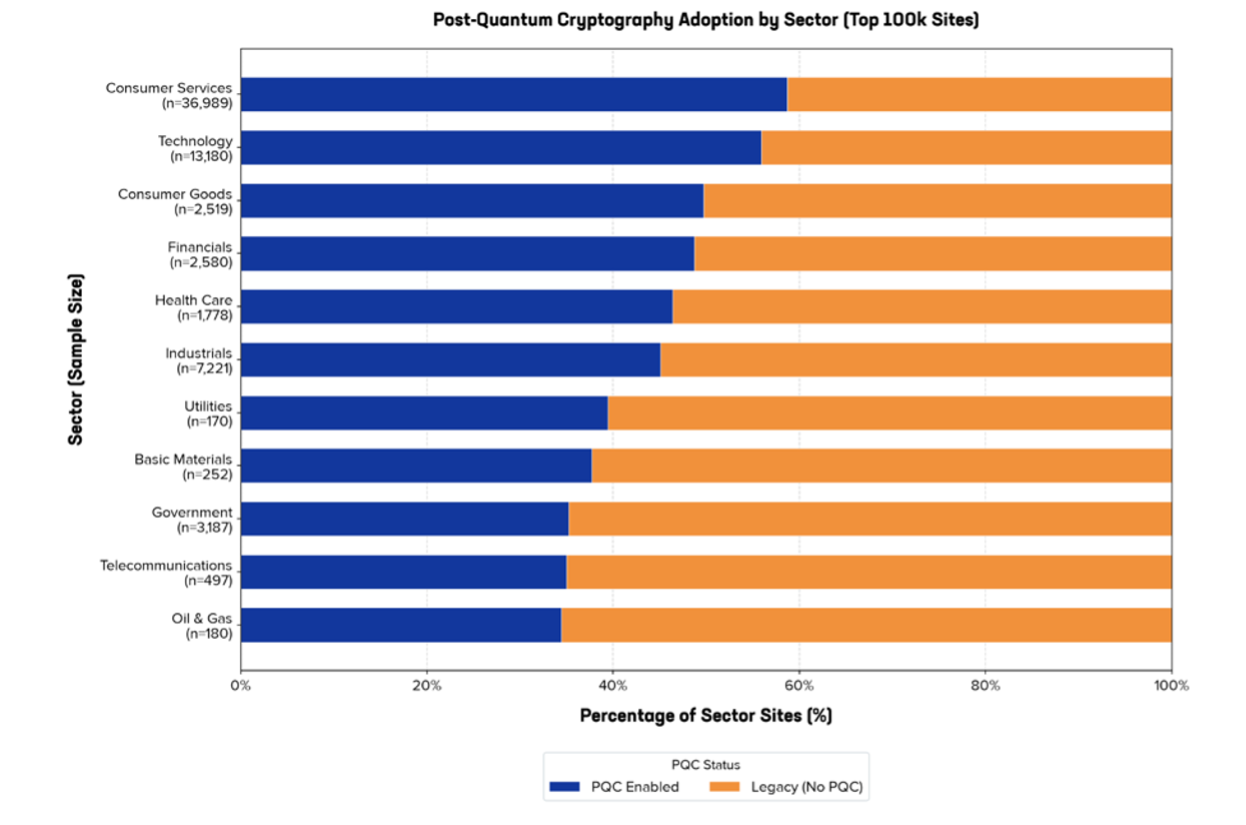
Across industries, when excluding Cloudflare hosted sites from the data, only 22% of websites are ready, thanks to organic migration efforts. A full 10.5% carry such technical debt that they cannot even support TLS 1.3, a requirement for hybrid and PQC ciphers that has been in common use for eight years now.
And even when we do include the impact of passive mitigation through CDNs, the industries that are least prepared include utilities, energy, telecommunications, and government organizations. That’s a problem, since each frequently handles long-lived and sensitive information that puts them at high risk from “harvest now, decrypt later” attacks. Q-Day—the theoretical date when quantum computing evolves sufficiently to break classic cryptography—may still be two years or more away, but attackers are storing stolen data now for that future.
This all means that deliberate PQC migration for public websites is not moving quickly enough. The end-to-end PQC readiness required to protect critical infrastructure, east-west traffic, and other assets is likely even further behind. Several laggard industries face the most risk, but none is exempt. Although consumer-facing and technology websites lead the pack, no industry has more than 59% adoption.
Nuance lurks in the disparities
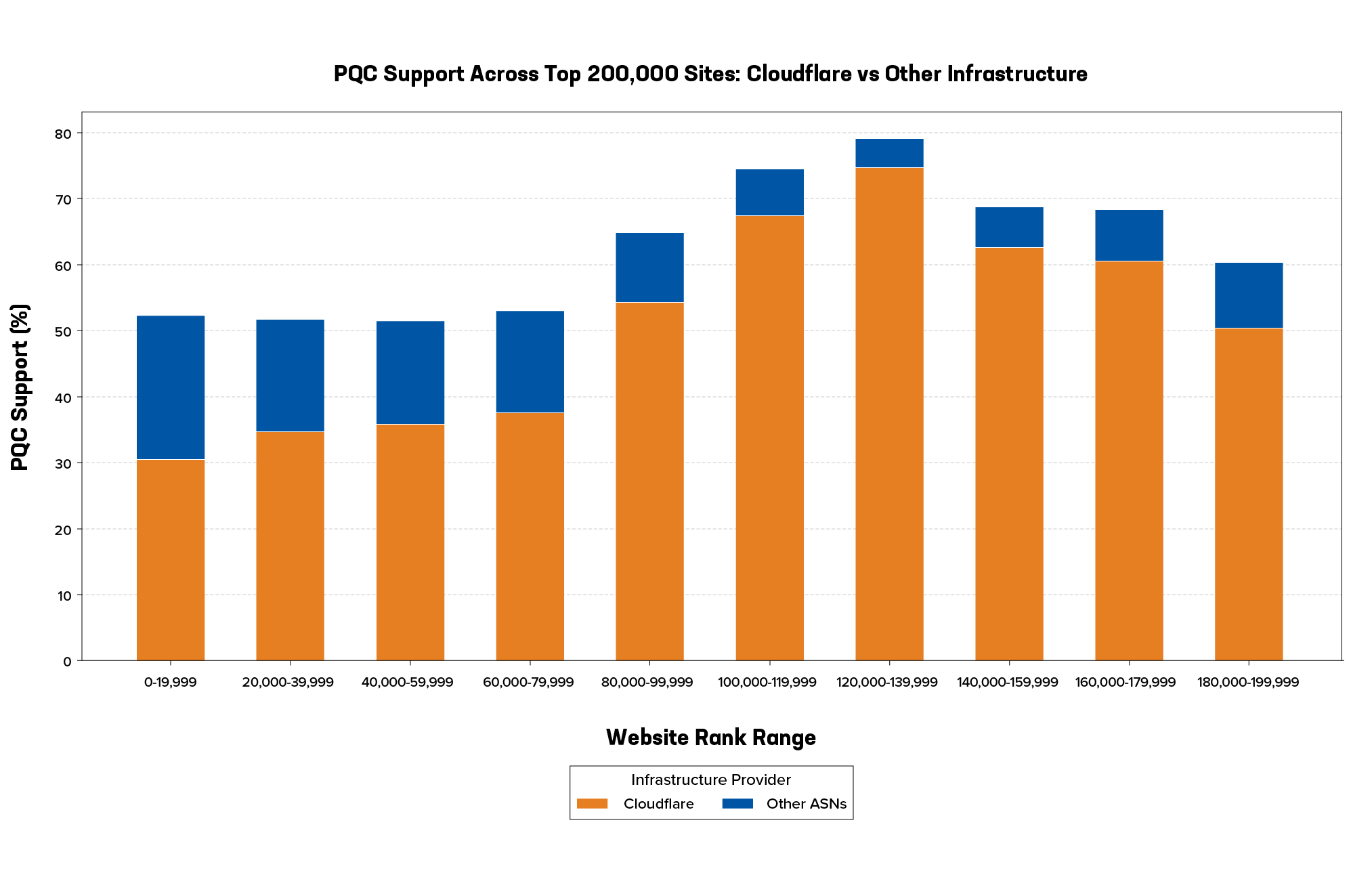
Furthermore, there’s considerable nuance in the disparities between the readiness of the largest enterprises and that of smaller or medium-sized businesses. PQC and hybrid cipher adoption peaks not with the large companies holding the world’s top websites but in more middling ranks (from the top 80,000 to the top 200,000), where medium-sized and smaller businesses are relying on their cloud and CDN providers for security by default. On the surface, these smaller organizations appear as a group to be better protected than the behemoths, with PQC readiness approaching or at 80%.
The problem with relying on third-party PQC support is complacency. Those mid-sized businesses may have no idea which ciphers their CDN is using and have little to no say in the decision. More importantly, most are probably not very urgently addressing the risks for the rest of their infrastructure, from origin servers to API ecosystems.
Overcome barriers to progress
Meanwhile, the world’s highest-value and most highly visible domains show significantly poorer PQC or hybrid cipher adoption. Why?
First, the companies that own those domains typically operate complex environments and configurations. Many struggle under burdens of technical debt around legacy operational technology (OT) or core legacy apps.
Legacy web servers are also a factor. In fact, some emerging markets have unexpectedly high rates of PQC readiness because they largely bypassed more traditional architectures and jumped directly to modern, cloud-first strategies. On the other hand, the telecommunications industry generally lags because it’s so highly invested in private, specialized, and self-hosted networks.
Second, even organizations without those challenges must sometimes overcome a range of other barriers. Governments, in particular, typically wrestle with lengthy budgeting and procurement cycles, although any organization can be challenged by the financial and architectural implications of evolving cryptography. Regulatory and data sovereignty requirements are also hurdles.
There’s evidence, for instance, that major industrial economies in the European Union are lagging North America more than we might expect. This is due in part to their data sovereignty requirements, which favor self-hosted, on-premises data centers or regional providers, reducing the CDN effect in these geographies and removing the option of default PQC readiness at the edge. Some EU nations may also be waiting for EU-wide guidance from the European Union Agency for Cybersecurity (ENISA) while considering the highly specific recommendations of a few national cybersecurity agencies.
Stay cryptographically agile across your estate
Specific recommendations that favor a single cipher are indeed suspect, because no one PQC cipher will eliminate risk over time. Crypto agility will be crucial, and inflexibility is already holding some organizations back.
One symptom is the use of overly long-lived certificates. Our research revealed that nearly one in five top websites (19%) still deploy certificates with lifespans exceeding 90 days. Organizations that haven’t yet automated short-lived certificate renewals will find it nearly impossible to rapidly rotate ciphers as the post-quantum transition will require.
They’ll need greater agility not only to defend against ongoing PQC threats and manage steadily dropping certificate lifespans, but also to secure their estates against crypto analysis powered by AI to break classic ciphers.
Remember to prepare beyond websites
Although all progress is welcome, it’s important to note that our research focused exclusively on websites. While the public edge has helped organizations make significant improvements to secure data in transit, most have barely begun to address other, equally vital PQC threats.
These threats include overt risks to infrastructure and internal networks and traffic. They also include preparation for the latency and operational impacts that lengthy PQC ciphers may have on authentication protocols, internal service meshes, IoT and OT devices, and Kubernetes mTLS payloads, for instance.
Take the steps that can’t wait
Whether Q-Day arrives sooner than expected or later, in many ways the event itself is irrelevant. Regulatory mandates and common-sense precaution dictate that organizations of all sizes begin taking steps toward better protection. A few places to start immediately:
- Inventory all cryptography touchpoints in your organization to build a cryptographic bill of materials (CBOM). You must know what will be affected to remediate the risks.
- Adopt TLS 1.3, if your organization hasn’t already. It’s mandatory to deploy hybrid ciphers.
- Take all necessary steps to reduce the lifespan of certificates and automate renewals as the standard lifespan dwindles from months toward mere days.
- Understand what CDNs, hyperscalers, and cloud providers can do for you—and what they can’t. Don’t rely solely on security by third-party default. Learn what ciphers they’re using and keep up with their evolutions as you improve readiness across your CBOM.
- Talk to all your technology vendors about where and how PQC readiness is built into their solutions and how you can take advantage of their expertise.
- Educate yourself or a PQC team in your organization to help make the decisions that will increase your overall cryptographic agility moving forward.
To learn more, visit our PQC solutions webpage. Also, be sure to check out the full F5 Labs report, 2026 State of PQC on the Web.
About the Author

Related Blog Posts
Multi-model AI security strategies: Two steps to take now
Key actions enterprises can take today to improve multi-model AI visibility and cybersecurity amid explosive agentic AI growth.

How CISOs can measure AI security risk
Learn how CASI, ARS, and F5 Labs threat intelligence help CISOs measure AI security risk across the full AI lifecycle.

Three moves CISOs can't afford to delay
Findings from recent F5 research—and what CISOs must do to get ahead of these trends.

Three forces reshaping security leadership: Distributed AI inference, threat evolution, and hybrid multicloud
See the latest AI trends rapidly altering the security landscape.
F5 Report 2026: AI inferencing has arrived, complicating an already complex IT landscape
Newly released F5 research shows the majority of enterprises are taking AI inference in-house, with the average company now using seven AI models.

Lessons we are learning from our security incident
F5 CISO Christopher Burger answers common questions from customers surrounding the recently disclosed security incident.