For years, vulnerability management followed a familiar sequence. A vulnerability was discovered and disclosed, security teams assessed the risk, organizations tested a fix, and patches moved through change control and maintenance windows before reaching production.
That model depended on something organizations could easily take for granted: time.
Today, that time is disappearing. Artificial intelligence is accelerating vulnerability discovery, exploit development, and automated attack workflows. As those capabilities improve and become more widely available, security teams face a fundamental mismatch. Attackers can increasingly operate at machine speed, while defenders must still have to operate within the realities of enterprise IT.
“The answer is not to abandon security fundamentals or bet on an AI silver bullet. It is to determine how organizations can preserve those fundamentals when the window for acting on them has radically changed.”
The vulnerability race has changed
The numbers illustrate how dramatically the equation has shifted.
As I discuss in F5’s virtual Post-Mythos Security Summit, in 2018, the mean time from vulnerability disclosure to exploitation was more than two years, giving defenders roughly 771 days of breathing room. By 2021, that window had fallen to about 10 months. In 2024, it was 53 days. In 2025, it was roughly three weeks.
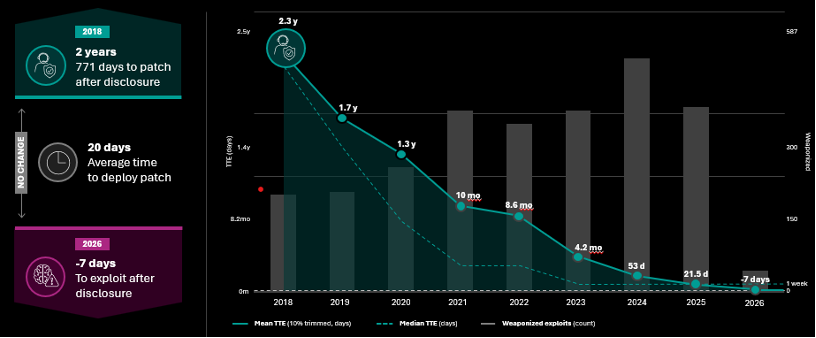
Today, Mandiant M-Trends data puts the estimate at minus seven days. In other words, exploitation can begin a week before a vulnerability is publicly disclosed. Meanwhile, the average time required to deploy patches remains essentially unchanged at approximately 20 days, despite the collapse in time available to defenders.
This doesn’t mean that security and IT teams simply need to work faster. Deploying a patch across an enterprise environment requires testing, change control, maintenance planning, availability protections, and coordination across teams. Those processes exist for good reasons. Rushing a change into production can create its own security and business risks.
The problem is that those processes were designed for a security environment in which defenders generally had more time.
Offensive capabilities are becoming more accessible
Frontier AI is also changing who can operate at greater speed.
The most advanced models attract much of the attention, but the broader trend may be more important. Widely available AI models are already capable of assisting with tasks such as reverse engineering, penetration testing, and vulnerability research. At the same time, new projects are emerging around agent-backed red teaming and web vulnerability assessment.
Capabilities that begin at the frontier rarely remain there forever. As models improve and offensive tooling becomes easier to use, sophisticated vulnerability discovery and exploit-development techniques have become more accessible to a broader range of adversaries.
That changes vulnerability management from a race against other human operators into something increasingly shaped by automation. And it raises an uncomfortable question: What happens when attackers can act before an organization can safely complete its patching process?
Patching cannot carry the entire burden
Patching remains essential. But when exploitation can precede disclosure, organizations cannot assume that remediation alone will close the exposure window quickly enough. Simply discarding the operational safeguards that make software changes safe isn’t an option either.
Instead, security leaders must think more broadly about the period between discovery and remediation. How can organizations reduce exposure while a patch moves through required testing and approvals? How can they identify which assets need attention first? How can they ensure security protections react faster without creating unacceptable operational risks?
These are becoming security questions and operational questions at the same time. They also point toward a larger shift in how organizations should think about resilience.
The goal is not to simply make existing processes happen more quickly; it’s to create an operating model capable of responding to AI-driven threats while preserving the discipline, visibility, and accountability enterprises still require.
While technology will be a critical part of your response, it’s only a part of the solution. Organizations often struggle not because they lack security tools, but because their operations cannot keep pace with the threat environment.
What happens when the patch window hits zero?
In my session at the F5 Post Mythos Security Summit, “When patching isn’t fast enough,” I take this problem from theory to practice by exploring what security and operations leaders can do when traditional remediation timelines collide with AI-speed threats. I also offer concrete steps organizations can take to strengthen their security posture, and show how F5 is approaching the challenge of helping defenders keep pace.
The answer is not to abandon security fundamentals or bet on an AI silver bullet. It is to determine how organizations can preserve those fundamentals when the window for acting on them has radically changed.
Watch my on-demand session at the F5 Post-Mythos Security Summit to learn more about modern patching in the frontier AI era.
About the Author

Michael is responsible for the enterprise‑wide strategy and execution to operate the company with security and resiliency at its core. He leads F5’s Security, Risk, and Digital Operations organizations, driving end‑to‑end operational trust for customers, partners, and employees. Montoya joined F5’s executive leadership team in October 2025 after serving on F5’s Board of Directors from 2021 to 2025. Prior to F5, Montoya was Chief Operating Officer at BlueVoyant and previously served as Chief Information Security Officer at Equinix and Digital Realty. He spent more than a decade at Microsoft in global leadership roles, including Chief Cyber Security Officer, regional CIO/CISO for EMEA and Asia, and a global leader for Datacenter Operations.
More blogs by Michael MontoyaRelated Blog Posts

When patching can't keep pace and protection can't wait
Because security threats move faster than app development and deployment cycles, protection must operate independently. Here’s how modern WAAP steps up.

Securing the new control points in the AI journey
AI architecture is fundamentally different than traditional IT environments and requires a different security strategy to protect critical AI workloads.
The patch window has closed. Here is how F5 is built for what comes next.
As AI models have changed software security, the industry needs to adapt.
Best practices for optimizing AI infrastructure at scale
Optimizing AI infrastructure isn’t about chasing peak performance benchmarks. It’s about designing for stability, resiliency, security, and operational clarity
Datos Insights: Securing APIs and multicloud in financial services
New threat analysis from Datos Insights highlights actionable recommendations for API and web application security in the financial services sector

How AI inference changes application delivery
Learn how AI inference reshapes application delivery by redefining performance, availability, and reliability, and why traditional approaches no longer suffice.