Zero Trust Architecture: What is it and why do governments need it?
The digital transformation has made government services considerably more convenient and efficient for agencies and citizens around the world, but it has also introduced significant security vulnerabilities. Governments increasing depend on interconnected systems, web-based applications, APIs, cloud platforms, and remote networks, making them prime targets for cyberattacks. As cyber threats grow in complexity and scale, traditional security measures struggle to defend against modern risks. Enter Zero Trust Architecture (ZTA), a transformative approach to cybersecurity that offers an effective and scalable solution in these multi-network environments. But what is ZTA, and why is it critical for modern governments?
As its name suggests, Zero Trust Architecture operates on the principle of "never trust, always verify." Unlike traditional security models that place implicit trust in users and devices within a network's perimeter, ZTA assumes that breaches are inevitable. It constantly verifies each entity attempting to access systems, applications, APIs, data, or services, both inside and outside the network perimeter. This approach eliminates the assumption that anything or anyone within a network is inherently safe, instead requiring ongoing authentication and attention.
How does Zero Trust Architecture help governments?
Challenge
Governments need ZTA now more than ever
Governments must manage sensitive data, maintain infrastructure, and safeguard national security. These responsibilities make them high-value targets for cybercriminals, state-sponsored attackers, and disruptive technologies such as botnets. Whether the target is a healthcare system assailed by ransomware, a power grid exposed to foreign interference, or finance platforms exploited for fraud, governments cannot afford to operate without a robust security framework like ZTA.
The growing reliance on APIs and web applications by governments intensifies the need for ZTA. Public-facing services such as unemployment benefit portals, voter registration systems, and municipal payment platforms rely heavily on APIs to function. Unauthorized API access can compromise entire systems, enabling attackers to steal personal information, manipulate data, or bring services to a halt. With zero trust in place, API traffic is continuously inspected for normal behavior, and any unauthorized calls or anomalies are flagged and blocked in real time.
Bot defense is another critical use case for governments adopting ZTA. Malicious bots are increasingly used to scrape sensitive data, execute mass credential-stuffing attacks, and overwhelm web application. These attacks can disrupt essential services like citizen-facing portals for public registration or tax filing. A zero trust approach integrates advanced bot mitigation strategies by leveraging AI systems to distinguish between legitimate users and malicious bots. Using pattern recognition and behavioral analysis, AI can quickly identify suspicious activity, such as unusual spikes in requests or repeated login attempts, and mitigate the risk posed by bots before they trigger widespread damage.
Use case 1
Securing APIs and web apps in a zero trust framework
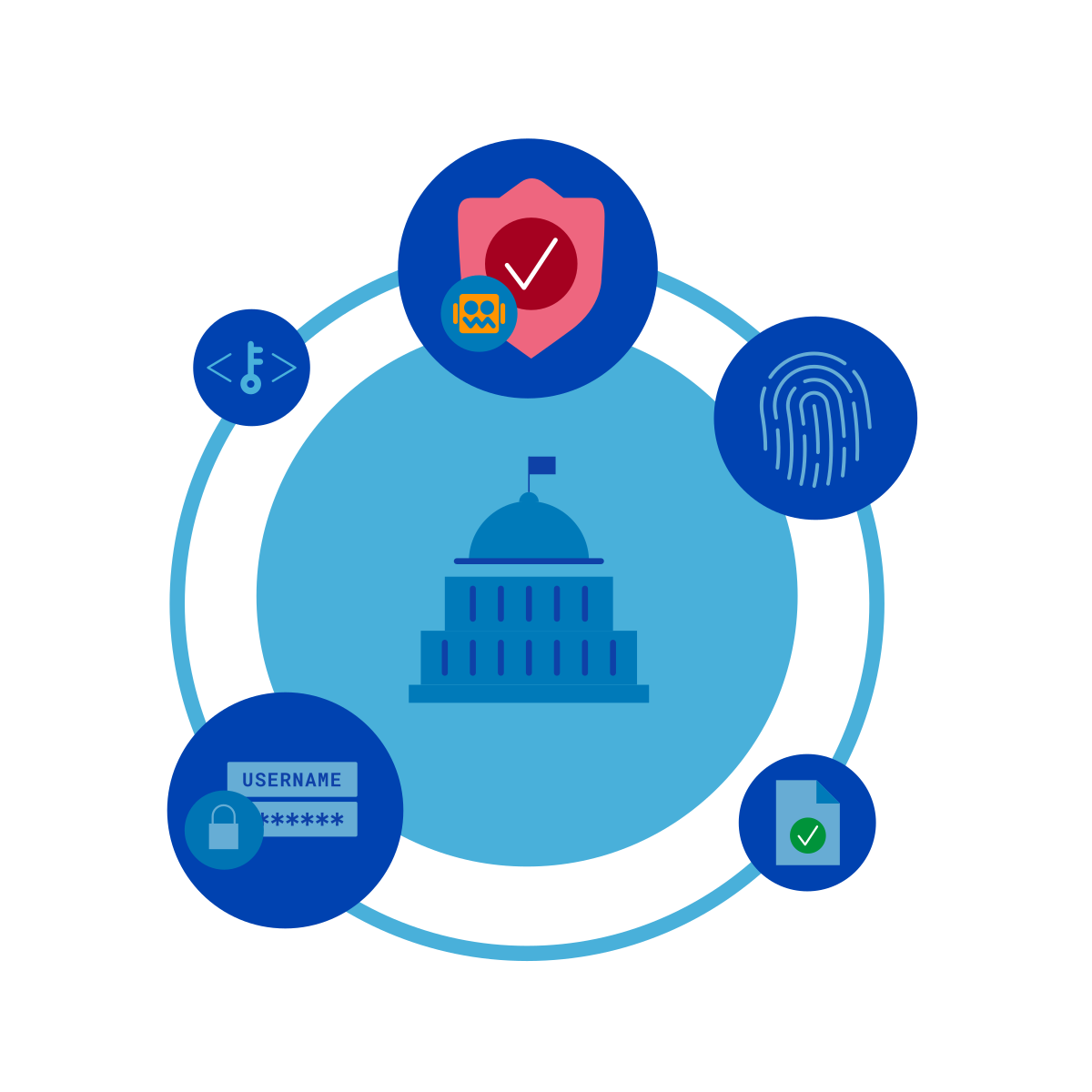
In a zero trust system, APIs are governed by strict access controls based on least privilege. For example, an API call from one government department attempting to retrieve data from another system must pass through multiple layers of authentication, validating not only the user or device making the query but also the context of the request, such as its origin and intended purpose. This eliminates the risk of unauthorized API usage—a significant weakness in traditional systems. Additionally, API traffic is encrypted to prevent man-in-the-middle attacks.
Web application security is similarly improved with zero trust enforcement. Each user interaction must be continuously authenticated, ensuring that only verified users gain access to secure systems. AI technologies play a critical role, constantly analyzing user behavior to detect anomalies such as unusual file requests, large data transfers, or login attempts at odd hours. These insights enable real-time blocking of fraudulent behavior, safeguarding sensitive applications in environments where attacks evolve rapidly.
Use case 2
Leveraging AI and automation for zero trust in government
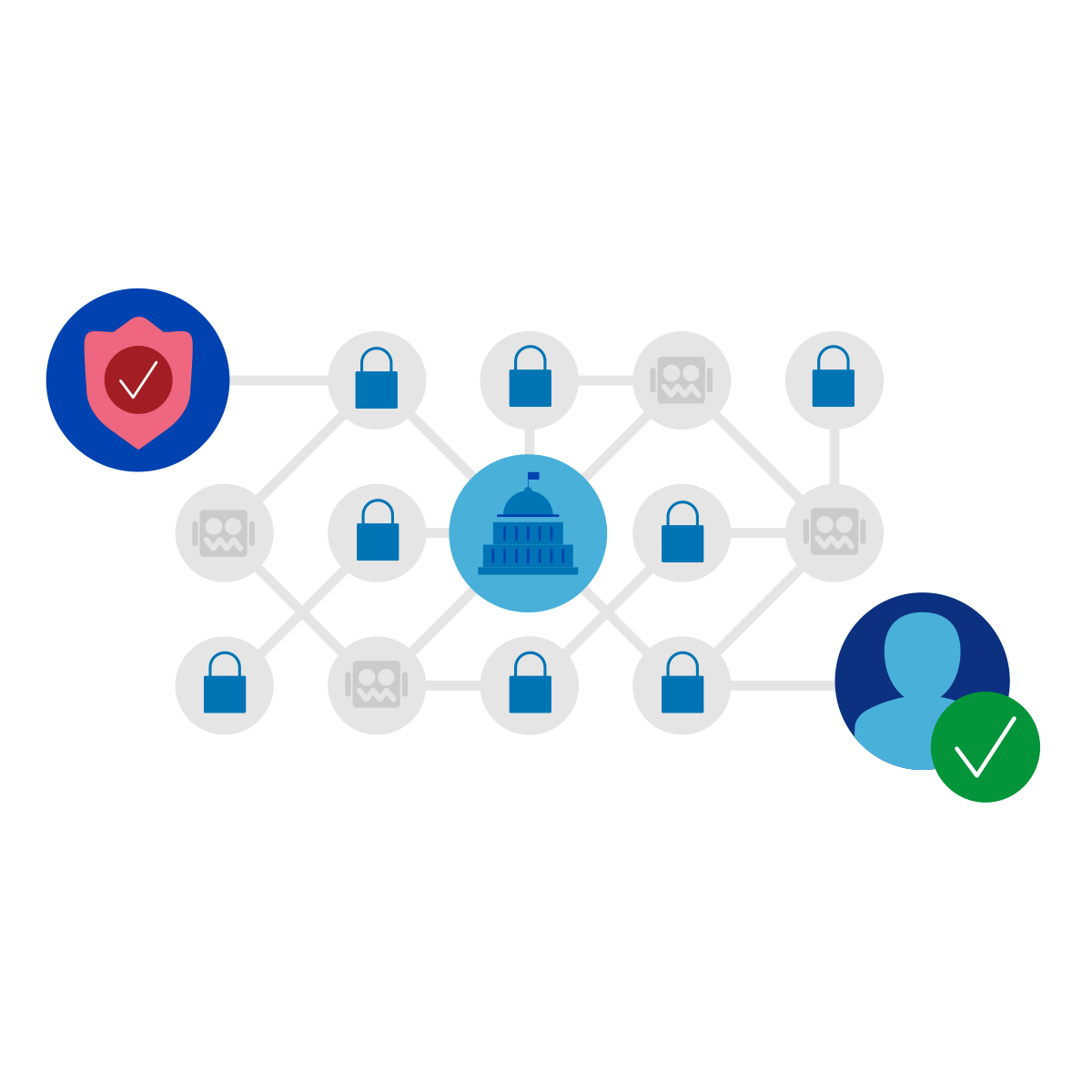
AI is a cornerstone in modernizing zero trust adoption and addressing challenges like API and bot security. Traditional security operations are labor intensive; responding to API misuse or bot attacks requires resources beyond the capabilities of overstretched IT teams. AI-driven automation resolves these bottlenecks and ensures the scalability of a zero trust framework across complex government networks.
AI strengthens zero trust by enabling adaptive risk assessment across all access points. For instance, if a government employee working from home attempts to access critical databases using unrecognized credentials or a previously unused device, AI can automatically detect the anomaly and prevent access. Moreover, AI systems continuously monitor API traffic for unusual activity, such as sudden spikes in usage or abnormal query patterns, and immediately flag potentially malicious interactions.
Adaptive bot mitigation solutions, powered by AI, can also distinguish between legitimate automated processes and malicious bots. For instance, web application firewalls integrated into zero trust environments can leverage AI to differentiate between a government-approved service bot accessing datasets and a credential-stuffing bot executing brute force attacks. This distinction is critical for maintaining service continuity while defending against automated threats.
Conclusion
Building a sustainable zero trust future
The adoption of zero trust is not without its challenges. Government systems must overcome legacy infrastructure, budget constraints, and personnel training gaps to fully integrate ZTA principles. Nonetheless, the benefits of a zero trust approach—including advanced web application and API security as well as robust bot defense—demonstrate the model’s necessity in protecting modern government ecosystems.
Public trust in government institutions largely depends on their ability to safeguard citizen data and ensure that vital services remain functional without disruption. Breaches involving government web applications or APIs can do untold damage, undermining citizen confidence while imposing significant financial burdens. With ZTA, governments position themselves to meet these responsibilities effectively by implementing cutting-edge security solutions.
Looking ahead, the combination of ZTA and AI will form the bedrock of government cybersecurity. Advances in AI technology will allow governments to automate larger portions of their workflows—improving real-time response rates to emerging threats while standardizing API security, web application defenses, and bot mitigation. This synergistic approach between zero trust principles and AI capabilities will ensure that governments remain resilient and agile against adversaries in an increasingly digital and interconnected world.
Learn more about how Zero Trust Architecture protects government agencies.