Networking for Kubernetes
Standardize Kubernetes networking, support AI inference workloads, and scale securely without operational overhead.
Deliver, secure, and scale applications, APIs, and AI workloads on Kubernetes
Kubernetes solves core operational challenges, but it does not control how traffic behaves. As organizations manage multiple clusters, tenants, and teams, this control can lead to fragmented tooling, inconsistent security, limited end-to-end visibility, and systems that are harder to operate. The F5 Application Delivery and Security Platform (ADSP) extends enterprise-grade solutions for networking, security, and observability into modern Kubernetes environments and supports AI inference workloads.
Standardize Kubernetes application delivery
Standardize across environments on a proven, enterprise-grade platform trusted by Platform and DevOps teams.
Extend ADC investments to Kubernetes
Bridge traditional ADC environments with Kubernetes to preserve investments while enabling modern application delivery.
Ensure AI-readiness
Power AI workloads with AI-optimized application delivery on Kubernetes, the leading platform for AI apps.
Govern at scale
Apply consistent traffic management and security policies to achieve end-to-end visibility across clusters, tenants, teams, and environments.
Reference architecture
The following set of reference architecture diagrams are designed to help you understand application delivery in Kubernetes.
Networking in Kubernetes
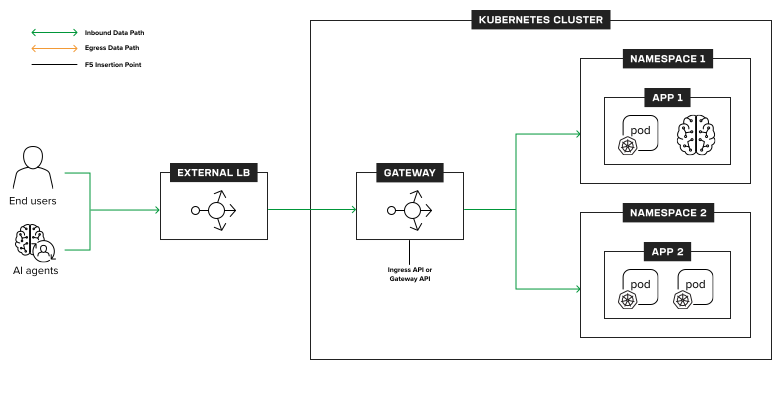
Production-grade Networking for Kubernetes
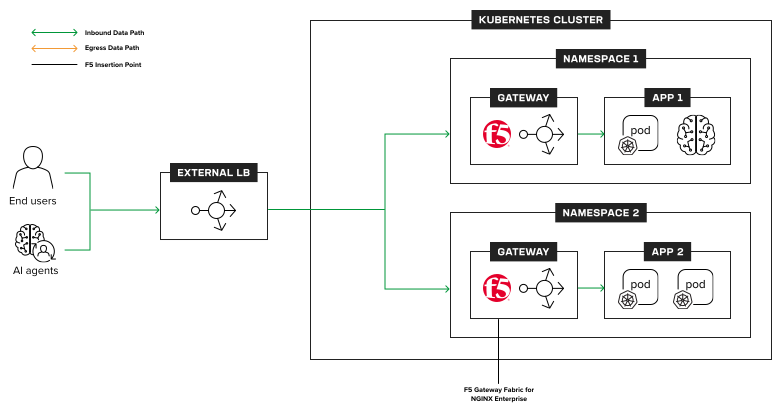
Enterprise-grade Networking for Kubernetes
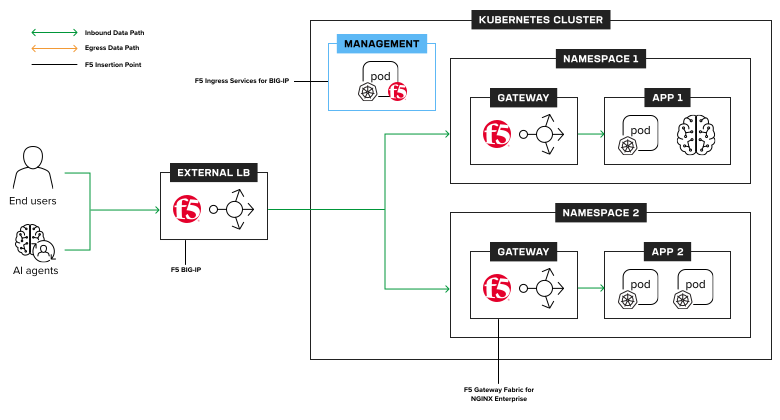
Strategic Networking for Kubernetes
Explore Kubernetes networking use cases
Ingress for Kubernetes
F5 NGINX Ingress Controller
Proven, trusted, production-ready ingress solution.
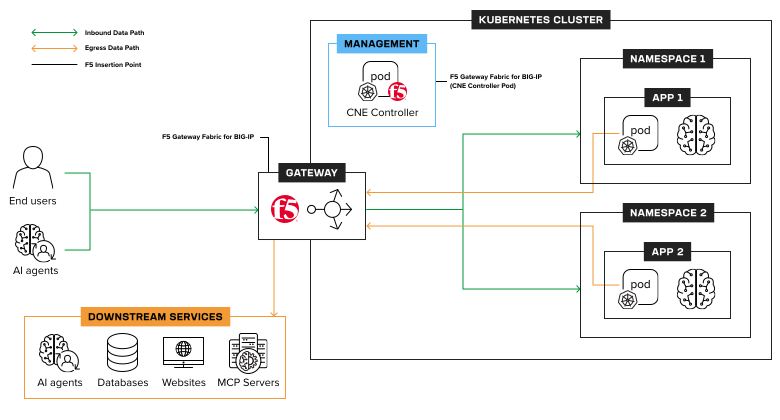
F5 BIG-IP Next for Kubernetes
Scalable, multi-tenant ingress and egress control for Kubernetes clusters.
F5 NGINXaaS for Azure
Supports consistent app delivery across Azure-hosted Kubernetes environments.
F5 BIG-IP Container Ingress Services
Extend BIG-IP traffic management and security into Kubernetes.
F5 WAF for NGINX
Enforce and scale app and API security across distributed architectures and hybrid environments.
F5 NGINXaaS for Google Cloud
Supports consistent app delivery across Google Cloud Kubernetes environments.
Gateway API
F5 NGINX Gateway Fabric
Production-grade Gateway API with support for model-aware routing.
F5 WAF for NGINX
Secure modern apps and APIs running on F5 NGINX with Kubernetes-ready WAF
AI factory load balancing
F5 BIG-IP Next for Kubernetes
Scalable, multi-tenant ingress and egress control for Kubernetes clusters.
F5 NGINX Gateway Fabric
Production-grade Gateway API with support for model-aware routing.
Multi-cluster and multi-tenancy
F5 BIG-IP Container Ingress Services
Extend BIG-IP traffic management and security into Kubernetes.
F5 BIG-IP Next for Kubernetes
Scalable, multi-tenant ingress and egress control for Kubernetes clusters.
F5 NGINXaaS for Azure
Supports consistent app delivery across Azure-hosted Kubernetes environments.
F5 NGINX Ingress Controller
Proven, trusted, production-ready Ingress solution
F5 NGINX Gateway Fabric
Production-grade Gateway API with support for model-aware routing.
F5 NGINXaaS for Google Cloud
Supports consistent app delivery across Google Cloud Kubernetes environments.
Observability for Kubernetes
F5 NGINX Gateway Fabric
Production-grade Gateway API with support for model-aware routing.
F5 NGINX Ingress Controller
Ensure consistent protection across distributed apps and environments with SaaS WAF
F5 BIG-IP eBPF Observability
Extends BIG-IP Cloud-Native Edition with real-time, kernel-level visibility into Kubernetes traffic without sidecars or app-level instrumentation.
F5 BIG-IP Container Ingress Services
Extend BIG-IP traffic management and security into Kubernetes.
Resources
Articles and eBooks
Recent news
Videos
Frequently asked questions
Kubernetes is an open-source container scheduler and orchestration platform that automates the deployment, scaling, networking, and lifecycle management of containerized applications. It provides abstractions such as pods, services, and ingress to decouple applications from underlying infrastructure, enabling portability across on-prem, cloud, and edge environments. Kubernetes is widely used to run microservices, APIs, and increasingly AI/ML workloads due to its scalability, resilience, and ecosystem support. The Kubernetes project is hosted by the Cloud-Native Computing Foundation (CNCF), a subsidiary of the non-profit Linux Foundation. In addition, there are many different software and SaaS vendor distributions of Kubernetes available.
Cost-effective Kubernetes starts with controlling operational overhead. A primary operational focus should be on standardizing networking, traffic management, and security rather than layering point tools per cluster or cloud. Organizations reduce operational cost by reusing a consistent ingress and Gateway API architecture, templating deployments, and improving utilization through intelligent load balancing and observability. Performance is preserved by using production-grade networking that supports high throughput, low latency, and automation via Kubernetes-native APIs and GitOps workflows.
F5 optimizes Kubernetes networking for AI/ML by providing intelligent traffic management that goes beyond basic round-robin load balancing. F5 supports model-aware routing, high-throughput L3–L7 traffic handling, and deterministic performance required for GPU-backed inference and training workloads.
As organizations expand their use of Kubernetes, it can be easy to create cluster sprawl and Kubernetes cloud service sprawl. This typically creates fragmentation across networking, security, and observability. Different ingress controllers, cloud load balancers, and policy models lead to configuration drift, inconsistent security enforcement, and limited end-to-end visibility. Operational complexity increases as teams manage multiple control planes and toolchains. Without a properly designed connectivity layer, scaling Kubernetes across clusters and clouds results in higher cost, slower troubleshooting, and reduced reliability.
The easiest way to run Kubernetes at the edge is to use a lightweight, consistent Kubernetes distribution combined with centralized networking and security control. Edge environments require predictable performance, components that are lightweight, minimal operational overhead, and support for intermittent connectivity. By standardizing ingress, traffic routing, and security policies across core, cloud, and edge, teams can deploy Kubernetes at scale while maintaining visibility, isolation, and automation without relying on cloud-specific services.