Enterprises deploying AI applications and agents need agility to keep security aligned with evolving use cases, policies, and regulations. With F5 AI Guardrails, organizations already gain powerful defensive guardrails that block threats, prevent data leaks, and enforce security policies in real time. Now, with Custom Scanner Versioning, these controls are more flexible, testable, and adaptable than ever.
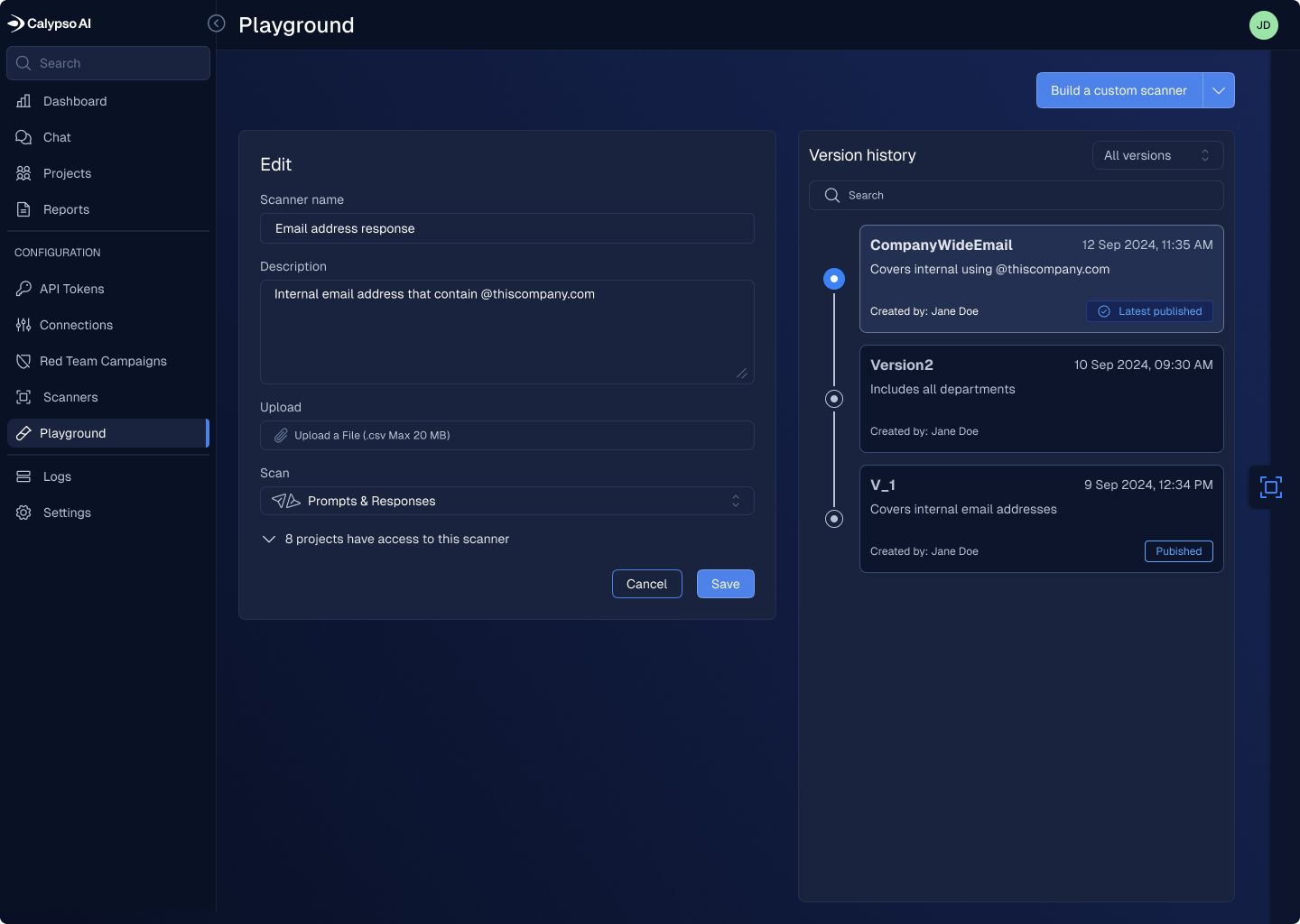
What Custom Scanner Versioning Is and How It Works
Custom Scanner Versioning is a new feature in AI Guardrails that gives security teams full lifecycle control of their AI scanners. It allows you to:
- Create unlimited versions of the same scanner, using either custom or automatically incremented names.
- Test multiple versions simultaneously to compare detection performance and coverage.
- Publish and roll back versions without disrupting live projects.
- Enforce version control at the project level or allow projects to run different versions of the same scanner.
- Filter version history to quickly view published vs. unpublished versions and see which projects can access each version.
With versioning, security teams can continuously improve detection accuracy and deploy updates confidently, knowing production applications remain protected.
Why Versioning Matters
Custom Scanner Versioning gives enterprises greater agility and precision in their AI security operations. By enabling easy iteration, side-by-side testing, and controlled deployment of scanner updates, security teams can continuously strengthen their defenses as new detection logic is developed. This flexibility allows teams to align scanner versions with project-specific needs, ensuring that every application receives the most appropriate level of protection. At the same time, the structured approach to testing and improvement optimizes detection performance, resulting in a more adaptive, resilient, and enterprise-ready AI defense tool that keeps security postures ahead of evolving threats.
Use Cases
Custom Scanner Versioning empowers enterprises to strengthen their AI security posture in ways that weren’t possible before.
Rapid Response to Emerging Threats
When a new adversarial prompt or jailbreak technique surfaces, security teams can immediately develop a new scanner version to detect it. With versioning, that scanner can be tested in parallel against the current production version, compared for accuracy, and published the moment it’s ready—without introducing downtime or operational risk. This transforms AI security from reactive to adaptive, giving teams the confidence to meet new threats as they emerge.
Regulatory and Policy Changes
Another major use case is adapting to regulatory and policy changes. Enterprises today face a constantly shifting compliance landscape, from data privacy regulations to emerging AI-specific rules like the EU AI Act. Custom Scanner Versioning allows organizations to roll out new detection logic or policy-aligned scanners quickly and methodically. Teams can deploy updated versions to select projects or environments, validate performance, and then scale them across the enterprise, enabling compliance without slowing down innovation.
Environment-Specific Customization
Finally, environment-specific customization is critical for large organizations operating across multiple teams, regions, or application types. Different business units may have unique risk profiles or regulatory obligations. Custom Scanner Versioning allows each environment to run the scanner version that best aligns with its needs, while maintaining centralized visibility and control. This means security leaders can empower teams to innovate locally without compromising global governance.
Advancing Enterprise AI Defense with Greater Agility
Custom Scanner Versioning elevates AI Guardrails from by giving security teams greater precision and flexibility in how they manage and evolve their AI defensive controls. With the ability to test, version, and deploy new scanners seamlessly, enterprises can refine detection logic, respond to emerging threats, and adapt to evolving compliance requirements—all without disrupting production workflows.
This feature strengthens an already dynamic AI security solution, empowering enterprises to stay proactive, agile, and resilient in the face of an ever-changing AI threat landscape.
About the Author

Related Blog Posts
Cloud-native modernization for the AI and 5G/6G era
See why 5G/6G, Kubernetes maturity, and AI are accelerating cloud-native modernization, and how F5 BIG-IP Cloud-Native Edition improves efficiency.
Who can you trust in the age of AI agents?
New features for F5 Distributed Cloud Bot Defense enable organizations to distinguish between trusted and fraudulent AI traffic.
Securing F5 NGINX in the age of AI
How F5 is applying AI-driven security practices across the F5 NGINX portfolio to help deliver safer, more resilient software.
From dashboard fatigue to operational excellence: Why XOps needs F5 Insight for ADSP
Learn how F5 Insight for ADSP lays the visibility foundation for XOps—turning fragmented signals across applications and infrastructure into actionable intelligence.

Govern your AI present and anticipate your AI future
Learn from our field CISO, Chuck Herrin, how to prepare for the new challenge of securing AI models and agents.

F5 recognized as one of the Emerging Visionaries in the Emerging Market Quadrant of the 2025 Gartner® Innovation Guide for Generative AI Engineering
We’re excited to share that F5 has been recognized in 2025 Gartner Emerging Market Quadrant(eMQ) for Generative AI Engineering.