While GPU clusters and AI factories dominate headlines, core business operations depend on less visible object storage pipelines. Database archives and backups must run reliably. If these pipelines stall, applications lose access to critical data and business processes stop immediately. For CIOs, storage bottlenecks are not infrastructure details; they are business continuity threats. These pipelines support compliance and disaster recovery.
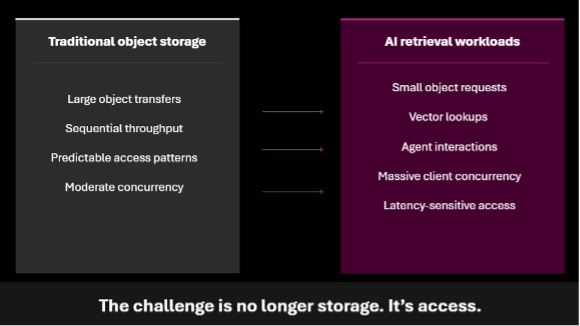
AI data delivery amplifies this operational pressure. Large language models and retrieval-augmented generation (RAG) systems demand fast and reliable data access. Consequently, the core challenge has shifted from how much data you can store to how quickly and securely you can move it between platforms and models.
The object storage pipelines nobody thinks about until they fail
Enterprise object storage serves distinct workloads. While some support high-profile AI projects, others run day-to-day operations. These operational pipelines rarely get executive attention, yet they determine whether you can recover from an outage and achieve service level objectives.
These pipelines span four core operational accountabilities. If any of these pipelines fail, business operations halt:
- Business continuity: Database write-ahead logs (WAL) and backups. Traditionally, WALs were written to local solid-state drives (SSDs). Today, modern cloud databases can write WALs to S3 compatible storage. Together, these workflows allow teams to restore core systems immediately after failures.
- Security operations: SIEM logs and forensic evidence. Incident response and threat detection teams rely on this data to investigate active attacks.
- Compliance and governance: Regulatory archives and immutable vaults. For these workloads, data availability is a strict legal mandate rather than an operational preference.
- Enterprise data platforms: Data lakes and RAG knowledge bases. These pipelines feed the applications and machine learning engines that drive your products.
None of these backend workloads are glamorous. However, they are the exact pipes that determine whether your company remains compliant and prepared during a crisis.
The hidden risks live in the data path
Although traditionally managed as back-end infrastructure, modern object storage is actually an active network service. Whether you use Amazon S3 or private object storage systems, applications query storage over HTTP/S using REST APIs. This architectural reality means that object storage pipelines inherit the exact same performance and security liabilities that threaten modern web applications and web services.
Availability risks occur when traffic spikes overwhelm network interfaces or storage controllers fail. Performance bottlenecks are equally disruptive. Latency spikes and network congestion degrade critical backend workflows even when the underlying storage disks are healthy. For example, a delay in a database archive stream can stop write-ahead logs, which stalls database performance and triggers a sudden outage. The real risk isn’t in the first failure, but in how far it spreads. Without isolation in the data path, a problem in one pipeline turns into systemwide outage.
Using web APIs for storage access expands your enterprise attack surface. These endpoints are vulnerable to DDoS attacks. With security teams and developers relying on object storage to feed real-time analytics and AI models, a security compromise at the storage API layer has severe operational consequences.
Managing raw capacity is no longer the primary hurdle. The critical engineering challenge is maintaining control over data movement as it flows between applications and repositories. Securing and optimizing this transit path is now just as important as maintaining the underlying storage platform.
Bringing engineering discipline to object storage data pipelines
Modernizing data infrastructure for analytics and AI means you can no longer treat object storage as a passive repository. You must manage the data path itself. Just as you use an application delivery controller (ADC) to secure user-facing web apps, you need equivalent control points for the backend storage pipelines that power your AI data delivery. By placing F5 BIG-IP in front of your storage buckets, you turn a passive, vulnerable API endpoint into a highly available, secure, and accelerated data delivery pipeline.
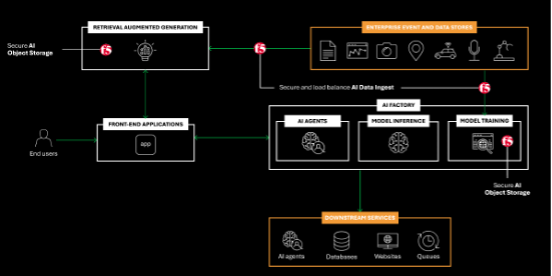
Because modern object storage is accessed over the network via HTTP/S APIs, it behaves exactly like a web application. This means an ADC like F5 BIG-IP is the native tool to manage it. As a control layer between applications and data stores, BIG-IP secures and stabilizes data movement.
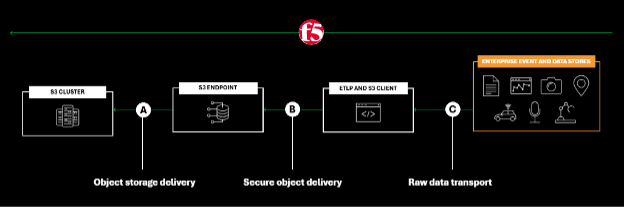
This architecture delivers massive operational advantages without requiring you to refactor applications or redesign storage platforms:
- Zero storage refactoring: Upgrading storage to add security and routing is a costly and multi-year project. Placing BIG-IP in front of storage injects enterprise-grade routing and logging immediately, requiring zero changes to underlying storage or application code.
- Accelerated performance via network offloading: Storage systems are built to read and write data, not manage network overhead. BIG-IP offloads processor-intensive tasks like SSL/TLS decryption. By shifting these network-heavy duties away from the storage array, your storage CPU can focus on I/O and speed up AI query response times.
- Active security shielding: Traditional storage security is passive, relying on access keys that cannot detect malicious queries. BIG-IP acts as an active shield, inspecting incoming storage API traffic with a web application firewall (WAF) to block SQL injections and DDoS attacks before those threats reach the storage layer.
To ensure high availability, BIG-IP monitors endpoint health and routes traffic around offline nodes. It also dynamically steers queries across data centers. This contains the blast radius of component failures and keeps your service levels predictable as data volumes and AI model demands scale.
Reliable data movement is now a business requirement
By placing an ADC-driven control layer between applications and storage, you establish a resilient and controllable data path. This architectural choice applies the same rigorous engineering discipline to object storage pipelines that you already use for your primary customer-facing applications and APIs.
The most critical enterprise data pipelines are often the least visible. Whether you run disaster recovery or maintain compliance, operational stability depends entirely on how reliably data moves across your network.
As performance demands mount, you can no longer evaluate object storage solely by capacity and scale. For business leaders, the goal is not simply storing more data, but also ensuring the data powering your critical operations and AI initiatives remains continuously available and secure. Storing data is only the first step; you must actively engineer the data path itself for resilience, control, and containment.
F5’s focus on AI doesn’t stop here—explore how F5 secures and delivers AI apps everywhere.
About the Author

Related Blog Posts
Beyond visibility: Six more questions F5 Insight for ADSP helps you answer and act on
Map workloads, easily upgrade software across your F5 BIG-IP fleet safely, and assess post-quantum cryptography readiness with F5 Insight for ADSP v2.0
How are customers using the F5 AI Security Platform?
See why customers are turning to the F5 AI Security Platform for strong, out-of-the-box protection plus the customization they need to meet their specific security needs.
Who can you trust in the age of AI agents?
New features for F5 Distributed Cloud Bot Defense enable organizations to distinguish between trusted and fraudulent AI traffic.

From dashboard fatigue to operational excellence: Why XOps needs F5 Insight for ADSP
Learn how F5 Insight for ADSP lays the visibility foundation for XOps—turning fragmented signals across applications and infrastructure into actionable intelligence.

Govern your AI present and anticipate your AI future
Learn from our field CISO, Chuck Herrin, how to prepare for the new challenge of securing AI models and agents.

F5 recognized as one of the Emerging Visionaries in the Emerging Market Quadrant of the 2025 Gartner® Innovation Guide for Generative AI Engineering
We’re excited to share that F5 has been recognized in 2025 Gartner Emerging Market Quadrant(eMQ) for Generative AI Engineering.