Retailers spend months preparing for the traffic surge that arrives with Black Friday. And you would think attackers do the same, steadily increasing automated activity as the shopping event approaches. But three years of retail telemetry tell a different story.
An F5 analysis of traffic from retailers protected by F5 Distributed Cloud Bot Defense across the 2023, 2024, and 2025 Black Friday seasons found that automation did not consistently build toward Black Friday, nor did the day itself experience the highest concentration of automated traffic. Instead, automation followed a more nuanced pattern, targeting specific customer journeys and business processes long before shoppers filled their carts.
For security and digital commerce leaders, the takeaway is simple: defending Black Friday starts well before Black Friday.
The busiest day isn’t always Black Friday
One of the most consistent findings across all three seasons was that the automation rate actually dropped on Black Friday itself. Automation represented 11.6% of transactions on Black Friday in 2023, 14.8% in 2024, and 14.6% in 2025, each below the average for November in the corresponding year.
That does not mean attackers stopped targeting retailers.
In 2023 and 2024, automated transaction volume increased on Black Friday. Human shopping activity simply grew much faster, making malicious traffic a smaller percentage of the total. In 2025, automated volume decreased on the day itself, but the broader pattern held: Black Friday was not when retailers experienced the highest concentration of automation.
Perhaps most surprisingly, the peak day for automated activity varied significantly by year. The busiest automated traffic occurred 23 days before Black Friday in 2023, one day after Black Friday in 2024, and 38 days before Black Friday in 2025.
For executives planning seasonal security operations, this has important implications. If defensive measures are scaled only for Thanksgiving week, organizations may miss the periods when attackers are actually most active.
Attackers target business processes, not shopping dates
While timing varied from season to season, something else remained remarkably consistent: automation focused on specific retail workflows.
The most targeted flows reflected the economics of each retail segment. Fashion retailers saw the most automation in product search activity, often associated with scraping product catalogs, pricing data, and availability information. General ecommerce retailers saw the highest rates in add-to-cart workflows, a common indicator of inventory hoarding and other forms of purchase manipulation. Quick-service restaurant (QSR) brands saw persistent activity aimed at gift card and account-related functions, consistent with loyalty program abuse and gift card fraud.
These findings suggest that attackers are not primarily optimizing around calendar events, but around opportunities.
Whether the objective is scraping product intelligence, abusing promotions through fake account creation, testing stolen credentials, or draining stored value, attackers repeatedly gravitate toward the digital functions that generate business value.
This also explains why a retailer's site design matters. Organizations that expose rich product information, loyalty programs, promotional offers, or account-based features create different incentives for attackers, leading to different automation profiles.
The lesson is clear: security teams should prioritize protection around high-value customer journeys rather than assuming all traffic carries equal risk.
Web remains the primary battleground, for now
Across all three years, web applications remained the dominant target for automation.
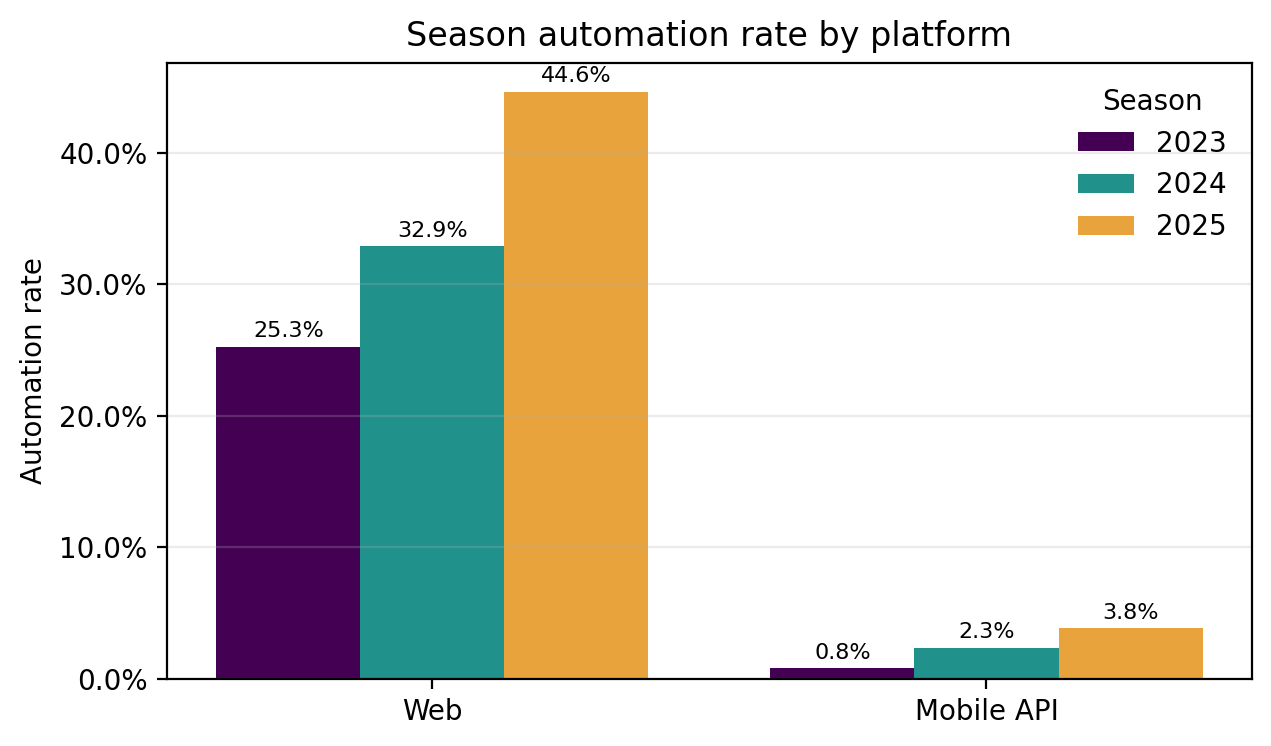
Web automation rates increased from 25.3% in 2023 to 44.6% in 2025. By comparison, mobile API automation rose from 0.8% to 3.8% during the same period. Although mobile API automation grew faster as a percentage, web traffic remained far more heavily targeted, with web transactions roughly 12 times more likely than mobile API transactions to be automated in 2025.
This finding should not be interpreted as evidence that APIs are inherently safer. Previous F5 research has shown that poorly protected APIs often become the preferred attack surface. Rather, these results reflect retailers that maintained relatively consistent protection across both channels.
For organizations investing in digital commerce, the takeaway is not to choose between web and API security. It is to ensure coverage is applied consistently across both environments so attackers cannot exploit weaker channels.
Sophisticated automation is becoming more common
Another important finding is that automated attacks are not evolving uniformly. The sophistication of automation varied considerably by retail segment and platform. Some areas showed dramatic movement toward highly advanced automation, while others remained dominated by relatively basic techniques. The strongest example came from ecommerce web traffic, where highly sophisticated automation increased from 5.5% in 2023 to 97% in 2025.
At the same time, other segments moved in the opposite direction, demonstrating that there is no universal trend toward more advanced bots across the industry.
This underscores the need for adaptive defenses that can distinguish automated behavior across a wide spectrum of sophistication levels, from simple scripted attacks to automation specifically designed to imitate legitimate users.
What retailers should expect this holiday season
Three years of data point to several practical expectations for the coming holiday season:
- Automation is likely to remain elevated throughout the weeks leading into Black Friday, rather than peaking exclusively on the shopping day itself.
- Web applications will remain the primary focus for automated attacks when web and mobile channels receive similar protection.
- Fashion retailers should expect continued pressure on product search functions, ecommerce retailers on add-to-cart and account creation workflows, and QSR brands on account and gift card-related activity.
- Both simple and highly sophisticated automation will continue to coexist, requiring layered detection and mitigation strategies.
The most important lesson, however, is what the data did not show. Across three seasons, there was no evidence that automation consistently climbs as Black Friday approaches or that a single date becomes the predictable focal point for attackers.
So what practical steps should retailers take? First, encourage your security team to inventory key customer journeys and business processes to identify where they are most exposed to unwanted automation. Second, review bot detection and mitigation coverage across those workflows, including web and API channels. And third, ensure monitoring and protections are in place throughout the shopping season, rather than scaling up only around Black Friday.
Rather than planning around a specific day, the more durable strategy is to protect the business processes attackers repeatedly target: product discovery, account access, promotion abuse, gift card systems, and checkout-related workflows. Those attack surfaces are active long before Black Friday arrives, and they remain attractive long after it ends.
To learn more, read the full F5 Labs report.
Also, explore how F5 Distributed Cloud Bot Defense can help identify and mitigate malicious automation while preserving seamless experiences for legitimate customers
About the Author

Related Blog Posts

The Black Friday automation trend everyone gets wrong
Three years of F5 retail data reveal that bot attacks peak before Black Friday, targeting high-value customer journeys rather than shopping dates.

Why most enterprises haven’t reached Kubernetes maturity
F5 research shows that only 38% of enterprises running Kubernetes in production reach enterprise-grade maturity. Here’s what holds the rest back and where to start.

How CISOs can measure AI security risk
Learn how CASI, ARS, and F5 Labs threat intelligence help CISOs measure AI security risk across the full AI lifecycle.

Three forces reshaping security leadership: Distributed AI inference, threat evolution, and hybrid multicloud
See the latest AI trends rapidly altering the security landscape.
F5 Report 2026: AI inferencing has arrived, complicating an already complex IT landscape
Newly released F5 research shows the majority of enterprises are taking AI inference in-house, with the average company now using seven AI models.

Lessons we are learning from our security incident
F5 CISO Christopher Burger answers common questions from customers surrounding the recently disclosed security incident.