What is AI data security?
AI data security protects the data, models, and interfaces that AI systems use from misuse, leakage, and attack.
AI data security protects the data, models, and interfaces that AI systems use from misuse, leakage, and attack.
AI data security involves the practices, controls, and innovative technologies that work together to safeguard data, models, and AI APIs from any unauthorized access, misuse, manipulation, or leaks throughout the entire AI lifecycle. It expands on traditional data security by focusing on model safety, inference security, and the protection of AI decision-making processes.
AI data security vs. traditional data security
Traditional data security tools focus on safeguarding assets, storage environments, and methods of data transmission. Though they work well to control data access, block some threats, and keep unauthorized individuals from reading data, they can’t adequately secure AI systems.
AI systems are dynamic and probabilistic. Identical prompts for a generative AI engine can produce different outputs depending on prompt context and intent. Traditional tools can’t evaluate that context or intent, and as a result, they can’t spot threats hidden in prompts, detect corrupted training data, or uncover attempts to manipulate an AI system’s internal decision-making.
AI data security analyzes context and intent to find potentially malicious actions. These tools place guardrails around AI inputs and outputs to sanitize data ingestion, scrutinize AI system prompts, and redact outputs when necessary. They can also implement boundaries for agents to prevent unintended behaviors.
Why AI data security matters now
AI systems and infrastructure introduce new security challenges beyond traditional data protection. Organizations must safeguard models, API interfaces, and inputs/outputs that could leak private info or deceive the system. Taking protective measures enhances overall security.
Generative AI, LLM applications, and autonomous systems depend on large data sets and continuous data flow, creating vulnerabilities such as data poisoning, model theft, prompt injection, and the exposure of sensitive information. As AI is embedded in customer apps, workflows, and decision-making, AI data security is vital to high-stakes business goals such as trust, continuity, and compliance.
How do AI systems introduce new risks? Here are a few common examples:
- AI systems can leak sensitive information through model outputs.
- AI APIs introduce new attack surfaces and much higher frequency attack patterns.
- Models can be manipulated via malicious prompts or adversarial inputs.
- Model snapshots (checkpoints), vector representations (embeddings), and training data become sensitive IP requiring protection.
- Inference endpoints must operate under tight constraints on latency, scale, and policy.
Mitigating shadow AI and data exposure
Insider AI risks present significant challenges for protecting data. Employees might inadvertently expose data by using unauthorized AI tools that have no guardrails in place. For example, employees could paste customer details, confidential IP, or source code into an AI system, unaware that this data could be used to train an AI company’s model. Meanwhile, inputting sensitive data into a generative AI engine or AI-powered software development tool could also leave that data exposed to external threats.
AI data security across the lifecycle
AI data security must follow the data and model across every stage of the AI lifecycle. Traditional perimeter-only approaches fail because AI assets move across environments and interact dynamically with users, applications, and other models. Security must be continuous, embedded, and model-aware.
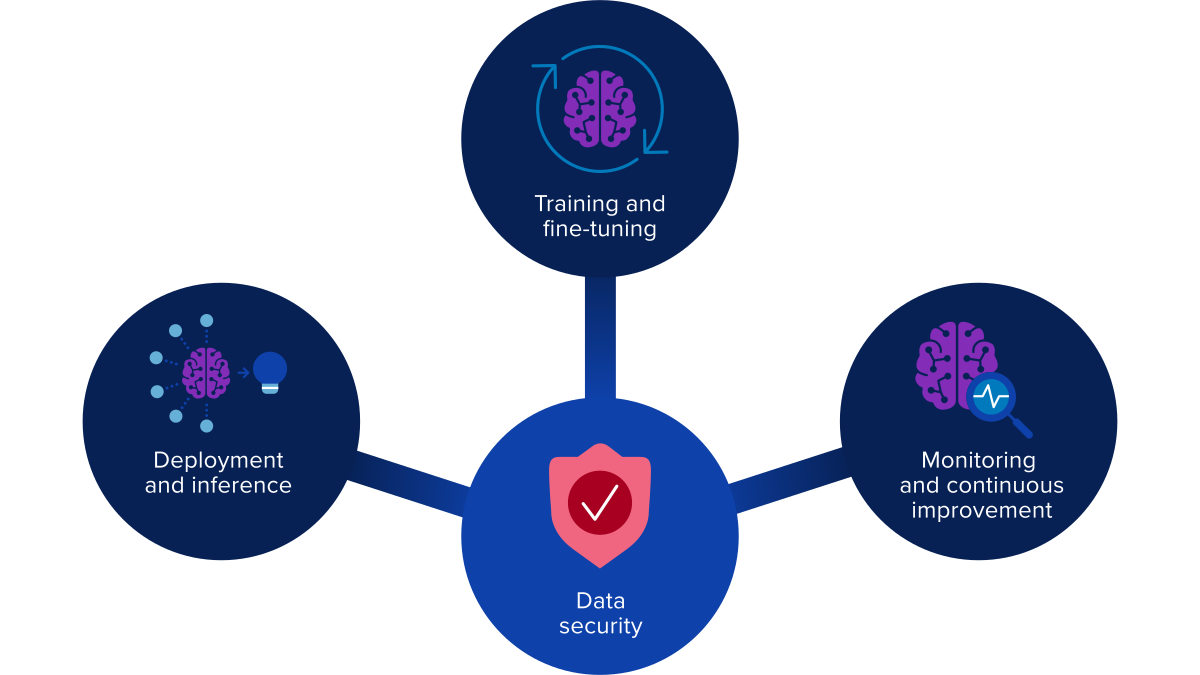
- Data collection and preparation: AI security starts before training. Data ingestion, labeling, and feature engineering risk exposing sensitive information to theft, unauthorized access, and data poisoning, where attackers inject manipulated data to bias or degrade the model. Strong governance, validation, and access controls are crucial before data enters an AI pipeline.
- Training and fine-tuning: Training data, model checkpoints, embeddings, and gradients hold sensitive information. Compromise during training and tuning can cause model tampering, IP loss, exposure of regulated data, and adversarial manipulation, permanently changing model behavior.
- Deployment and inference: Inference APIs are prime targets for prompt injection, output manipulation, model extraction, data harvesting, and overload. Access must be authenticated, tightly controlled, and inputs inspected for adversarial payload behavior.
- Monitoring and continuous improvement: Model drift, bias, harmful behavior, and unauthorized usage need ongoing monitoring, logging, and oversight. Operators must detect anomalies, access patterns, or safety and compliance issues
Why perimeter-only security can’t manage this environment
AI workloads span data lakes, clusters, registries, gateways, edge nodes, and endpoints, so security can't rely on a single perimeter. Protection must follow data and models throughout their lifecycle, applying consistent authentication, inspection, and policies at all interaction points with users, apps, or services.
Core principles/controls for AI data security
Effective AI data security applies a combination of security, privacy, and operational controls:
- Data governance and impact assessments: Validate legality, data quality, lineage, and privacy implications before data is used in AI development.
- Zero trust and least privilege: Enforce authentication and authorization at every boundary, including data repositories, model artifacts, and inference APIs.
- Data minimization and anonymization: Reduce sensitive information exposure and tag data sets with sensitivity labels for downstream enforcement.
- Model-level protections: Secure checkpoints, embeddings, training artifacts, and accelerator environments.
- Runtime inspection of inputs and outputs: Detect prompt injection, malicious payloads, toxic content, or inadvertent leakage.
- Continuous monitoring and human oversight: Required for high-stakes AI decisions and regulated industries.
- API and traffic governance: Ensure only validated requests reach inference endpoints.
While governance decisions are made outside the network, F5 enforces them in practice by ensuring that only approved data sources, identities, and services can access AI systems. F5 Distributed Cloud Services and F5 BIG-IP apply policy-based access control, data classification-aware routing, and APIs to allow lists so that training and inference data flows match the approved governance rules.
Securing AI data in motion and at rest
AI pipelines rely on continuous data movement from ingest to feature stores and inference endpoints. Securing these flows requires:
- Encryption for data in motion and at rest.
- Authentication and authorization for all API access.
- Secure API design with schema validation, rate limiting, and threat detection.
- Web application firewall (WAF), distributed denial-of-service (DDoS) attack, and bot protection as the first enforcement layer.
- Segmented environments to isolate training data, inference endpoints, and model artifacts.
- Traffic inspection to detect anomalies or hidden threats in encrypted channels.
F5 secures AI data pipelines by adding an inline enforcement layer before gateways and model endpoints. Solutions like F5 Distributed Cloud Web App and API Protection (WAAP), F5 Distributed Cloud API Security, F5 BIG-IP Advanced WAF, F5 BIG-IP Access Policy Manager (APM), F5 BIG-IP SSL Orchestrator, and F5 NGINX App Protect manage Transport Layer Security (TLS), authentication, validation, rate limiting, WAF, DDoS attack protection, bot defense, and encrypted traffic inspection, ensuring only verified requests reach AI models. This helps safeguard AI data pipelines against malicious payloads, unauthorized access, unusual activity, and data exposure.
At inference, and across the broader AI environment, F5 combines infrastructure and AI-specific controls to secure how models, applications, agents, and users interact. F5 NGINX Ingress Controller, F5 Distributed Cloud Mesh, and F5 BIG-IP Next Kubernetes can help isolate tenants, segment environments, and enforce traffic and access policies around inference workloads. F5 AI Guardrails adds AI-specific runtime inspection and policy enforcement for prompts, responses, agent actions, and tool use. F5 AI Gateway governs access to models, agents, and tools, while F5 AI Red Team conducts adversarial testing of models, applications, and agents to identify weaknesses. F5 Workforce AI Security provides visibility and governance across sanctioned and unsanctioned AI use.
Advanced privacy controls and data protection
Several advanced tactics can help organizations preserve the privacy and security of sensitive data during model training and real-time inference.
During model training, organizations must ensure that raw training data remains confidential and that models cannot be reverse engineered to reconstruct sensitive data later. This may include:
- Data masking and synthetic data: Trains models using computer-generated data sets that simulate data without using real customer records.
- Math-based (differential) privacy: Injects carefully calibrated mathematical noise into training to reduce the risk that sensitive information about individual records can later be inferred from the model
- Federated learning: Keeps real data secure inside local servers while sending only model parameter updates to a central server.
To protect data during real-time inference, organizations should use tactics that limit the potential exposure of unencrypted information. This includes:
- Real-time data redaction: Automatically scrubs sensitive details from user prompts before they reach the AI system and then restores them locally when returning an answer.
- Hardware vaults: Processes AI queries inside hardware-encrypted chips, preventing unauthorized entities from accessing it.
- Advanced cryptography: Enables AI models to analyze only fully encrypted data and to deliver answers without decrypting the underlying file.
Securing models, inputs, and outputs
AI models introduce unique security requirements, such as model security, output security, and understanding security via context.
Model security involves protecting checkpoints, embeddings, and model weights (learned numerical values) from theft, tampering, or unauthorized replication. Input security with AI firewalling must filter and inspect input prompts and payloads for prompt injection threats, adversarial input, malicious code input and oversized or malformed inputs designed to overwhelm and crash systems.
Output security involves preventing leaks of sensitive data, intellectual property, or harmful content through AI outputs.
Traditional security solutions lack awareness of specific AI threats, and practices such as AI Security Posture Management (AI-SPM) should be employed to continuously monitor configurations, policies, and runtime behavior across multicloud and hybrid environments to identify drift or misconfigurations.
F5 provides layered controls to help secure AI models, inputs, outputs, and the surrounding application and API infrastructure. BIG-IP Advanced WAF, Distributed Cloud WAAP, Distributed Cloud API Security, and NGINX App Protect can sit in front of AI gateways and inference endpoints to authenticate callers, inspect traffic, and enforce application and API security policies around AI workloads. F5 AI Guardrails adds AI-specific runtime inspection and policy enforcement for prompts, responses, agent actions, and tool use; F5 AI Gateway governs access to models, agents, and tools; F5 AI Red Team adversarially tests models, applications, and agents to identify weaknesses; and F5 Workforce AI Security provides visibility and governance across sanctioned and unsanctioned AI use.
AI Guardrails and Workforce AI Security add AI-specific inspection and policy enforcement to help block prompt injection, sensitive data leakage, harmful content, and other risky activity. Workforce AI Security also extends visibility and governance across sanctioned and unsanctioned AI use, helping organizations understand which AI tools are being used, how they are being used, and where sensitive data or policy violations may be occurring.
Operationalizing AI data security
Enterprises must integrate AI security into existing processes:
- DevSecOps and MLOps integration: Involves embedding security gates into training and deployment pipelines. This approach ensures that vulnerabilities, misconfigurations, and risky data flows are identified early, preventing them from reaching production AI systems.
- Clear internal policies: Guide the safe use of both internal and external AI tools. These policies establish guardrails to help minimize accidental data exposure and prevent the misuse of generative or third-party AI services.
- Regulatory alignment: Involves ensuring compliance with the General Data Protection Regulation (GDPR), the Health Insurance Portability and Accountability Act (HIPAA), the California Consumer Privacy Act (CCPA), sector-specific rules, and emerging AI regulations. Enterprises need to regularly track AI data flows and model behavior to meet these regulations, thereby avoiding fines, operational risks, and compliance drift.
- Shared responsibility model: Ensuring AI security involves collaboration among networking, data, application security, and AI platform teams. Successful protection depends on coordinated ownership to prevent any single team from becoming a bottleneck or blind spot in the AI pipeline.
- Employee training: Ensure teams are familiar with safe prompt techniques, data handling, and model use guidelines. Properly trained staff are essential for minimizing human errors, which are a leading cause of AI-related data leaks and misuse.
Final thoughts
AI data security is an essential part of confidently growing AI use throughout an organization. Safeguarding the data, models, and interfaces that drive AI systems involves ongoing controls, smart inspection, and robust governance at every point in the AI journey. By integrating intelligent security and traffic management directly with AI gateways and inference endpoints, F5 helps organizations enforce zero trust, prevent data leaks, block malicious inputs, and ensure smooth, compliant AI operations across hybrid and multicloud environments.
Frequently asked questions
How does AI data security differ from traditional data security?
AI data security differs from traditional data security due to a dynamic approach suited for contextual AI systems. Traditional data security protects static assets, data storage, and data transmission methods. These solutions can’t analyze the context and intent that is key to identifying threats within AI systems. AI data security analyzes that content and intent, placing guardrails around AI inputs and outputs, and implementing boundaries for AI agents.
What is data poisoning, and how can enterprises prevent it during AI training?
Data poisoning is the attempt to alter an AI model’s training data so that the model produces inaccurate or biased results during inference. To prevent poisoning, enterprises should analyze data before training, control access to training data, track changes to that data, and employ solutions to protect training infrastructure and data in transit.
How do inline AI firewalls protect LLMs against prompt injection and data leaks?
Inline AI firewalls protect against prompt injection and data leaks by acting as a reverse proxy, sitting in front of large language models (LLMs). They prevent prompt injection by screening input intent, restricting what the AI system can do, and inspecting responses. Similarly, they protect against data leaks by masking input data, restricting retrieval to authorized files, and inspecting output for sensitive information.
What is an AI bill of materials (AI-BOM) and why is it critical for enterprise security?
An AI-BOM is a list of every element in an AI system. It should include information about not only models and data sets but also dependent relationships, embeddings, prompts, and data retrieval sources. The AI-BOM provides visibility into the AI supply chain, helping organizations find and address potential security vulnerabilities.
How does F5 help secure vector databases and retrieval-augmented generation (RAG) architectures?
F5 secures vector databases and RAG architectures by providing inline protection throughout the AI pipeline using F5 Distributed Cloud. Instead of relying on access controls built into databases or RAG environments, organizations can use F5 to apply security, traffic management, and identity enforcement at the ingress points, API gateways, and network layers surrounding the databases and architectures.
What F5 capabilities support enterprise AI security?
The F5 AI Security Platform brings together AI Guardrails, Workforce AI Security, AI Gateway, and AI Red Team to help organizations govern, test, and protect AI systems.
AI Guardrails helps enforce runtime policies and protect against risks such as prompt injection, sensitive data leakage, harmful content, and unsafe agent actions. Workforce AI Security provides visibility and governance across sanctioned and unsanctioned AI use and can inspect and enforce policy on AI interactions. AI Gateway provides a centralized control point for governing access to models, agents, and tools, while AI Red Team uses adversarial testing to identify vulnerabilities and weaknesses in models, applications, and agents.
For broader protection across applications, APIs, and distributed environments, the F5 Application Delivery and Security Platform (ADSP) provides capabilities including web application and API protection, bot management, DDoS mitigation, and application delivery.
