While every enterprise is racing to adopt AI, almost none have figured out how to govern it. One well-known global technology company blew through its entire 2026 AI budget in four months. Another tried to control its budget by capping employee AI spending at $200 per week. If the most technically sophisticated companies on the planet can't control their AI spending, most enterprises have little chance.
According to McKinsey & Company, 88% of organizations already use AI, yet most AI traffic flows straight to third-party large language models (LLMs) with no cost controls, governance, and audit trail. Token spending is scaling tenfold year-over-year, while personally identifiable information (PII) is being leaked to models enterprises don't own and agents reach MCP tools unrestricted.
To help address these issues, F5 today announced our next-generation F5 AI Gateway: a single control plane that controls, optimizes, and secure every AI interaction across models, agents, tools, APIs, and data, wherever they run.
The governance gap is widening
The current landscape of AI governance is fragmented by design. Some vendors bolt AI features onto broader API management platforms, resulting in less specialized and, less performant offerings that lack purpose-built AI governance. Others deliver slick developer workflows but lack the enterprise trust, support, and longevity that regulated industries demand.
The result is predictable. Enterprises are stitching together bespoke proxies, provider-specific SDKs, standalone guardrails, and separate observability tools, creating fragile pipelines and vendor sprawl, and no unified policy model across models, agents, and tools.
Earlier this year, F5 launched the F5 AI Security Platform to give enterprises unified protection across every layer of their AI estate, from the models and data sources that power AI applications to the APIs and agents that connect them. F5 AI Gateway is purpose-built to close the governance gap, and with this enhanced release, it becomes the runtime enforcement point for the AI Security Platform, turning platform-level policies into real-time decisions on every request.
Three critical functions, one control plane
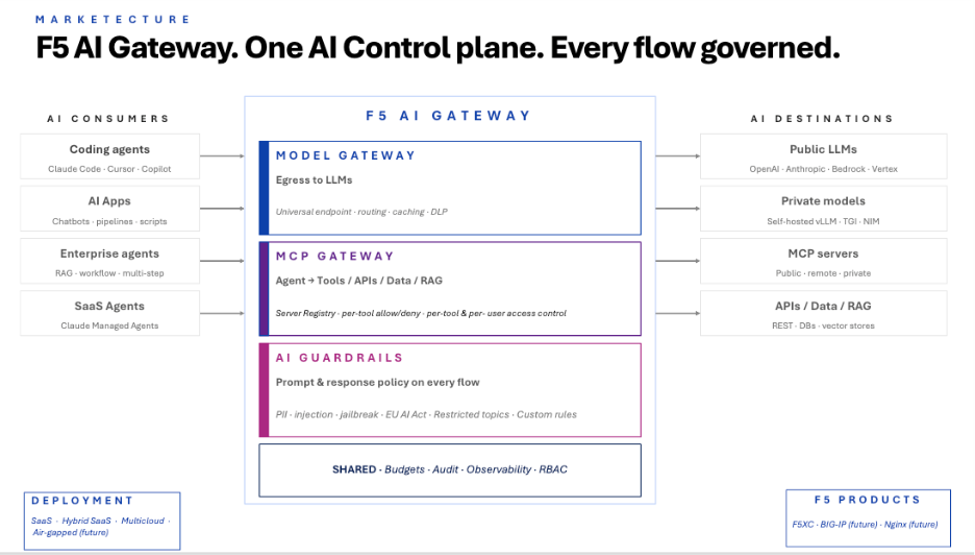
F5 AI Gateway unifies three critical functions under one control plane, one policy model, and one console, eliminating the need to stitch together standalone tools:
Model Gateway manages and optimizes every LLM interaction. A universal endpoint abstracts provider complexity, while smart routing automatically directs requests to the optimal model for the task so premium models aren't burned on trivial workloads. A Model Registry gives platform and development teams a curated catalog of approved models, eliminating guesswork about what's sanctioned thereby accelerating AI innovation.
Semantic and exact caching, provider fallback, and multi-cloud GPU-aware routing deliver measurable results: a 30–60% reduction in token costs within 90 days, with no application changes required. Prompt caching alone reshapes tokenomics. By caching prompts with similar intent and meaning, AI Gateway eliminates redundant inference calls, so organizations pay once for work that used to be billed over and over again.
For FinOps leaders watching AI invoices balloon, that's not a roadmap promise. It's a quantified outcome. And for IT Ops teams that don't have any visibility into AI spending, token metering and real-time dashboards attribute every dollar to a specific user, team, and model, turning cost mystery into cost intelligence.
MCP Gateway governs the new frontier of agentic AI. As agents proliferate, they have full access to MCP servers and tools without any controls or audit trail. MCP Gateway introduces a centralized MCP Server Registry that gives teams a single view of every MCP server across the organization, whether public, remote, or private.
Per-tool allow/deny and access controls ensure agents only reach tools they're explicitly authorized to use, while developers get efficient, high-performance routing to models and tools without wiring up provider-specific SDKs or managing fallback logic themselves. Per-tool budgets and quotas prevent runaway consumption of AI by agents. Without per-tool controls, agent tokenomics are effectively unbounded. A single autonomous loop can consume thousands of dollars in tokens before anyone notices
F5 AI Guardrails enforce 20+ policies on every prompt and response, including the redaction of personally identifiable and personal health information, prompt-injection and jailbreak defense, and custom rules tailored to organizational and regulatory requirements. Fail-closed enforcement blocks unsafe exchanges before they reach models or users. Full audit trails, SOC2/ISO/HIPAA alignment, security information and event management (SIEM) export, and data residency controls make every AI interaction provable, enabling teams to verify compliance, not just promise it.
Shared capabilities like budgets, audit, observability, and role-based access control (RBAC) apply consistently across all three functions. No fragmented controls. No disjointed views.
One platform for app, AI, and API delivery and security
Most solutions in this space address one slice of the AI governance challenge. F5 AI Gateway addresses the full picture and then goes further.
Because AI Gateway is part of the F5 Application Delivery and Security Platform, organizations don't just get AI governance. They get AI governance plus L7 load balancing, bot defense, API security, API gateway, WAF, and DDoS protection in a defense-in-depth architecture that spans Layers 3 and 4 through prompt-and-response security.
And as the enforcement layer of the F5 AI Security Platform, AI Gateway extends that defense in depth into the AI estate itself—so that the data that flows into models is inspected and protected, agent-to-tool interactions are authorized and audited, token consumption is attributed and optimized, and every action is recorded for compliance. No other solution consolidates AI Guardrails, WAF, API security, bot defense, and DDoS protection into a single layered architecture.
For CIOs driving operational efficiencies, this is a single platform for app, AI, and API delivery and security that reduces vendor sprawl and operational complexity in one move. For CFOs watching AI costs spiral, it's provable ROI with quantified outcomes, and finally, a way to make enterprise tokenomics predictable through budget tiers, per-user spend tracking, and threshold alerts that fire before bills become crises.
For CISOs navigating an expanding AI threat surface, it's defense in depth from infrastructure to prompt. For security leaders and AI governance teams, it's the answer to "who can access what" across every model, agent, and tool.
And for developers and platform engineers, the Model Registry, MCP Registry, and per-tool access controls mean fewer tickets, fewer integration headaches, and a governed AI platform they'll actually want to use.
Early momentum across industries
This next-generation F5 AI Gateway is already being adopted by enterprises that can't afford to wait for AI governance to mature on its own.
A major credit card processor in the Middle East is deploying AI Gateway to enforce guardrails against prompt injection, jailbreak attacks, and PII exfiltration, ensuring that customer payment data and personally identifiable information never reach third-party models unprotected. For this customer, fail-closed enforcement and full auditability aren't optional features. They're regulatory imperatives.
One of the largest technology companies in Silicon Valley that spends between $50 million and $100 million annually on LLM inference is turning to AI Gateway to gain visibility into where those tokens are going and bring costs under control. At that scale, tokenomics is a board-level concern: every percentage point of cache-hit improvement or smart-routing optimization translates into millions of dollars reclaimed. With token metering, per-team budget profiles, and smart routing that steers trivial workloads away from premium models, the opportunity to reclaim tens of millions in AI costs is immediate and quantifiable.
A leading financial services organization in Asia-Pacific, early in its enterprise AI journey, is also using AI Gateway to build governance into its foundation from Day One. The organization’s operations and IT teams want cost visibility and budget controls, while its developers need a curated Model Registry and MCP Registry to accelerate innovation with the right tools. By starting with a unified control plane rather than bolting on governance later, the financial services firm is positioning AI as a managed, scalable capability from the outset.
Three industries. Three continents. One common requirement: govern AI before it governs you.
Enterprises are adopting AI faster than they can govern it. F5 AI Gateway gives every team the visibility, control, and confidence to change that equation. Try it now.
Also, be sure to read our press release.
About the Author
.jpeg)
Nirav Shah is the Senior Vice President and Head of Products and Solution Marketing at F5, where he leads the strategic direction for Application Security and AI Security. Before joining F5, he spent eleven years at Fortinet in several leadership positions, most notably heading the AI-Powered SASE, SOC, and Secure Networking solutions. His extensive background also includes significant roles at Cisco Systems, where he spearheaded major initiatives for SD-WAN. With more than two decades of experience in the cybersecurity sector, he has an established record of launching market-defining products and building high-performance teams that align product development with sales and marketing for maximum impact. As a thought leader and USC alumnus, he is a frequent speaker at industry conferences and a regular contributor to leading publications on the intersection of AI and cybersecurity, while remaining dedicated to mentoring emerging cybersecurity professionals.
More blogs by Nirav ShahRelated Blog Posts
Cloud-native modernization for the AI and 5G/6G era
See why 5G/6G, Kubernetes maturity, and AI are accelerating cloud-native modernization, and how F5 BIG-IP Cloud-Native Edition improves efficiency.
Who can you trust in the age of AI agents?
New features for F5 Distributed Cloud Bot Defense enable organizations to distinguish between trusted and fraudulent AI traffic.
Securing F5 NGINX in the age of AI
How F5 is applying AI-driven security practices across the F5 NGINX portfolio to help deliver safer, more resilient software.
From dashboard fatigue to operational excellence: Why XOps needs F5 Insight for ADSP
Learn how F5 Insight for ADSP lays the visibility foundation for XOps—turning fragmented signals across applications and infrastructure into actionable intelligence.

Govern your AI present and anticipate your AI future
Learn from our field CISO, Chuck Herrin, how to prepare for the new challenge of securing AI models and agents.

F5 recognized as one of the Emerging Visionaries in the Emerging Market Quadrant of the 2025 Gartner® Innovation Guide for Generative AI Engineering
We’re excited to share that F5 has been recognized in 2025 Gartner Emerging Market Quadrant(eMQ) for Generative AI Engineering.