Reliable, secure delivery for AI services powered by NetApp storage
F5 BIG-IP keeps the path to NetApp StorageGRID fast, resilient, and secure as agents place unpredictable demand on the data behind AI services.
AI data storage for unpredictable demand
Agents are becoming major consumers of enterprise data, and they behave differently than the workloads infrastructure was built to serve. With 98% of organizations preparing for agentic AI, that demand is arriving fast.1 Agentic traffic is hard to predict and impossible to size in advance, fanning out across tools, sub-agents, and models. The data behind it must still arrive quickly, stay available, and stay protected.
NetApp StorageGRID is the object storage foundation for these AI services, keeping data available, manageable, and secure at AI scale. F5 BIG-IP is the intelligent control point in front of it, sitting along the path agents travel and keeping that path dependable as demand rises and falls.
Together, F5 and NetApp improve the resiliency of the infrastructure behind AI services, accelerate requests, data delivery, and responses, and add a layer of security along the way.

Managing the flow of agent requests
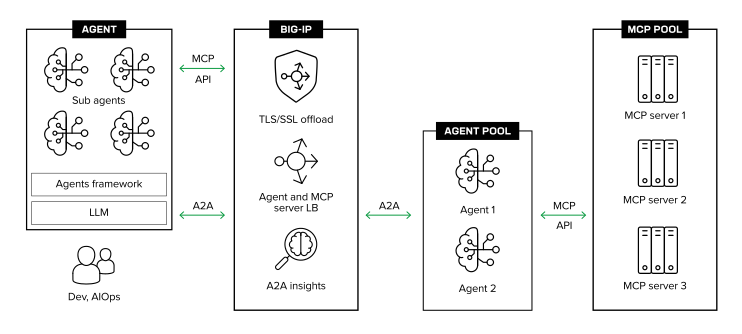
Requests from agents arrive in volumes and patterns that shift by the minute. BIG-IP sits in front of MCP and agent-to-agent traffic as the control point for the service, keeping the MCP tier robust enough that agents get what they need when they need it. Two jobs carry that weight: scaling the tier to absorb unpredictable bursts and matching each request to the resource built for it.
Scaling the MCP tier under shifting load
An organization can run a pool of MCP servers rather than a single origin, and BIG-IP spreads agent requests across it. Health checks pull any server that is down or degraded out of rotation, and the pool expands to absorb bursts that cannot be sized ahead of time. Two more controls hold the tier steady when traffic turns uneven:
- Bandwidth management: Static controllers cap the throughput a virtual server and the pool behind it can consume, while dynamic controllers watch individual sessions and throttle the noisy-neighbor traffic that spikes past a set threshold.
- SSL offload: BIG-IP terminates TLS at the tier; it can take crypto work off the servers and free them to scale further.
Directing requests to the right back end
MCP calls vary in what they ask of the infrastructure. BIG-IP can read each request and send it where the work belongs:
- Compute-heavy tools to GPU pools
- Read-only tools to cached replicas
- Sensitive or high-privilege tools to isolated, audited environments
Routing by tool type keeps demanding work off shared infrastructure and holds risky executions inside controlled pools, with no change to how agents are configured. JSON-RPC schema validation confirms each request matches a valid JSON-RPC 2.0 schema and blocks malformed or oversized payloads before a tool ever processes them.
A2A insights
Agent-to-agent traffic is newer and less mature than direct MCP calls, and it is harder to see into. As agents begin coordinating with other agents, that exchange becomes its own layer to understand and verify. BIG-IP observes and logs A2A traffic along the path:
- Developers and AIOps teams gain visibility into how agents interact.
- Protocol behavior can be verified and multi-agent workflows troubleshot.
- Teams are positioned to support A2A as adoption grows.
Delivering data from NetApp storage
Once a request reaches the storage tier, the data behind it has to move fast and intact back to the agent that asked for it.
Load balancing across the storage cluster
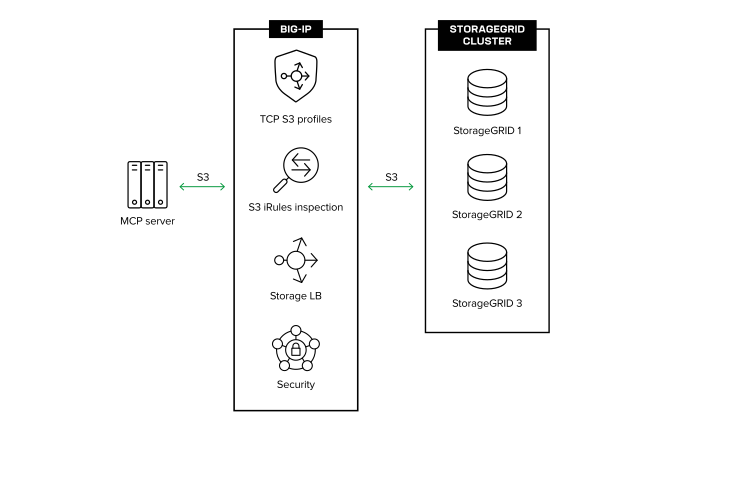
Most times, StorageGRID runs as a pool of nodes, and BIG-IP distributes S3 requests across them. If a node fails, the S3 endpoint BIG-IP presents stays up and traffic continues to the healthy nodes, keeping the storage tier available.
TCP profiles tuned for S3
S3 traffic has different needs along its transfer path. BIG-IP offers TCP profiles that align with those needs: a WAN profile on the client side that delivers steady performance, minimizing latency, jitter, and loss, and a LAN profile on the server side to enable extremely high throughput for large object transfers. Together, the profiles enable a more predictable, optimized route that stands up to real-world network demands and impairments.
S3 iRules inspection
BIG-IP understands S3 natively, reading the action, bucket, object, and authentication type directly from each request. That awareness removes the need in some cases, such as browser-based POST uploads, to hand-decode the encoded JSON where S3 instructions live or to hand-build XML error responses that SDKs expect. Traffic policy that once took roughly 80 lines of custom code can drop to 15, giving teams intelligent control over S3 traffic without deep protocol expertise.
Securing S3 workloads
Agents distribute access to data more freely and less predictably than traditional applications, which widens the ways storage can be reached and misused. BIG-IP applies security at the point every request passes through on its way to StorageGRID, enforcing controls that generic HTTP inspection cannot
- Pre-signed URL governance: Enforce expiration, block replayed or altered requests, and restrict use to approved source IPs and regions.
- PII filtering: Inspect for sensitive data such as SSNs, driver's license numbers, and passport IDs, and block content that breaches policy.
- Centralized certificate management: Manage all TLS certificates in a centralized place instead of across every storage node, reducing expired or misconfigured certifications.
- Post-quantum cryptography (PQC) support: Enforce PQC-ready cipher suites to protect encrypted traffic against future quantum computing threats.
- Deep packet inspection: Inspect every S3 API request at layer 7 and block suspicious activity, such as reconnaissance scanning for bucket names or data structures, before it reaches storage nodes.
- IP intelligence: Block requests from known malicious IP addresses and botnets before they reach storage endpoints.
- DDoS mitigation: Absorb service-provider-scale attacks in every appliance to keep storage available.
Together, these controls give teams a centralized place to enforce data security as agent access scales.
Ready for a future of agent demands
Agentic demand will keep growing and shifting, and the data behind it has to stay fast, available, and protected. NetApp StorageGRID provides the storage foundation for AI services, and F5 BIG-IP keeps the path to it dependable: load balancing across pools, optimizing S3 traffic, and enforcing security from the first agent request to the data and back. Together, F5 and NetApp give teams the resilience, speed, and protection that production AI depends on.
Get started
Learn more about F5 and NetApp.
Sources
1. F5, 2026 State of Application Strategy Report, May 2026
Key benefits
Faster agent communication
Requests, data delivery, and responses move quickly across the path, even as demand shifts.
Resilient access to AI data
Load balancing and health checks keep MCP services and StorageGRID available through node and server failures.
Stronger protection for stored data
A security layer in front of storage guards against data exposure, malicious traffic, and emerging threats.
Reliable MCP services
BIG-IP steers each request to the back end built for its tool and screens payloads before they land, holding the MCP tier steady when demand spikes.
Scale for unpredictable demand
Pools of agents, MCP servers, and storage nodes grow to absorb demand that cannot be sized in advance.
Key features
Fastest path for agent requests
Distribute requests across pools of MCP servers and agents with health checks for reliable service.
Intelligent MCP routing
Steer requests by tool type and validate JSON-RPC payloads before they reach a tool.
A2A insights
Observe and log agent-to-agent traffic for visibility, verification, and troubleshooting.
S3 traffic optimization
Load balance across the storage cluster and pair native S3 inspection with tuned TCP profiles to speed transfers.
Data security
Enforce pre-signed URL, PII, certificate, and threat controls at the path to StorageGRID.