Secure AI from data to runtime with F5 and Forcepoint
Improve AI compliance and governance through data-driven AI security with runtime enforcement.
AI adoption is increasing governance, compliance, and security risks
AI adoption is accelerating as governments, businesses, and organizations deploy GenAI assistants, agents, and autonomous workflows to gain a competitive edge. However, most organizations still lack the visibility and runtime controls needed to adequately secure AI models and agents, much less govern them. Traditional security and operational governance models weren’t built for AI’s data ingestion needs, unpredictable and dynamic behaviors, and constantly changing exposure risks.
Three common AI challenges
When safely governing AI for better compliance and reduced security risks, most organizations face three common challenges:
- Data blindness: Organizations lack a complete understanding of what data exists, where it resides, or which AI systems can access it.
- Disconnected controls: Data security, application security, and AI governance are typically managed in silos, creating gaps between policy intent, policy enforcement, and the actual AI behavior.
- No runtime assurance: Security teams cannot validate that AI systems behave safely once deployed, resulting in increased risks of data exposure or unintended harmful outputs.
Building an AI security lifecycle framework
As organizations implement AI, it is necessary to improve AI security approaches and lessen operational risks. The AI security lifecycle starts with ensuring data integrity and evolves to runtime security for better governance in a cycle of continuous evaluation and improvement.
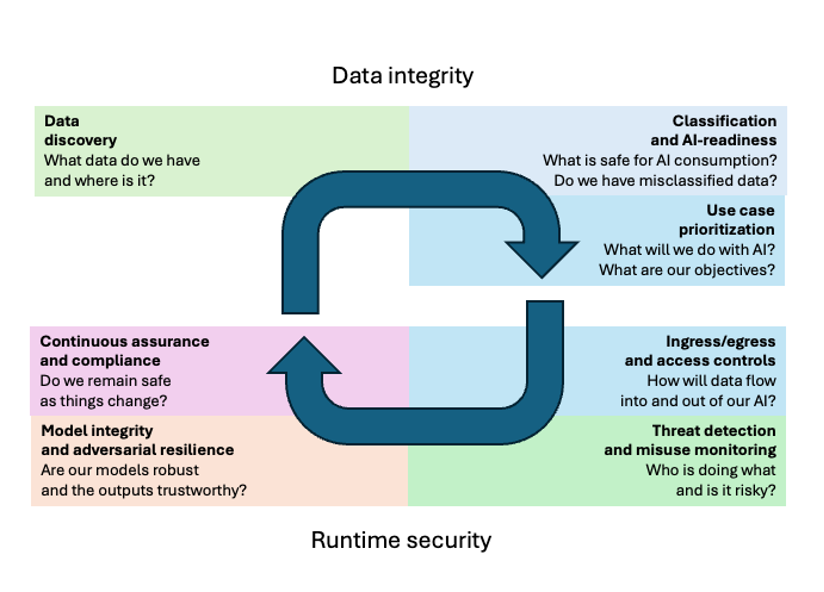
Together, F5 and Forcepoint have solutions that help organizations build a continuous AI security lifecycle for more compliant and governed AI operations.
Building AI data integrity
Before AI can operate in a safe and trustworthy manner, organizations must know what data they have, how to classify it, and if it’s ready for AI consumption.
- Data discovery
Organizations begin by identifying structured and unstructured data across cloud, SaaS, endpoints, and data platforms to create a factual baseline of AI-relevant data exposure. - Data classification
Data must be classified using explainable and auditable methods so that sensitivity, regulatory relevance, and business importance are clearly understood. Doing so allows data to be properly governed. - Use-case prioritization
Not all AI use cases carry equal risk. Organizations must determine which AI workflows pose the greatest business risk based on data sensitivity, exposure, and usage. This enables security teams to focus on high‑impact AI risks first.
Forcepoint’s AI-native Data Security Posture Management (DSPM) capabilities across data discovery and classification help organizations close the gap between visibility and control to find the hidden risks in data powering your AI solutions.
Securing AI runtime operations
Once data integrity is established, organizations need runtime protections and telemetry to help security teams continuously validate AI behavior as part of the AI security lifecycle. This includes:
- Ingress, egress, and access control
Organizations must apply controls to AI interactions as they occur, governing what data can enter or exit AI systems and who or what can access them, ensuring AI systems operate within clearly defined boundaries. - Threat detection and misuse monitoring
Security teams need to continuously monitor AI systems for misuse, abnormal behaviors, and indicators of compromise, enabling faster detection and a clearer understanding of risk. - Model integrity and adversarial resilience
To prevent abuse, organizations should safeguard models against adversarial manipulation, poisoning, and integrity drift so AI systems remain reliable, predictable, and safe. - Continuous assurance
To meet the needs of security leaders, boards, and regulators, AI security must be assessed continuously through telemetry, policy validation, and operational evidence of both compliance and remediation.
F5 ensures that AI systems remain resilient, trustworthy, and aligned with enterprise governance requirements as they evolve in production environments. With AI guardrails, red teaming, and application-layer protections, F5 enables organizations to test, monitor, and enforce policies across AI applications, APIs, models, and agents. With the F5 AI Security Platform, organizations can detect prompt abuse, prevent data exfiltration, and identify vulnerabilities before they can be exploited.
Adopt AI securely with F5 and Forcepoint
Working together, F5 and Forcepoint provide a pragmatic path for enterprises to adopt AI without rebuilding your security architecture. By combining Forcepoint’s leadership in data discovery and classification with F5’s expertise in AI application protection, guardrails, and adversarial testing, organizations can secure AI across the lifecycle, from foundational data understanding to runtime protection and continuous assurance.
Learn more about F5 AI Guardrails, F5 AI Red Team, and F5 AI Remediate for AI runtime protection.
Learn more about the F5 and Forcepoint partnership.
KEY BENEFITS
Reduce operational risks across the AI lifecycle
Discover, classify, and control data going into your AI applications and enforce runtime policies for reduced risk of data exposure and harmful outputs.
Improve data security for AI
Stop AI from ingesting improper or sensitive data by discovering and classifying information, monitoring data use, and safeguarding AI responses.
Ensure AI governance and compliance
Apply AI and data policies that align with regulatory requirements while ensuring operations and outputs don’t put your organization at risk.