Just this month, IDC reported that the global SDN market will be worth $12.5 billion by 2020 – representing a CAGR of 53.9% from 2014 onwards. SDN applications – including Layer 4-7 network and security services and analytics – are forecast to achieve a CAGR of 66 percent through 2020, when they will account for revenue of more than $3.5 billion.
SDN separates the “brains” of the network from the physical devices, which can make the network more agile and easier to manage. Importantly, the technology is now proving a fertile innovation platform for DevOps, a model for developing software and services quickly by encouraging standardized communication and collaboration between application developers, IT, and networking professionals.
F5’s State of Application Delivery report echoes IDC’s growth predictions, with 41% of EMEA organisations believing SDN will be “strategically important” to their organisation over the next two to five years. 26% expect to buy SDN technology within the next 12 months. 41% will do so to lower operating costs, 27% to reduce time to market.
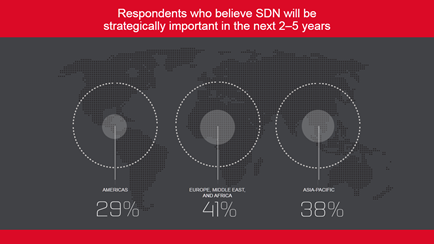
Some ease on the network management burden is clearly needed. IT managers are under significant pressure to lower costs while also expanding operations, providing more services, stepping up security and managing a massive influx of users. In EMEA – as on the world stage – the importance of cutting-edge, rapidly achievable, ROI-rich automation, orchestration and programmability has never been in higher demand.
Effective automation tools and frameworks are entirely dependent on programmability features such as application programming interfaces (APIs) and templates that enable software-defined provisioning and configuration across application and network infrastructures. This speeds up deployment and reduces variations that can cause configuration errors.
According to our SOAD feedback, the top five IT job roles—infrastructure architects, network managers, security engineers, IT director or VP, and application architect— labeled all facets of automation-enabling programmability as “important” to “highlight important”: APIs (58 percent), templates (49 percent), and data path programmability (67 percent).
This is where the potential of Software-Defined Application Services (SDAS) really comes into play, taking the principles applied to SDN (which primarily addresses layers 2-3 in the networks) and deploying them to the application layer (layer 4-7). By enabling unprecedented support for programmability across all three planes (data, control and management), it is possible to provide “out of the box" functionality that can further be tailored to meet specific business and operational requirements of any application.
Another important and recent SDN and DevOps development is their combined influence on how cloud models are shaped and deployed.
Whereas DevOps cloud conversations to date have often focused on public cloud, SOAD respondents seem to associate DevOps more with private cloud.
The SOAD report found that of the 43 percent of participants who see private cloud as strategically significant, 23 percent also believe DevOps is significant, and almost twice as many (44 percent) believe the same about SDN. This seems to indicate that as organizations develop and deploy applications in their private clouds, they believe DevOps practices together with SDN implementations will give them the agile IT environments they need to meet their business requirements.
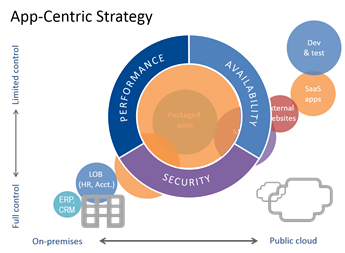
The best way forward for many is an approach that ensures consistent delivery services for every app regardless of deployment model; an app-centric strategythat abstracts away the complexities of disparate cloud environments and enables continued use of skills and policies while supporting a DevOps approach.
While we are still in the relatively early stages of SDN’s influence and impact, the automation and orchestration tools that DevOps applies to application development are starting to filter up into the network. Unavoidably and excitingly, both programmability and the use of frameworks are fast becoming critical to an organization’s ability to continuously deploy applications and services.
F5 Networks and Cisco are demonstrating the potential of SDN and DevOps at Cisco Live! from 15 February in Berlin. Highlights include joint solutions for operationalizing the network that simplify and automate end-to-end, L2-L7 application delivery for both existing and next-generation data centres.
About the Author

Lori MacVittie is a Distinguished Engineer and Chief Evangelist in F5’s Office of the CTO with deep expertise in application delivery, automation strategy, and infrastructure. She is known for turning complexity into clarity whether she’s defining guardrails for AI agents, dissecting brittle multicloud architectures, or probing the limits of scalable systems. She brings more than thirty years of industry experience across application development, IT architecture, and network and systems operations. Before joining F5, she served as an award-winning technology editor. MacVittie holds an M.S. in Computer Science and is a prolific author whose publications span security, cloud, and enterprise architecture. She is also an avid tabletop and video gamer with unapologetically strong opinions about cheese.
More blogs by Lori Mac VittieRelated Blog Posts

A new path to technical excellence for F5 partners
Introducing F5 Partner Foundations, a structured learning curriculum to build F5 partner engineer expertise with a clear pathway to specialization.
Secure-by-design storage for agentic AI: Why runtime visibility plus traffic control matters
Learn how F5 is collaborating with NVIDIA to help protect agentic AI with secure-by-design AI infrastructure, runtime visibility, and traffic control.

Why sub-optimal application delivery architecture costs more than you think
Discover the hidden performance, security, and operational costs of sub‑optimal application delivery—and how modern architectures address them.
Architecting for AI: Secure, scalable, multicloud
Operationalize AI-era multicloud with F5 and Equinix. Explore scalable solutions for secure data flows, uniform policies, and governance across dynamic cloud environments.
AppViewX + F5: Automating and orchestrating app delivery
As an F5 ADSP Select partner, AppViewX works with F5 to deliver a centralized orchestration solution to manage app services across distributed environments.

F5 NGINX Gateway Fabric is a certified solution for Red Hat OpenShift
F5 collaborates with Red Hat to deliver a solution that combines the high-performance app delivery of F5 NGINX with Red Hat OpenShift’s enterprise Kubernetes capabilities.