The pace of application development and deployment has evolved dramatically over the past decade, driven by the rise of cloud-native ecosystems. Organizations now demand agility, scalability, and reliability to deliver AI workloads, APIs, or containerized microservices in a highly distributed, multicloud reality. Meeting these demands, however, introduces challenges in managing complex infrastructures, ensuring security and maintaining efficient operations while fostering innovation.
To address these needs, application delivery architectures, solutions, and tools must adapt to the new reality and the future. Emerging trends like SaaS-first strategies, unified cloud stacks, infrastructure simplification, and enhanced observability are now becoming table stakes, redefining how cloud and platform architects design business- and mission-critical solutions. In this blog post, we explore how these trends are shaping the future of application delivery.
“In a world of increasing cloud-native complexity and rising user demands, the future of application delivery in the cloud lies in the next-level ADCaaS solutions that simplify infrastructure and unify cloud stacks, empowering organizations to focus on designing and implementing resilient, scalable, and innovative digital experiences.”
Accelerate delivery of digital experiences
In today’s fast-moving business environment, organizations want less infrastructure to manage and more time to innovate. That’s why so many cloud and platform teams are prioritizing a Software-as-a-Service (SaaS)-first strategy for core application delivery needs.
Instead of hosting, maintaining, and upgrading infrastructure components, SaaS-first models allow you to consume critical services on demand. This shift not only accelerates the development and improvement of digital experiences delivered, but also lowers operational overhead while keeping the cost optimized.
For example, some scenarios that require advanced customization and programmability are hard or sometimes even impossible to implement with default cloud platform tools. In some cases, deploying and managing virtual machines or containers is required to host deployable application delivery software, which carries extra operational burden.
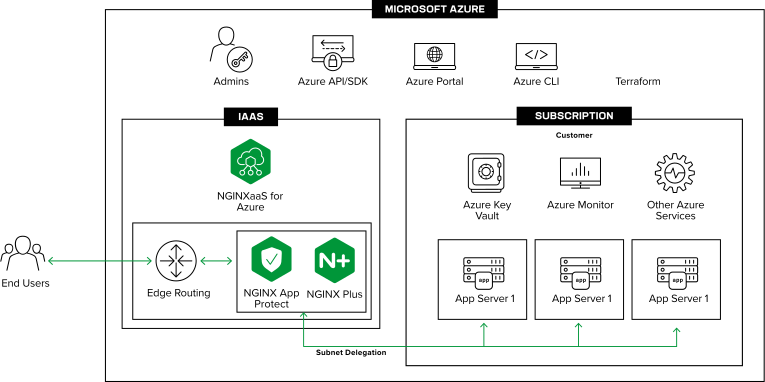
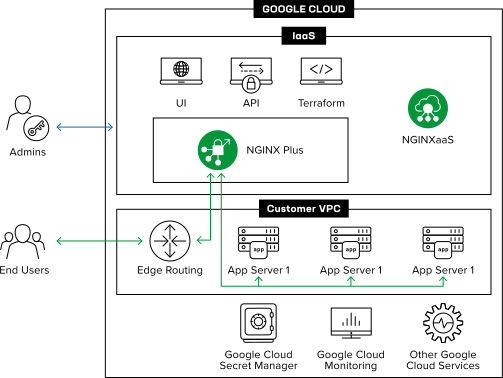
By leveraging F5 NGINXaaS for Azure or F5 NGINXaaS for Google Cloud, teams can eliminate the complexities of deploying, managing, and maintaining application delivery controller (ADC) instances themselves. As a next-level ADCaaS solution, F5 NGINXaaS simplifies operations, scales elastically, and reduces management burdens. Cloud and platform architects can now focus on delivering exceptional user experiences instead of worrying about back-end maintenance.
Ensuring consistency across environments
Many organizations are adopting multicloud strategies to improve resilience and achieve higher flexibility. However, as applications are deployed across environments, increasing complexity and tool sprawl can hamper performance, security, and operational efficiency. A unified cloud stack helps address this challenge by standardizing application delivery infrastructure within and across cloud providers through technology consolidation and tight integration with the cloud provider’s ecosystem.
Unified stacks are particularly valuable for organizations managing complex ecosystems, as they enable consistency in governance, traffic routing, and security policies. They also simplify collaboration between teams by providing a common baseline for application delivery operations.
F5 NGINXaaS enhances this concept by offering a consistent application delivery platform across environments with native integration into a cloud provider’s ecosystem, including availability on the cloud marketplace. Built for cloud-native architectures, it provides fully managed and highly flexible and customizable SaaS load balancing and application delivery services for high-traffic applications, API communications, Kubernetes environments, and AI inference. With a unified stack, teams can seamlessly deploy applications across diverse infrastructures, driving efficiency and reducing risk.
Reducing complexity at scale
Simplification is key to agility. As cloud-native architectures grow increasingly distributed, the need to consolidate and streamline infrastructure components becomes more critical. In fact, one of the greatest challenges enterprises face today is managing the fragmentation that often comes with scaling apps, APIs, and microservices, such as using siloed tools for network and application load balancing, traffic management, and API communications.
Infrastructure simplification helps consolidate load balancing, API communications, and traffic optimization into fewer, more manageable tools, effectively flattening service architectures. Simplified systems are easier to deploy, maintain, and scale—enabling organizations to focus on their core competencies rather than managing stacks of overlapping tools.
F5 NGINXaaS exemplifies this simplification by combining the functionality of a network (layer 4) and application (layer 7) load balancer, augmented by built-in advanced security, into a single, managed solution. By relying on one unified tool, teams can streamline their workflows, reducing both time and cost while maintaining speed of innovation.
Cloud-native evolution empowers innovation
As emerging trends redefine application delivery, a cloud-native evolution is not just about adopting new technologies. but about embracing simpler, more efficient ways to meet users’ increasing demands. SaaS-first models reduce the burdens of operational complexity. A unified cloud stack improves consistency across environments, while infrastructure simplification eliminates unnecessary overhead.
With solutions like F5 NGINXaaS, these trends come together to create a streamlined vision of application delivery, empowering organizations to focus on growth and innovation, and delivering exceptional digital experiences.
Ready to get started? Visit us on the Microsoft Azure or Google Cloud marketplaces to learn more and get started with F5 NGINXaaS.
About the Authors


Related Blog Posts

A new path to technical excellence for F5 partners
Introducing F5 Partner Foundations, a structured learning curriculum to build F5 partner engineer expertise with a clear pathway to specialization.
Secure-by-design storage for agentic AI: Why runtime visibility plus traffic control matters
Learn how F5 is collaborating with NVIDIA to help protect agentic AI with secure-by-design AI infrastructure, runtime visibility, and traffic control.

Why sub-optimal application delivery architecture costs more than you think
Discover the hidden performance, security, and operational costs of sub‑optimal application delivery—and how modern architectures address them.
Architecting for AI: Secure, scalable, multicloud
Operationalize AI-era multicloud with F5 and Equinix. Explore scalable solutions for secure data flows, uniform policies, and governance across dynamic cloud environments.
AppViewX + F5: Automating and orchestrating app delivery
As an F5 ADSP Select partner, AppViewX works with F5 to deliver a centralized orchestration solution to manage app services across distributed environments.

F5 NGINX Gateway Fabric is a certified solution for Red Hat OpenShift
F5 collaborates with Red Hat to deliver a solution that combines the high-performance app delivery of F5 NGINX with Red Hat OpenShift’s enterprise Kubernetes capabilities.