Everyone knows that Kubernetes has won the container wars. Except what Kubernetes has won is the container runtime wars. You see, the container image war was won by Docker. That can be seen in the statistic that more than 1 billion Docker containers are downloaded every two weeks according to the State of Open Source Security Report 2019. Docker Hub has become for the enterprise what Apple's AppStore and Google Play are to consumers.
Container images run the gamut from base operating systems to app stacks, from databases to middleware to app engines supporting node.js, Python, and Go. They even include ecosystem integrations for application services.
If you're in the majority of organizations deploying containers, you're probably deploying Docker images within a Kubernetes environment.
And if you're doing that, then you're probably also deploying vulnerable container images. The aforementioned research from Snyk discovered that "each of the top ten most popular default Docker images contains at least 30 vulnerable system libraries." It's common, the report goes on to note, "for system libraries to be available in many docker images, as these rely on a parent image that is commonly using a Linux distribution as a base."
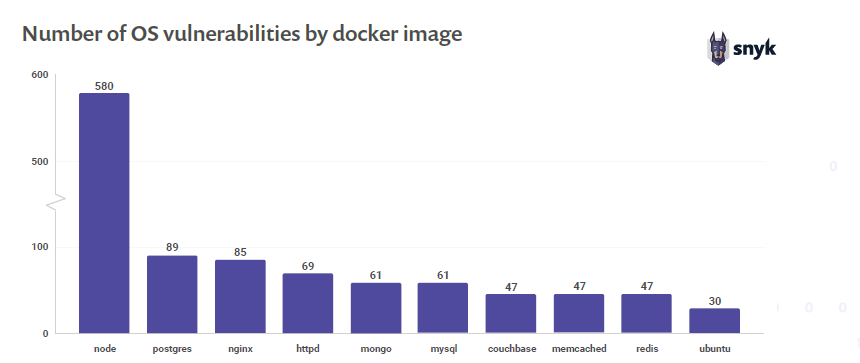
So, we've got a whole lot of vulnerable images being downloaded by organizations all the time. According to Snyk, the number of vulnerabilities is steadily increasing across all three major Linux distributions.
It's no surprise, then, that Tripwire's 2019 State of Container Security found a staggering 60% of respondents that had experienced a container security incident in the past twelve months. For nearly one in five (17%), that's likely because the organization was aware of the vulnerabilities - but deployed them anyway. That's despite Snyk's finding that for 44% of the Docker images found to contain known vulnerabilities there were newer and more secure base images available. In other words, simply pulling an up to date image would have mitigated the risk. Another 22% of those images with vulnerabilities could have been addressed by simply rebuilding the image.
Really. I can't make this stuff up.
A lot of the focus on "shifting security left" is as much about deploying the appropriate security application services (BOT defense, web application firewalls, identity and access control) as it is incorporating secure practices into the development and delivery life cycle. Those practices include scanning code and containers for known vulnerabilities and then addressing them.
That emphasis was for the 17% of you that knew about vulnerabilities in a container image but deployed without remediating.
We can do better than this. Yes, speed is important but speed without security is dangerous - not just to the organization but to customers who ultimately use the apps you're hurrying out the door.
If you aren’t already practicing safe containerization, consider putting into practice these steps:
- Assess usage. Many organizations aren’t aware how pervasive their consumption of open and third-party source/images really is. Getting a handle on that is an important first step. You can’t address vulnerabilities in software you don’t even know you’re using.
- Standardize. Try to find common ground across applications and operations and standardize on the fewest container images/components possible. This will distribute the security burden across the organization and ultimately result in better security for everyone.
- Secure code reviews. If you’re including third-party components or scripts (and you almost certainly are) then review it and deliver/build from a private repository.
- Secure container audits. If you’re consuming third-party images, audit and certify their security, then deliver from a private repository.
- Subscribe to security channels. If you’re relying on an image or source code, find and subscribe to the channel(s) through which they communicate potential vulnerabilities. Knowing is half the battle, after all.
About the Author

Lori MacVittie is a Distinguished Engineer and Chief Evangelist in F5’s Office of the CTO with deep expertise in application delivery, automation strategy, and infrastructure. She is known for turning complexity into clarity whether she’s defining guardrails for AI agents, dissecting brittle multicloud architectures, or probing the limits of scalable systems. She brings more than thirty years of industry experience across application development, IT architecture, and network and systems operations. Before joining F5, she served as an award-winning technology editor. MacVittie holds an M.S. in Computer Science and is a prolific author whose publications span security, cloud, and enterprise architecture. She is also an avid tabletop and video gamer with unapologetically strong opinions about cheese.
More blogs by Lori Mac VittieRelated Blog Posts

A new path to technical excellence for F5 partners
Introducing F5 Partner Foundations, a structured learning curriculum to build F5 partner engineer expertise with a clear pathway to specialization.

Secure-by-design storage for agentic AI: Why runtime visibility plus traffic control matters
Learn how F5 is collaborating with NVIDIA to help protect agentic AI with secure-by-design AI infrastructure, runtime visibility, and traffic control.

Why sub-optimal application delivery architecture costs more than you think
Discover the hidden performance, security, and operational costs of sub‑optimal application delivery—and how modern architectures address them.

Architecting for AI: Secure, scalable, multicloud
Operationalize AI-era multicloud with F5 and Equinix. Explore scalable solutions for secure data flows, uniform policies, and governance across dynamic cloud environments.
AppViewX + F5: Automating and orchestrating app delivery
As an F5 ADSP Select partner, AppViewX works with F5 to deliver a centralized orchestration solution to manage app services across distributed environments.

F5 NGINX Gateway Fabric is a certified solution for Red Hat OpenShift
F5 collaborates with Red Hat to deliver a solution that combines the high-performance app delivery of F5 NGINX with Red Hat OpenShift’s enterprise Kubernetes capabilities.