
This blog post is a first in a series profiling F5ers driving innovation.
Technology is evolving faster than ever, reshaping how organizations build, secure, and deliver digital experiences. But behind every new advancement, platform shift, or AI breakthrough are people asking bigger questions, challenging assumptions, and pushing ideas forward.
For Lori MacVittie, a Distinguished Engineer in F5’s Office of the CTO, innovation has never just been about technology itself. It’s about understanding how people interact with technology, where complexity creates friction, and what’s needed to make emerging technologies practical in the real world.
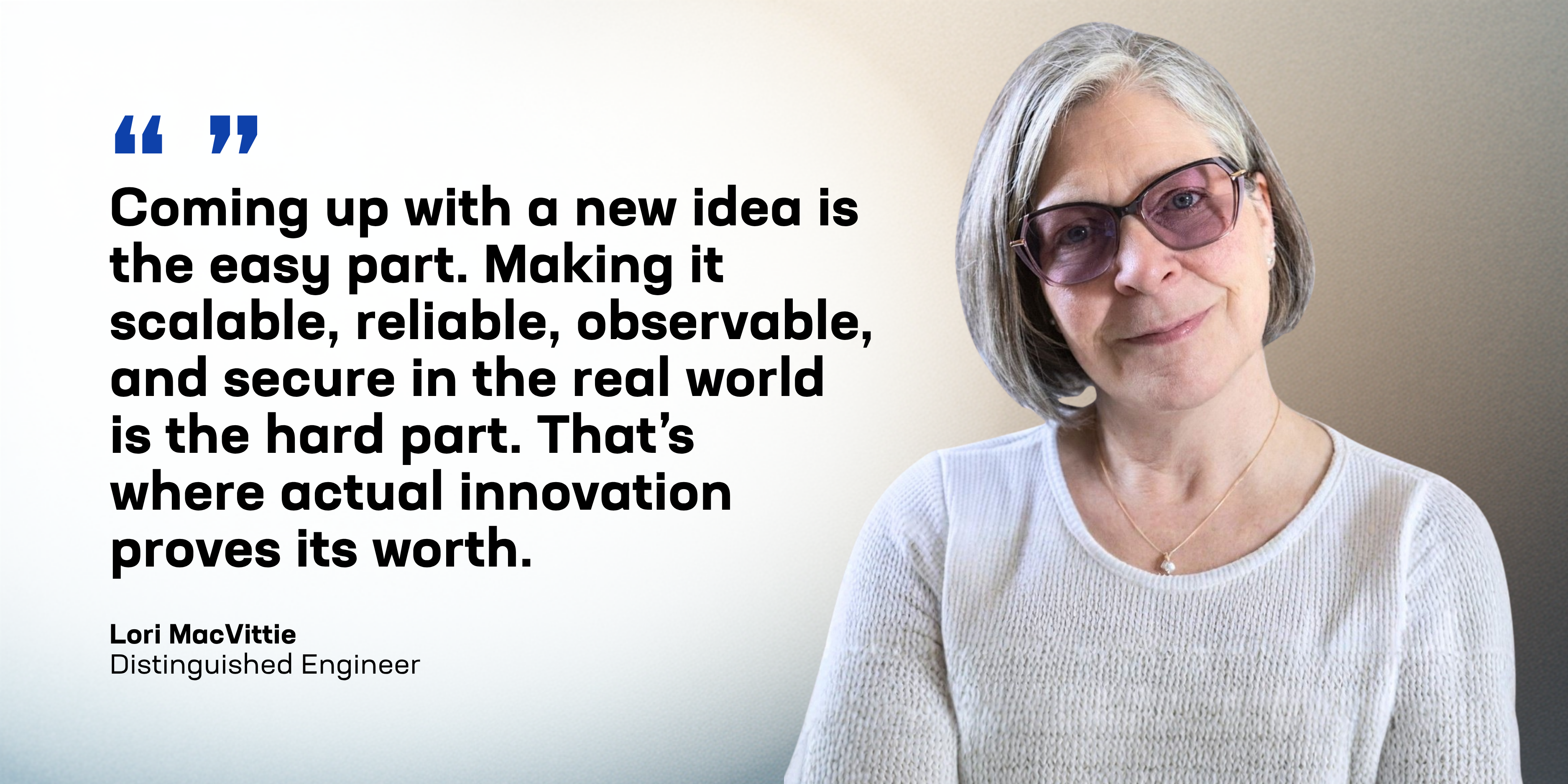
And in today’s AI-driven landscape, Lori believes the industry is focusing on the wrong part of the conversation.
“I think the industry romanticizes invention and undervalues operationalization,” she says. “Coming up with a new idea is the easy part. Making it scalable, reliable, observable, and secure in the real world is the hard part. That’s where actual innovation proves its worth.”
That perspective has become especially relevant as organizations rush to adopt AI. “Everyone wants to talk about model intelligence,” Lori explains. “Far fewer organizations want to talk about the infrastructure, routing, latency, and operational boundaries required to make those systems trustworthy at scale.”
For Lori, that operational reality is where the most meaningful innovation happens. Every major shift in computing eventually becomes an operational challenge—and AI is simply the latest technology forcing the industry to confront that reality at unprecedented speed.
Where curiosity began
Lori’s interest in technology started early. “My mother started out programming in the 1970s and brought home an Apple //e, one of the early personal computers, when I was a teenager,” she says. “That pretty much hooked me immediately.”
What fascinated her wasn’t just the technology itself, but the idea that software could create entirely new capabilities through logic and problem solving. “Technology felt equal parts engineering, creativity, and problem solving,” she says. “That’s still what draws me to it today.”
That mindset eventually led her to F5—a company that stood out during the formative years of the Internet for recognizing something many organizations had not yet fully realized: applications and networks were deeply interconnected.
“F5 understood early that applications and networks were not separate worlds,” Lori explains. “The network wasn’t just plumbing. It was part of how applications performed, scaled, stayed secure, and ultimately delivered value.”
That intersection between applications, infrastructure, and operations continues to shape how she thinks about innovation today.
One of the defining lessons throughout her career has been learning that building technology and innovating are not necessarily the same thing. “Building new systems and software is implementation,” she says. “But innovation always starts with ideas. Ideas are not bound to code. Innovation is an idea. Implementation is an idea made manifest.”
Solving the problems beneath the surface
Today, Lori spends much of her time focused on the operational consequences of AI—particularly how inference is reshaping traffic patterns, application behavior, security models, and delivery architectures.
“The consequences of AI, specifically inference, have profound impacts on traffic paths and application behavior,” she says. “That means sometimes radical changes to everything from delivery to security.”
What excites her most is uncovering the deeper challenges hiding beneath the surface. “I get terribly excited when I uncover the ‘real’ problem deep in the stack,” she says, “and then get to ruminate on how to address it.”
At the same time, organizations are struggling with the unpredictability AI introduces into systems and operations. “Chaos. Unpredictability. Dynamism,” Lori says. “Call it whatever you want, but AI is neither predictable nor governable by traditional solutions.”
According to Lori, many organizations are still approaching AI using assumptions built for far more deterministic environments. “They haven’t accepted that the assumptions we’ve relied on for decades are no longer applicable,” she explains.
That’s one reason she believes meaningful innovation requires more than simply building new technology for the sake of novelty. “Meaningful innovation should solve a real problem,” she says. “And it’s not enough to solve it for a handful of edge cases. The solution should scale and deliver tangible benefits—saving time, money, lives, or resources.”
In contrast, hype often works in reverse. “Hype tends to create the problem it solves,” she says.
The shift toward real-time logic
As AI adoption accelerates, Lori is paying especially close attention to the rise of agentic AI and autonomous systems. “Automation is where real gains in efficiency and productivity are made,” she says. “But agentic AI is not necessarily predictable.”
That unpredictability, she believes, represents one of the biggest challenges the industry has yet to fully grasp. “The industry is absolutely underestimating the impact of moving from defined, bounded application logic to real-time logic flows,” Lori says. “The impact on security is seismic.”
Traditional security models were designed around predictable application behavior. Agentic systems fundamentally challenge those assumptions, introducing new questions around governance, trust, policy enforcement, and operational control.
For Lori, solving those challenges will require organizations to rethink long-standing approaches across infrastructure, security, and operations—not just AI models themselves.
Advice for the next generation of technology leaders
Despite the pace of technological change, Lori believes one principle remains constant: innovation starts with curiosity. And while data, analytics, and automation are increasingly powerful, she cautions against overlooking the value of human insight. “Pay close attention to people and their insights,” she says. “That’s your team, users, and stakeholders.”
She believes one of the biggest risks organizations face is relying exclusively on data while ignoring human experience and intuition. “AI can’t instinctively know which questions to ask or how to interpret the nuances of real-world challenges,” Lori explains. “Your team does.”
For future technology leaders, that balance between technical expertise and human understanding will become increasingly important as systems grow more autonomous and complex. “Ignore people’s perspectives at your peril,” she says. “You may regret it when opportunities slip away or blind spots lead to costly missteps.”
The takeaway
As emerging technologies continue reshaping the industry, Lori’s perspective offers a reminder that innovation is rarely about chasing the newest trend. More often, it’s about asking better questions, solving meaningful problems, and building systems that can actually work in the real world.
Check out our previous Life at F5 blogs, highlighting F5ers shaping AI.
F5ers shaping AI: A Q&A with Mark Toler on securing AI with purpose
F5ers shaping AI: A Q&A with Hunter Smit on culture, growth, and meaningful work
F5ers Shaping AI: A Q&A with Ian Lauth on bringing clarity to AI security
Interested in working at F5? Explore open roles today.
About the Author
Related Blog Posts

From the dot-com era to the age of AI
After 26 years at F5, Truls Hofvind reflects on decades of innovation, growth, and the people and culture that have made F5 feel like home.

F5 donated $250,000 to Spokane wildfire recovery, directed by local employees
See how F5 is directing grants to community nonprofits following the devastating fires.

30 years of F5 through the eyes of F5ers
As F5 celebrates its 30th anniversary, we asked employees, including several who’ve been here for decades, what it means to thrive at F5. Read on to see their answers.
F5ers shaping AI: A Q&A with Hunter Smit on culture, growth, and meaningful work
From college discovery to shaping F5’s AI platform story, Hunter Smit shares how purpose, integrity, and people-first values define life at F5.

F5 Celebrates the CRN 2023 Women of the Channel
F5 is proud to applaud members of the F5 Channel Team receiving recognition via the 2023 Women of the Channel Awards

Now Celebrating: F5 North America 2021 Partner Awards
F5 recognizes the standout partners who have demonstrated exceptional expertise, commitment, and impact.