In 2022, we proposed a shift in enterprise architecture that, at the time, felt somewhat forward-leaning. The argument was simple: if organizations were going to operate AI-driven digital businesses, their architecture needed to evolve. Applications would remain the center of value, but the surrounding layers had to change. Application distribution and delivery, data architecture and governance, and infrastructure would form the operational core. Around those layers would sit the capabilities necessary to run highly automated, data-driven systems: observability and automation. Security architecture, operations, and governance would span the entire stack, with SRE practices tying the operational loop together.
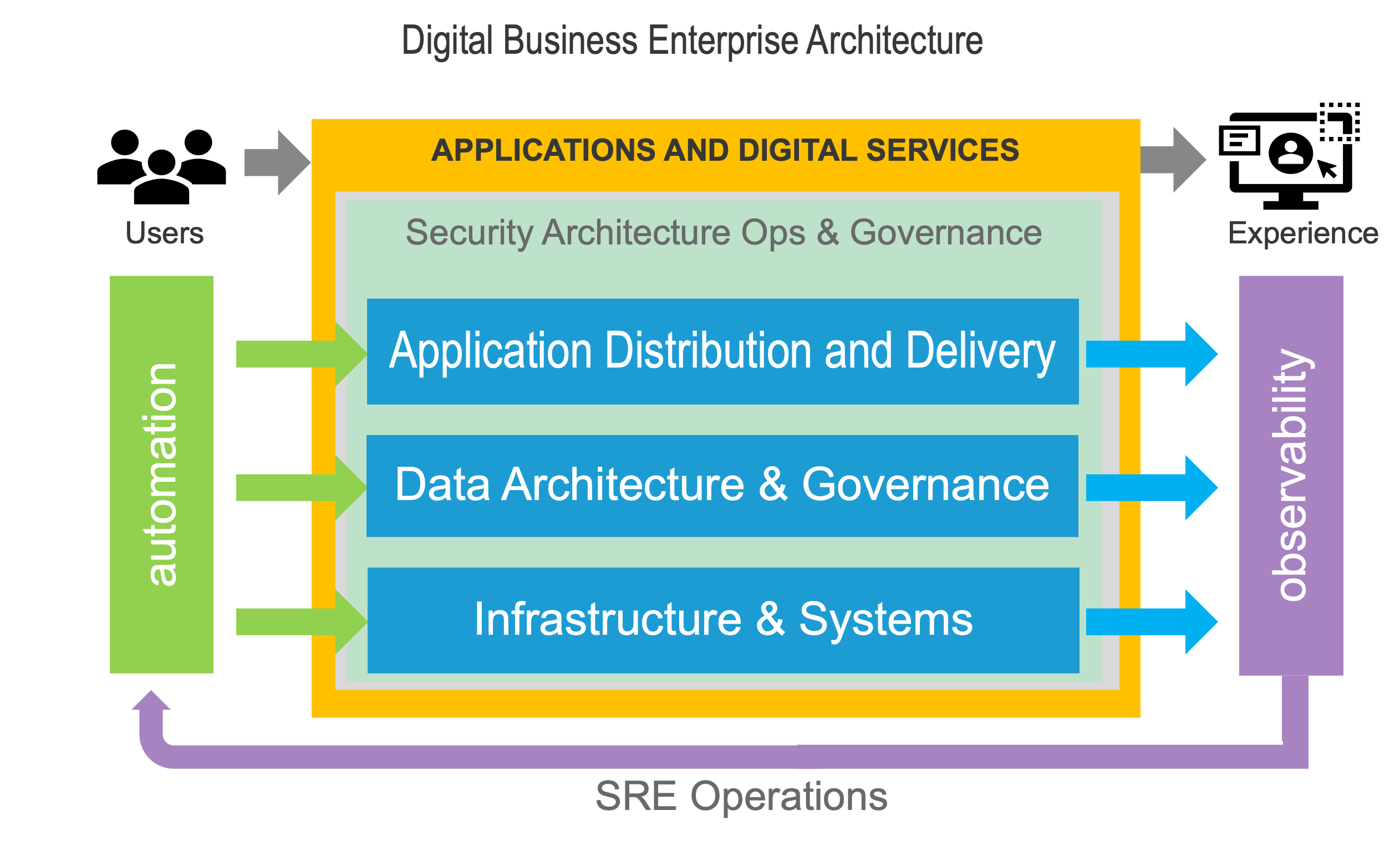
The premise behind that model was not that AI would appear magically everywhere. The premise was that AI would increase the rate of change in digital systems and the scale of machine-driven interaction between them. Observability would be required to understand what was happening inside those systems, and automation would be required to respond quickly enough to keep them stable.
Fast forward to today, and the architecture looks less hypothetical.
The current state of enterprise architecture
Our latest research shows that roughly three quarters of organizations already run AI-enabled applications, and more than 80% expect AI capabilities embedded across their portfolios in the near future. AI has effectively become another application dependency. Models are invoked through APIs, inference endpoints behave like services, and prompts and responses move between components as application traffic.
Once AI enters the application layer, the role of application distribution and delivery becomes immediately clear. Inference requests must be routed. Latency becomes critical to the user experience. Model endpoints must scale with demand. Interactions between applications and models must be inspected and governed.
But inference traffic is only part of the story.
The real architectural consequence of AI adoption emerges in the operational layers we highlighted years ago: automation and observability.
Those layers inevitably create new categories of system traffic.
Two new categories of system traffic
Automation traffic consists of machine-generated actions interacting with infrastructure. Agents call APIs. Automation platforms update configuration. Decision systems trigger workflows. These requests are no longer initiated primarily by humans. They are generated by systems reacting to signals and context.
Our research shows this shift already underway. Nearly two thirds of organizations report using AI to accelerate automation, and more than half allow AI systems to adjust policies or configurations automatically.
In practical terms, this means infrastructure is increasingly modified by machine-driven decisions. API calls, configuration changes, and operational workflows are triggered by software rather than operators.
That activity is automation traffic.
Automation traffic behaves differently from traditional operational interactions. It can occur at machine speed and at far greater scale than human activity. Because of that, it must be delivered and governed with the same discipline applied to application traffic. Systems must scale to handle bursts of automated activity. Rate limits and quotas may be required to prevent runaway automation. Identity and authorization controls must ensure agents operate only within their intended scope.
The second emerging traffic class is telemetry traffic.
Telemetry traffic consists of the metrics, logs, traces, and events flowing through observability systems. In traditional operations, telemetry primarily informed human decision-making. Operators observed system behavior and decided how to respond.
AI changes that loop.
Observability signals increasingly feed automated decision systems. Telemetry informs models that detect anomalies, recommend actions, or trigger remediation workflows. Instead of simply describing the system, telemetry becomes an input to the systems controlling it.
This raises the importance of telemetry traffic significantly. These signals must scale to support the growing demands of AI-driven analysis. More importantly, they must be trustworthy. If telemetry streams are inaccurate or manipulated, the automation systems depending on them may make incorrect or harmful decisions.
Telemetry pipelines therefore require delivery and security controls of their own. Sources must be authenticated to ensure signals are legitimate. Pipelines must scale to support increasing telemetry volume. Observability systems must monitor the telemetry infrastructure itself.
Automation traffic and telemetry traffic form a feedback loop. This loop is the operational heartbeat of AI-enabled environments.
What this all means
The architecture we proposed years ago anticipated the need for automation and observability because highly dynamic systems require both. What AI has done is accelerate the conditions that make those layers essential.
Automation produces automation traffic. Observability produces telemetry traffic.
Both arise as natural consequences of operating AI-enabled systems at scale. And like every other form of system interaction before them, these traffic classes must be treated as first-class citizens in enterprise architecture. They must be delivered reliably, governed by policy, authenticated by identity, and secured just like any other application or system traffic moving through the environment.
About the Author

Lori MacVittie is a Distinguished Engineer and Chief Evangelist in F5’s Office of the CTO with deep expertise in application delivery, automation strategy, and infrastructure. She is known for turning complexity into clarity whether she’s defining guardrails for AI agents, dissecting brittle multicloud architectures, or probing the limits of scalable systems. She brings more than thirty years of industry experience across application development, IT architecture, and network and systems operations. Before joining F5, she served as an award-winning technology editor. MacVittie holds an M.S. in Computer Science and is a prolific author whose publications span security, cloud, and enterprise architecture. She is also an avid tabletop and video gamer with unapologetically strong opinions about cheese.
More blogs by Lori Mac VittieRelated Blog Posts
Poisoned packages are killing our industry
Open source lacks a central registry for malicious packages even as AI and automation accelerate supply-chain abuse. The ecosystem needs a trusted way to report and track compromises.
AI App Delivery Top 10: Poor resource utilization
AI makes resource utilization volatile: request cost varies wildly by prompt, context, and reasoning, so routing by simple RPS creates GPU hotspots, queues, and latency spikes.
AI App Delivery Top 10: Inability to handle latency
AI makes latency a trust problem, not just performance: slow “assistant” responses feel like hesitation or failure, and token-heavy prompts/outputs expand work even on healthy systems.
AI App Delivery Top 10: Incomplete observability
AI won’t scale by itself. Without a unified control plane that collapses tooling and ownership boundaries, inference becomes the most brittle and coordination-heavy tier.

Behavior and boundaries: The agentic security shift
Agents create emergent, unbounded sequences where risk accumulates over time. Security must shift from single-request validation to continuous behavioral governance across multi-step, evolving flows.
Sessions are sticky, context is clingy: How inference cheats to maintain conversations
“Stateless” inference isn’t truly stateless—conversation state is hauled along in tokens each request. That replay drives bandwidth, compute, and latency as context grows.