Instant payments are now the norm, outages are more visible and more costly, and artificial intelligence (AI) is moving from experiments to production across banking and financial services intuitions. At the same time digital sovereignty is gaining momentum, and regulators are turning up the heat on operational resilience, led by initiatives like the EU’s Digital Operational Resilience Act (DORA) and similar efforts in other regions.
Against this backdrop, Celent’s new F5 sponsored report, Banking on Resilience: Building a Resilient, Intelligent Bank in the AI Era, explores how resilience is reshaping technology strategy and what banks need to do next.
The central question for every bank and financial services institution is simple:
Is resiliency a top strategic imperative for my organizations in 2026—especially given heightened outage risk, digital sovereignty trends, and AI moving into production?
The data says yes.
Improving resilience is a top technology priority for banks
Celent’s annual Dimensions Survey of 433 banking executives shows a clear reprioritization of technology investment. “Improving IT security and operational resilience” has jumped to the top of the list of IT spending drivers and has widened its lead over other priorities in both 2025 and 2026.
Other important drivers—enhancing customer experience, replacing legacy systems, product innovation, and regulatory compliance—still matter. But resilience now sits above them. Banks are signaling that it is no longer enough to grow digital capabilities; they must keep them reliably available.
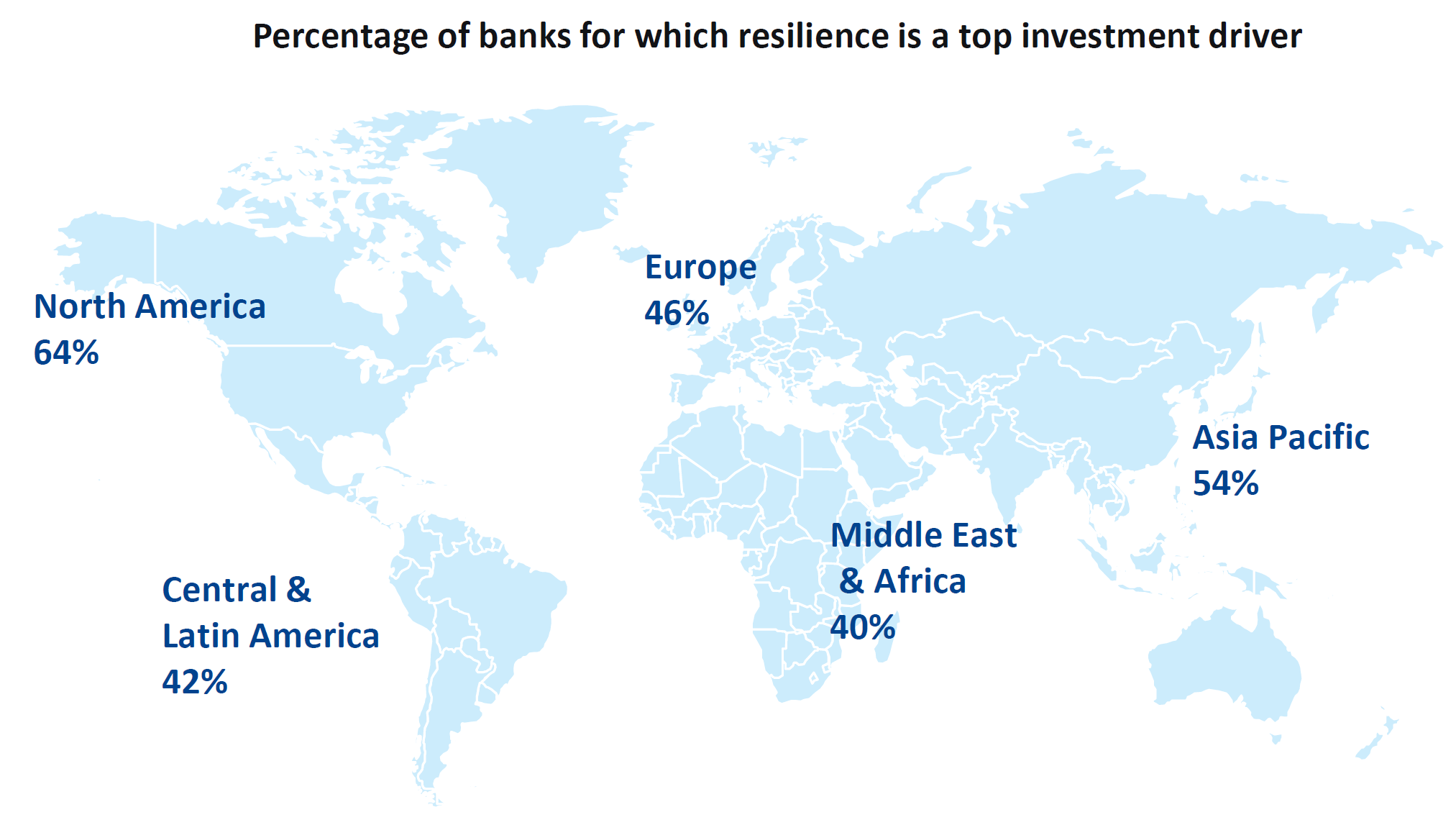
This is especially visible regionally. Celent finds 64% of North American banks and 54% of Asia Pacific banks rank “Improving IT security and operational resilience” as a top-three investment driver—well above the global average. European banks rank it slightly lower, likely because earlier regulatory pressure around DORA forced investments sooner, shifting some focus to other areas. But the trend is global: resilience has become a strategic theme across regions and tiers.
Why now?
New regulations such as DORA are pushing resilience onto board agendas. Regulators are increasingly worried about the concentration of critical banking infrastructure in a small number of hyperscalers, and with good reason. Despite the overall robustness of cloud infrastructure, banks felt the impact of two major, well-publicized outages from different hyperscalers in 2025, occurring just weeks apart. This has reinforced concerns about systemic risk and cloud concentration.
Scaling AI tests resilience
AI and advanced analytics are now a top investment priority for nearly half of banks globally (rising to 89% in North America and 67% in Latin America, according to Celent). Banks are rolling out AI-driven capabilities across fraud, risk, customer engagement, and operations. But as AI moves from pilot projects into production, it exposes a critical weakness: data infrastructure.
Celent’s research finds that 64% of Tier 1–3 banks in the UK and North America view their data architecture as a hindrance to AI and model development. The issues are familiar:
- Poor data quality and timeliness
- Fragmented data architectures and technical debt
- Inability to match the speed of data creation with the speed of decision-making
AI has a voracious appetite for data. To feed this engine, data delivery infrastructure must be fast, reliable, and scalable. And don’t forget optimized and secure. Slowed or broken data delivery will cripple even the best AI models. As the pace of banking and financial services accelerates, end-to-end AI performance—and its resilience—becomes crucial.
Resilience in payments is a business differentiator
Nowhere is resilience more visible to account holders than in payments.
Around the world, instant payments systems such as UK Faster Payments, SEPA Instant, Brazil’s PIX, India’s UPI, and the US RTP network have shrunk the margin for error. Consumers and businesses now expect funds to move and be reflected in balances instantly—even across borders.
Celent’s research from the report shows that strong digital capabilities and experiences correlate with:
- Better client retention and growth
- Lower cost of deposit acquisition
- Higher balances and fee income, especially in payments
In other words, resilience is not just a defensive posture; it is a growth lever. Banks are in a competitive battle for digital innovation, and those that can stay reliably available during spikes, outages, and incidents have a clear edge.
Charting the resilience road ahead
The Celent report goes deeper into how banks can plan for resilience—architecturally, operationally, and organizationally. It explores how to:
- Reduce technical debt and modernize data and application architectures
- Design for “always-on” operations across critical services
- Align AI ambitions with resilient, scalable data infrastructure
- Quantify the business value of uptime and the cost of downtime to the board
In 2026, resilience is not just an IT metric; it is a core business differentiator for banks and financial institutions.
With outage risks rising, digital sovereignty pressures intensifying, and AI rapidly moving into production, the institutions that treat resilience as a strategic, funded priority will be best positioned to grow—and to earn the trust of their customers—through the rest of the decade.
Read the full F5 sponsored Celent Banking on Resilience: Building a Resilient Intelligent Bank in the AI Era report. If resilience is on your agenda for 2026, this is one you’ll want to read.
Additionally, check out this new DevCentral technical article: Key Steps to Securely Scale and Optimize Production-Ready AI for Banking and Financial Services.
About the Author

Related Blog Posts

Securing the new control points in the AI journey
AI architecture is fundamentally different than traditional IT environments and requires a different security strategy to protect critical AI workloads.

The patch window has closed. Here is how F5 is built for what comes next.
As AI models have changed software security, the industry needs to adapt.

Best practices for optimizing AI infrastructure at scale
Optimizing AI infrastructure isn’t about chasing peak performance benchmarks. It’s about designing for stability, resiliency, security, and operational clarity
Datos Insights: Securing APIs and multicloud in financial services
New threat analysis from Datos Insights highlights actionable recommendations for API and web application security in the financial services sector

Secrets to scaling AI-ready, secure SaaS
Learn how secure SaaS scales with application delivery, security, observability, and XOps.

How AI inference changes application delivery
Learn how AI inference reshapes application delivery by redefining performance, availability, and reliability, and why traditional approaches no longer suffice.