Enterprise AI has crossed a threshold. According to the F5 2026 State of Application Strategy Report, organizations are now operating an average of seven AI models simultaneously, and 78% are running their own AI inference infrastructure. At the same time, 98% of organizations are actively preparing for agentic AI. The shift from experimentation to production is underway and happening faster than most organizations expected.
What makes this moment distinct is not just the scale of AI adoption, but its architecture. Enterprises are connecting multiple agents to multiple models, clouds, and data sources. The 2026 State of Application Strategy Report found that 93% of organizations operate in hybrid multicloud environments, and more than half are chaining or orchestrating multiple models to handle complex workflows. AI inference is no longer a single endpoint. It is a distributed system, and with that distribution comes a new category of risk.
When AI workflows span clouds, colocations, and on-premises environments, the attack surface expands. Sensitive data flows between systems. Agents make decisions autonomously. But the governance frameworks that worked for traditional applications were simply not designed for this type of traffic, and many organizations have already lost control.
A new operating reality for enterprise AI
Consider a customer service agent workflow running across multiple environments. A user query triggers a request to a private knowledge base, calls an external API for real-time data, and then routes the response through a public large language model (LLM) for summarization.
Each step introduces risk. Sensitive data may be exposed when leaving the enterprise boundary. External APIs may return unvalidated content. The model itself may generate responses that violate policy.
This is where governance becomes operational: not a report after the fact, but a control applied at each step of the workflow. But most traditional application security tools were built to inspect HTTP traffic, not AI-native interactions. They cannot detect when a model outputs content that violates compliance policy, when an agent exposes confidential data to a public LLM, or when an automated workflow drifts outside the boundaries an enterprise has set. Closing this gap requires controls designed specifically for how AI systems communicate and behave.
How Equinix Distributed AI Hub and F5 AI Guardrails work together
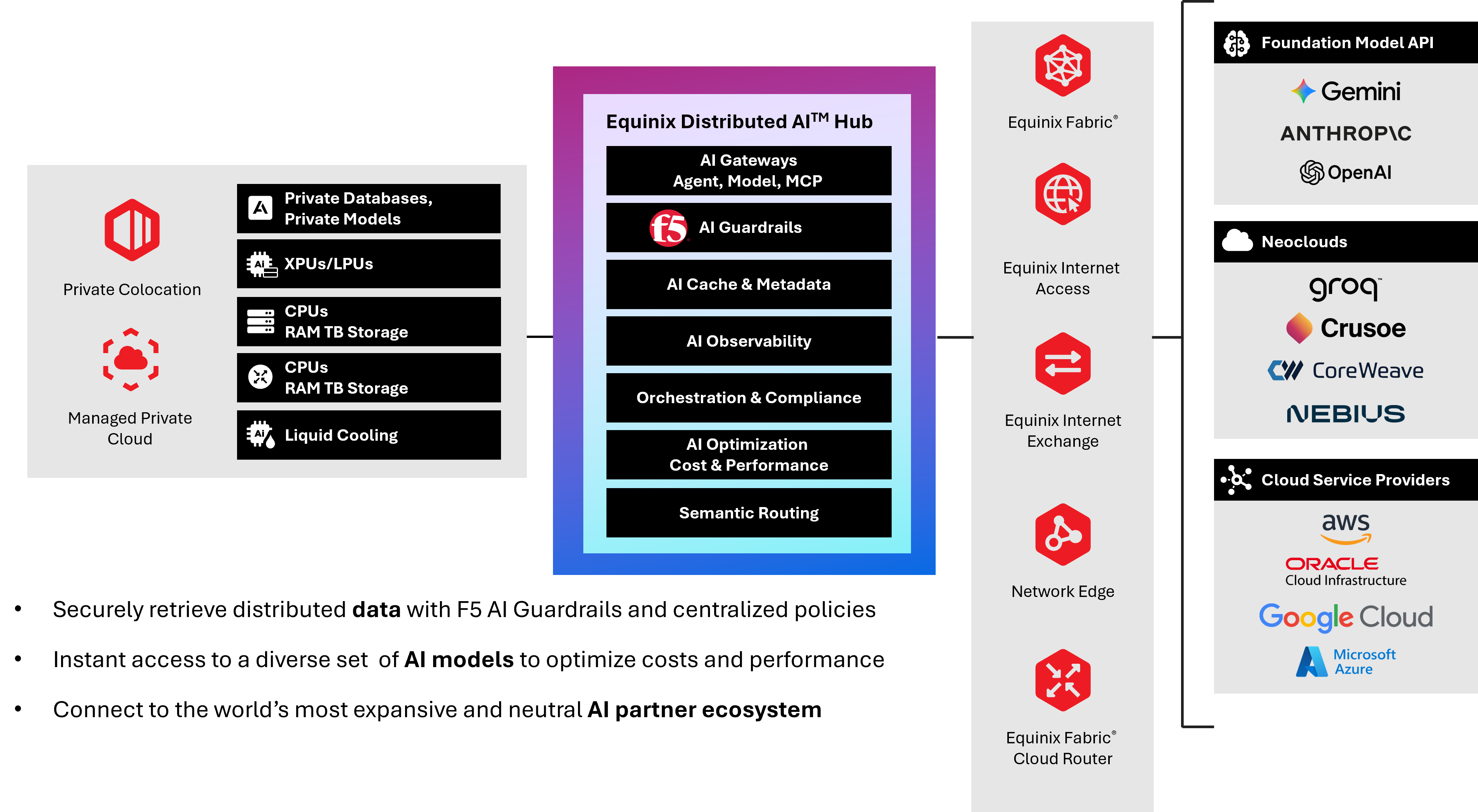
To help joint customers solve today’s AI governance and control challenges, F5 and Equinix are expanding our long-term partnership through the combination of the Equinix Distributed AI Hub and F5 AI Guardrails. Taking advantage of this joint offering allows organizations to shift AI inference and inspection closer to the edge, optimizing performance and minimizing latency for a seamless and secure user experience.
Spanning 280+ global Equinix data centers, the Distributed AI Hub provides a unified framework that brings together data, compute, cloud platforms and AI ecosystem partners in a vendor-neutral environment. It enables enterprises to run AI workloads where they perform best without rebuilding their architecture each time or moving data to different locations. Through this solution, Equinix offers a simple, secure way to connect models, move data, run inferencing, and manage distributed AI systems with consistent governance and control.
The Distributed AI Hub is open and vendor-neutral by design, giving customers the freedom to compose their own AI stack from best-of-breed providers. This flexibility is what allows teams to optimize for cost, performance, and sovereignty simultaneously.
Meanwhile, F5 AI Guardrails operates at the interaction layer, deployed on-premises at Equinix facilities to help meet strict regulatory needs. It applies AI-native, policy-based controls in real time to detect and block data leakage, policy violations, and harmful outputs during every AI interaction. Organizations can define custom and out-of-the-box compliance controls aligned to frameworks like GDPR and the EU AI Act. An adaptive policy engine maintains consistent governance across changing models, users, and business contexts, with centralized visibility and audit-ready traceability for every enforcement decision.
The combined architecture introduces a single enforcement point for AI interactions across environments. Equinix provides the private connectivity and placement options to run inference where it performs best, while F5 applies runtime controls to every request and response.
This shifts governance from an after-the-fact exercise to an inline capability. Instead of duplicating policies across teams, organizations can apply consistent enforcement once and extend it across models, clouds, and agents.
The result is simpler operations, stronger risk posture, and the flexibility to scale AI without rearchitecting security for each deployment.
The business case for governing AI at the infrastructure layer
Enterprises that try to bolt governance onto AI deployments after the fact often find themselves managing fragmented tools, inconsistent controls, and significant audit exposure. Each team builds its own guardrails, or none at all. Shadow AI usage grows. Vendor dependencies deepen. And when regulators ask for evidence of oversight, the documentation is incomplete. To avoid these issues, organizations need a proactive, centralized approach that helps control costs while preventing reactive, one-off investments and tool sprawl.
Building in governance at the infrastructure layer addresses these problems structurally. When policy enforcement is centralized and travels with the AI workload regardless of where it runs, organizations gain consistent visibility across every model and every environment. Compliance teams get the audit-ready evidence they need. Security teams get real-time protection against the threats most relevant to AI systems. And platform teams get the flexibility to choose models and providers based on performance and cost, not fear of losing control.
For whom this matters
As AI workflows expand across environments, governance cannot remain fragmented. Moving policy enforcement into the interaction path gives enterprises real-time control, consistent visibility, and the flexibility to scale without adding complexity.
This is what enables AI to move from experimentation into reliable, production infrastructure.
AI platform and infrastructure teams need the ability to build and scale distributed AI without inheriting unmanageable complexity. The combination of Equinix Distributed AI Hub and F5 AI Guardrails gives these teams a vendor-neutral foundation with consistent governance built in, so they can focus on delivering AI capabilities rather than managing security gaps.
Risk and compliance officers need traceability. Every AI interaction that passes through AI Guardrails generates a log that can be reviewed, reported on, and tied to specific enforcement actions. That evidence is what closes the loop between AI operations and regulatory accountability.
To learn more, read our press release. Also, be sure to check out our F5 and Equinix webpage.
About the Author

Related Blog Posts

A new path to technical excellence for F5 partners
Introducing F5 Partner Foundations, a structured learning curriculum to build F5 partner engineer expertise with a clear pathway to specialization.
Secure-by-design storage for agentic AI: Why runtime visibility plus traffic control matters
Learn how F5 is collaborating with NVIDIA to help protect agentic AI with secure-by-design AI infrastructure, runtime visibility, and traffic control.
Why sub-optimal application delivery architecture costs more than you think
Discover the hidden performance, security, and operational costs of sub‑optimal application delivery—and how modern architectures address them.
Architecting for AI: Secure, scalable, multicloud
Operationalize AI-era multicloud with F5 and Equinix. Explore scalable solutions for secure data flows, uniform policies, and governance across dynamic cloud environments.
AppViewX + F5: Automating and orchestrating app delivery
As an F5 ADSP Select partner, AppViewX works with F5 to deliver a centralized orchestration solution to manage app services across distributed environments.

F5 NGINX Gateway Fabric is a certified solution for Red Hat OpenShift
F5 collaborates with Red Hat to deliver a solution that combines the high-performance app delivery of F5 NGINX with Red Hat OpenShift’s enterprise Kubernetes capabilities.