

Object storage was built to hold data, not to direct heavy traffic. Now AI has changed the job. As companies push more data into S3-compatible storage to train and run models, the reads and writes pile up faster than the storage system's own load balancing can handle. Traffic backs up right where it matters most. One spike can take the system down. One slow path can leave expensive GPUs sitting idle. That is why the front door to your storage now matters as much as the storage itself. BIG-IP sits in front of the S3 cluster and keeps it steady. It blocks attacks, absorbs spikes, and spreads traffic across the healthy nodes, something the storage platform can't do well on its own.
As part of the F5 Application Delivery and Security Platform (ADSP), F5 BIG-IP serves as a data delivery layer for S3-compatible storage from leading AI storage vendors including Dell, MinIO, Scality, and NetApp. It abstracts storage endpoints, normalizes traffic behavior, and enforces consistent policy regardless of which vendor's cluster sits underneath.
Today, we have two announcements relating to our journey to build BIG-IP to speak even better for S3-compatible storage: upcoming S3-native iRules support coming later this year and two deployment guides for BIG-IP with Dell ObjectScale and MinIO AIStor.
These two steps forward enable a control point that is smarter, easier to deploy, and ready for the demands AI is placing on storage infrastructure.
Today, S3 logic is written in HTTP
With iRules, BIG-IP can already manage S3 traffic intelligently, deciding where to route a request based on the bucket, the operation, and how it's authenticated. Customers already run this in production every day. Previously, however, writing that logic required expressing S3 decisions in raw HTTP terms, parsing headers, matching URIs with regular expressions, and reasoning about query parameters one by one. It works, but it was more error prone. It also meant that you needed to be fluent in the AWS signature specification to write the logic and keep it current as the spec evolves.
Native S3 commands and events are coming to iRules
With native support for S3 in iRules coming later this year, BIG-IP will enable native S3 commands and events. The same logic, far easier: a single expression that reads like the check it performs. For example, identifying a pre-signed GET request shifts from a compound HTTP condition, four clauses that assume you know which query parameters carry the signature material, to one statement that names the operation directly. This new functionality compliments the S3 TCP/TLS profiles we introduced last year with BIG-IP v21.0.
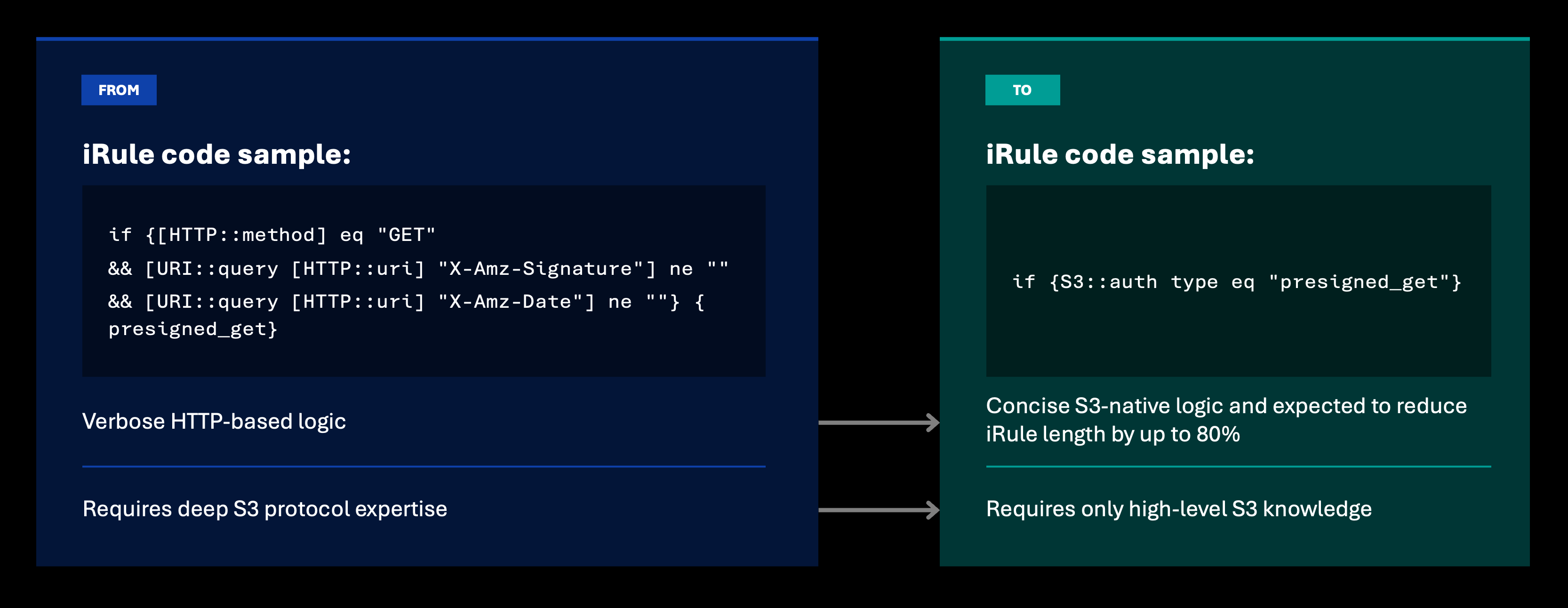
A few things follow from this: iRule length drops for typical S3 logic, by as much as 80% on common patterns. The author no longer needs to be an HTTP parsing or a SigV4 expert. Configuring S3 policies in BIG-IP is less error prone. With this new capability, a storage administrator or a security engineer can write and own S3 policies. The expertise moves to the people closest to the workload. That is a real change in who controls the rules governing your data.
(If you are interested in early access, visit f5.com/s3 to express interest to our product management and engineering teams. General availability is planned for later this year.)
Two deployment guides for Dell ObjectScale and MinIO
Programmability matters only if the foundation underneath it is sound. Today, we are also publishing two deployment guides that document, step-by-step, how to place F5 BIG-IP Local Traffic Manager in front of an S3-compatible storage cluster as a single, highly available endpoint.
The two deployment guides are for two popular storage vendors, MinIO and Dell, both of which are F5 technology alliance partners.
Deploy BIG-IP in front of MinIO AIStor. A guide for putting BIG-IP in front of a MinIO AIStor cluster as a single, highly available S3 endpoint. It includes a custom write-quorum health monitor that sends traffic only to nodes ready to accept writes, so a client never lands on a member that can't finish the operation, and it walks the full path from network to pool to virtual server to an end-to-end test. (Download the deployment guide here.)
Deploy BIG-IP in front of Dell ObjectScale. A guide for fronting a 32-node Dell ObjectScale cluster, covering everything from the rSeries and tenant setup through self IPs, routing, the pool, and the virtual server. It lays out both encrypted and unencrypted paths, so you can match the deployment to whatever your security standards require for S3 traffic. (Download the deployment guide here.)
The storage front door is now load-bearing
Object storage was built to scale capacity, not to broker traffic at this intensity. The load balancing built into these platforms was sized for steady enterprise demand. AI has changed that demand. As organizations ingest ever-larger volumes of data into S3 to feed training and inference, read and write traffic is climbing past what the storage tier's native balancing was designed to absorb. The path between storage and compute turns uneven and congested at exactly the moment it carries the most value.
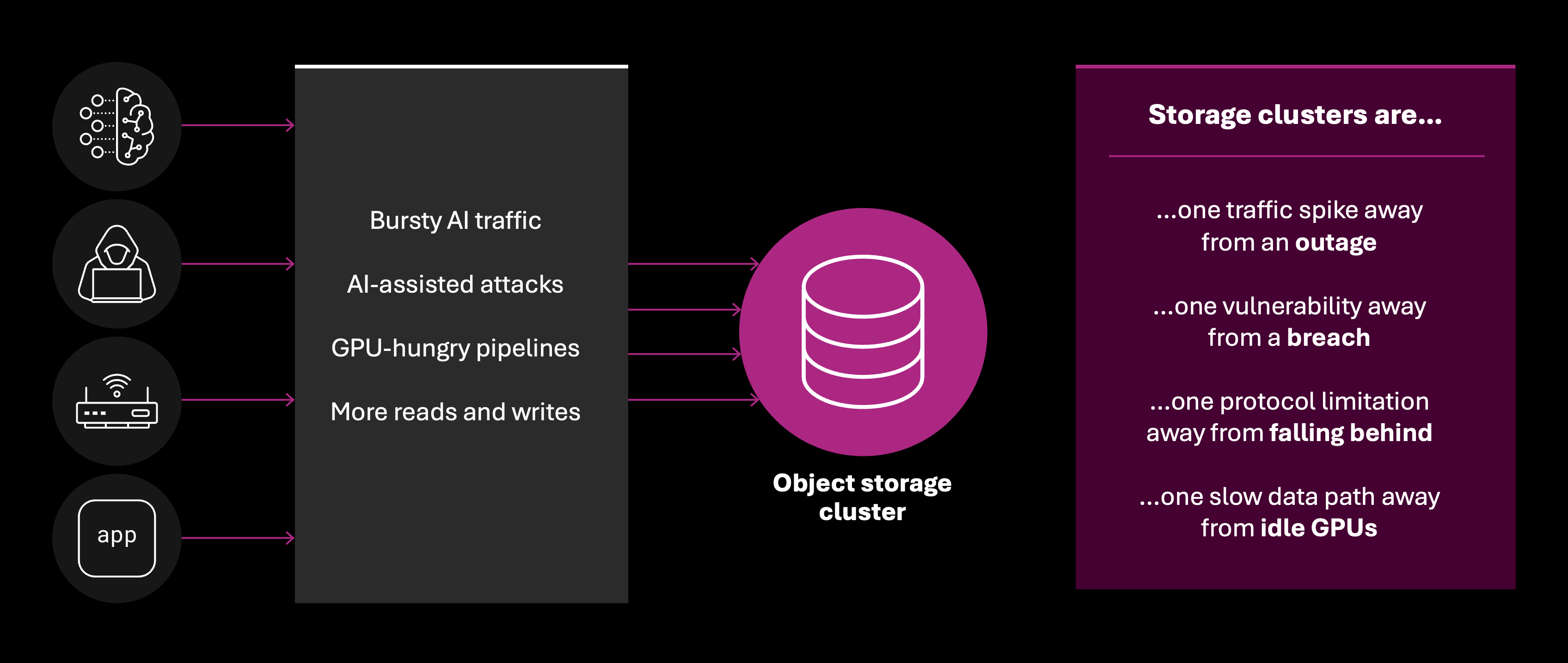
That gap is why the front door to your storage now matters as much as the storage itself. For AI data delivery, BIG-IP fronts the cluster as a highly performant, highly available endpoint, distributing load with the health awareness a storage platform cannot provide on its own and holding throughput steady as volume grows. The entry point to your data has become load-bearing infrastructure, and it should be engineered to meet this need.
The ADC of choice in front of storage
The pattern across both announcements is the same. F5 is investing in BIG-IP as the delivery and security layer built for object storage, not adapted to it. Native S3 programmability means the platform understands the protocol it governs. Validated deployment guides mean teams can move that platform into production with confidence.
As part of F5 ADSP, BIG-IP gives storage, security, and network teams a single control point in front of every S3 cluster, with the engineering discipline modern data pipelines now demand. Your storage admin can write the iRule.
Be sure to attend the F5 AI Summit, a three-hour virtual event on June 23 where we’ll be talking in depth about S3 programmability for F5 BIG-IP in the session, “Reliability belongs between compute and storage.”
F5’s focus on AI doesn’t stop here—explore how F5 secures and delivers AI apps everywhere.
About the Authors
Tanu Mutreja is a senior director of product management at F5, where she leads the enterprise AI and data delivery product portfolios. Tanu has built multiple industry-first products across AWS, Microsoft Azure, New Relic, and F5, enabling enterprises worldwide to build, deploy, and scale AI responsibly. Her work bridges deeply technical architectures with product strategy to advance the future of enterprise-scale AI.
More blogs by Tanu MutrejaHunter Smit is a senior manager of product marketing for solutions and strategy at F5. He leads solutions marketing across the F5 portfolio, including AI infrastructure and application security, and is driving F5’s entry into the emerging AI data delivery market. Hunter is a member of the Whitworth University School of Business Advisory Board and has served as an adjunct instructor for product marketing. He earned an MBA and a Bachelor of Business Administration degree in management from Whitworth University.
More blogs by Hunter SmitRelated Blog Posts

A new path to technical excellence for F5 partners
Introducing F5 Partner Foundations, a structured learning curriculum to build F5 partner engineer expertise with a clear pathway to specialization.
Secure-by-design storage for agentic AI: Why runtime visibility plus traffic control matters
Learn how F5 is collaborating with NVIDIA to help protect agentic AI with secure-by-design AI infrastructure, runtime visibility, and traffic control.
Why sub-optimal application delivery architecture costs more than you think
Discover the hidden performance, security, and operational costs of sub‑optimal application delivery—and how modern architectures address them.
Architecting for AI: Secure, scalable, multicloud
Operationalize AI-era multicloud with F5 and Equinix. Explore scalable solutions for secure data flows, uniform policies, and governance across dynamic cloud environments.
AppViewX + F5: Automating and orchestrating app delivery
As an F5 ADSP Select partner, AppViewX works with F5 to deliver a centralized orchestration solution to manage app services across distributed environments.

F5 NGINX Gateway Fabric is a certified solution for Red Hat OpenShift
F5 collaborates with Red Hat to deliver a solution that combines the high-performance app delivery of F5 NGINX with Red Hat OpenShift’s enterprise Kubernetes capabilities.