
F5 AI Security Platform
For continuous command over AI risks, F5 delivers the most adaptable platform for securing AI apps, services, models, and agents
AI mistakes cascade into headlines
When AI systems act at machine speed with more access than even the most over-privileged users, mistakes cascade into headlines. But the moment you define a boundary, users learn to evade it, attackers learn to exploit it, and agents amplify both. Addressing AI risk requires continuous command—a persistent capability to define, observe, evaluate, and enforce controls tailored to unique risk-definitions and business needs.
Eliminate the guesswork from AI security
AI application security
Secure and harden deployed AI systems with a continuous loop of testing and runtime protection tailored to unique enterprise needs.
- Defend against runtime threats like prompt injection and jailbreaks with industry-leading efficacy
- Harden defenses with continuous red teaming and auto-remediate discovered vulnerabilities
- Author bespoke policies and runtime controls in natural language
AI workforce security
Discover, classify, and govern workforce AI usage across users, agents, and third-party services.
- Classify AI workflows by intent for in-depth visibility into how AI is being used across the business
- Continuously identify and monitor shadow AI usage, sanctioned AI tools, and MCP servers across enterprise workflows
- Operationalize governance with enforceable controls to block or redact sensitive content and control agent-driven tool use
Core capabilities
Customization without complexity
Create bespoke controls through natural language
AI workforce visibility
Discover, classify, and monitor risky AI usage
Automated red teaming
Find and fix AI exploits faster than attackers retool
Agent security
Secure and govern agent actions and tool calls
Data loss prevention
Intercept sensitive data in AI agent and model interactions
Deployment flexibility
Deploy private AI in public cloud, private cloud, and on-prem
Model agnostic architecture
Consistent policy controls for all public and private models
Model risk registry
Inform model selection with security benchmark results.
AI Security Platform
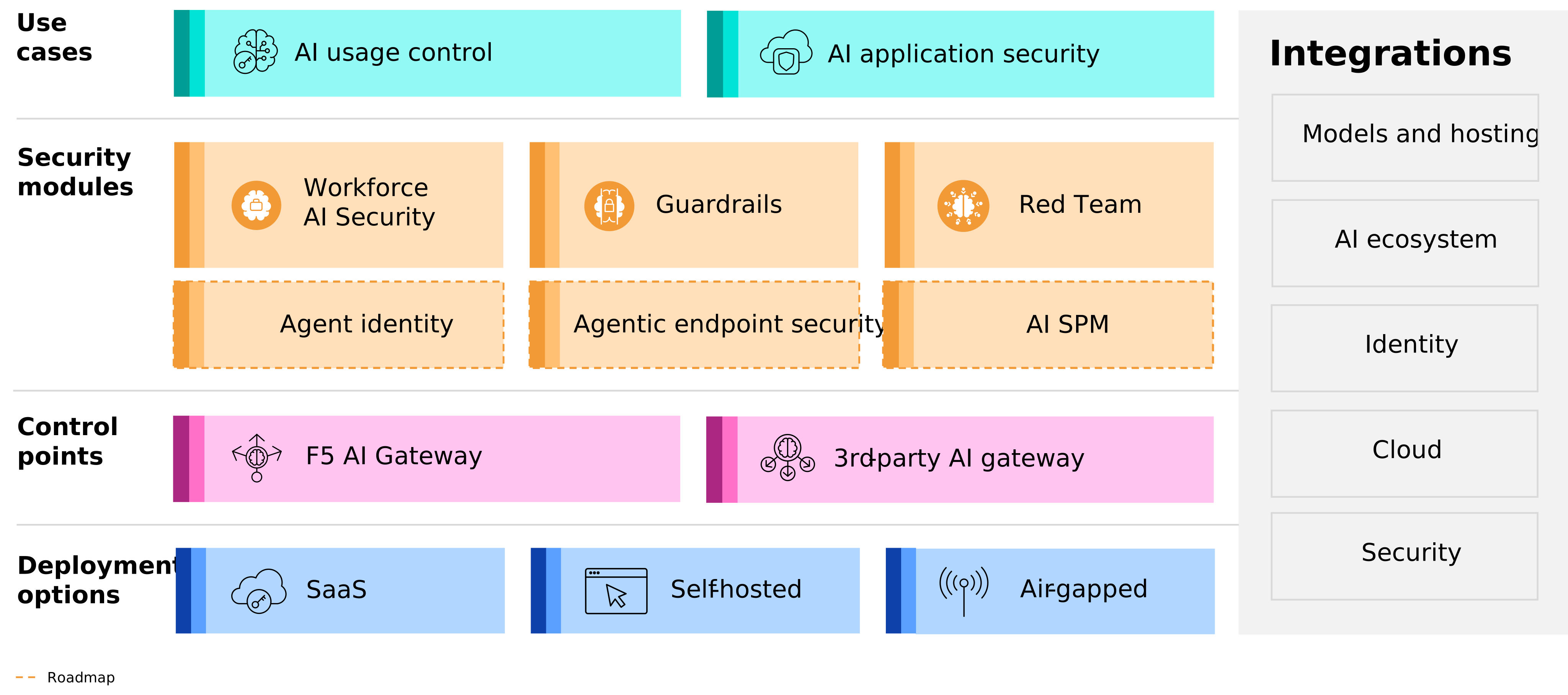
Deploy flexibly across the full spectrum of privacy needs
Public cloud
Deploy via AWS, Azure, or GCP with seamless integration into existing cloud infrastructure and workflows.
Hybrid cloud
Span on-prem and cloud environments with unified policy enforcement.
Private cloud
Maintain full control over AI security within your private infrastructure without external outbound calls.
On-prem air-gapped
Operate in fully isolated environments with no external connectivity.
Resources
Demos and videos
Blogs
Webinars
Insights and reports
WHITEPAPER
NSS Labs AI security whitepaper
Case studies
Technology alliances
Stronger AI security with the partners you trust
F5 integrates with leading security and AI vendors to extend protection across the full lifecycle. Joint solutions secure data, models, and the APIs between them, keeping your AI fast, governed, and under your control.



Frequently asked questions
An AI security platform provides centralized runtime protection, governance, and observability for AI models, applications, and agents. It protects enterprise LLMs by monitoring every interaction and blocking threats like prompt injection, data leakage, and other kinds of harmful outputs. Unlike point solutions, an AI security platform unifies capabilities that reinforce each other such as adversarial testing informing runtime defenses, or AI discovery identifying the most urgent models for security testing based on workforce adoption. This integrated approach delivers a more robust defense that fragmented tools simply can't match.
Open-source AI security tools offer a starting point but require significant internal expertise to configure, deploy, and maintain. They're community-driven, which often means slower updates, limited compliance-ready templates, and gaps in audit trails required for regulated industries.
Commercial AI security tools provide enterprise-grade capabilities including dedicated threat research, regular updates against emerging attack techniques, and out-of-the-box compliance controls needed for enterprise AI workloads.
AI governance is the framework of policies, controls, and oversight mechanisms that ensure AI systems align with organizational standards and regulations. It includes defining how AI is allowed to interact with users and data, maintaining audit-ready logs of AI activity, and aligning deployments to the risk management frameworks and compliance obligations specific to the organization. The F5 AI Security Platform helps teams operationalize AI governance with customizable policy enforcement aligned to unique risk categories and providing auditability for every model, user, and agent action.
AI Security platforms are purpose-built to secure and govern enterprise AI workloads, rather than comprehensive security and user activity monitoring. Traditional network threats exist in packets and data, whereas AI threats live in the words and tokens exchanged between users, agents, and models. Traditional cybersecurity solutions should be used in tandem with dedicated AI security tooling for an effective defense-in-depth approach.
Model provider guardrails are typically a baseline protection designed to meet the provider’s compliance obligations and risk appetite rather than protections extensible to all enterprise use cases, and risk definitions. In recent SecureIQLab testing of foundational models’ built-in guardrails against sophisticated AI attacks, roughly 13% of attacks were successfully blocked. Model providers may offer limited security controls but the efficacy of those controls does not meet the standards of most enterprise workloads and often restricts those controls to specific models rather than the full breadth of an organization’s AI inventory.