Virtual patching is your first line of defense
Frontier AI can turn vulnerabilities into working exploits before they can be disclosed. With F5, enterprises leverage virtual patching to block exploits at runtime, buying time to build, test, and deploy patches.
Exploits now arrive before disclosures
Frontier AI transforms vulnerabilities into working exploits before a CVE can even be disclosed. Measured against disclosure, vulnerability-to-exploit time is now negative. Patch cycles that take weeks cannot stop attacks built in minutes. Virtual patching makes runtime your primary line of defense, blocking exploits in the data path while developers remediate code safely.
Block exploits at runtime
Stop negative- and zero-days at the application layer before they ever reach vulnerable code.
Turn scans into enforcement
Link vulnerability discovery with WAF policy for virtual patches in minutes.
Block confidently, not blindly
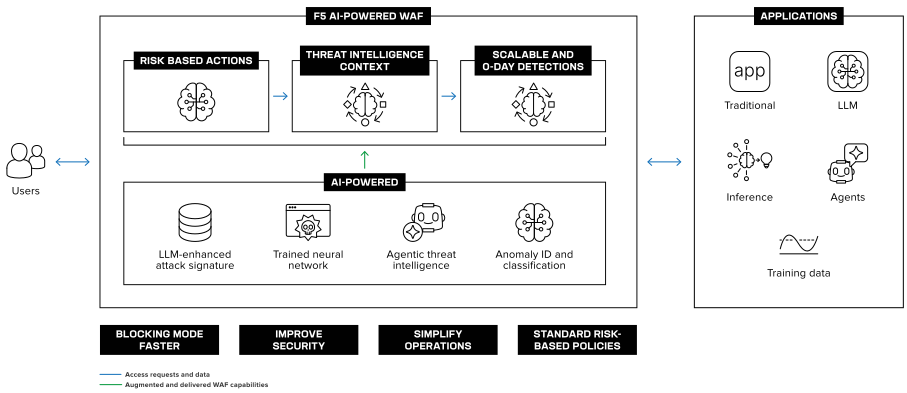
AI-powered risk scoring cuts false positives from 28% to 1% for faster blocking mode.
Patch virtually anywhere
Enforce consistent protection across cloud, on-premises, edge, and air-gapped environments.
From weeks exposed to minutes protected
Virtual patching closes the gap between vulnerability discovery and a permanent fix
Without virtual patching, every discovered vulnerability is like the starters pistol for a race. The exploit can be live in production for weeks while code fixes move through development, testing, and deployment. With F5, a virtual patch can neutralize any attempted exploit in minutes, so the application stays protected while developers fix code within standard change control process instead of racing against the clock.
How F5 helps
The API visibility gap
The API visibility gap
You can't virtually patch what you haven't found. F5 Web App Scanning and F5 API Security for Distributed Cloud continuously discover the apps, APIs, and vulnerabilities you didn't know you had and that were reachable, then feeds the findings straight into enforcement. For environments requiring air-gapped or sovereignty, F5 API Security Local Edition delivers the same API discovery entirely on premises.
When exploits outpace patches
When exploits outpace patches
Frontier AI can turn vulnerabilities into working exploits before disclosure, while code fixes, testing, and deployment can take weeks under change control processes. F5 protects the vulnerability-to-exploit gap at runtime. F5 Distributed Cloud Web App Scanning results flow directly to F5 WAF for BIG-IP, identifying signatures to virtually patch against exploits, and can be applied in and protected by F5 WAF for Distributed Cloud, which applies surgical virtual patches in minutes and stops negative- and zero-days before signatures exist.
The blocking mode dilemma
The blocking mode dilemma
False positives make blocking mode feel riskier than the attacks it stops because of the preponderance of false positives and negatives. So, WAFs sit in monitoring mode. The AI-powered risk engine in F5 WAF for Distributed Cloud scores every request in real time, cutting false positives from 28% down to 1% and giving SecOps the confidence to block sooner without disrupting legitimate users.
Sovereign and air-gapped apps
Sovereign and air-gapped apps
Sovereignty and regulatory requirements keep your most critical workloads air-gapped or in-country, while most modern security assumes cloud connectivity you can't allow. F5 WAF for BIG-IP, F5 API Security Local Edition, and F5 Threat Campaigns deliver a fully on-premises WAAP experience, with local controls, consistent policies, and virtual patching that never phones home.
Trending topics
Resources
Blogs
Recent news
White papers
Frequently asked questions
Virtual patching is a security control that blocks attempts to exploit a known or suspected vulnerability at runtime, before a permanent code fix is deployed. Instead of changing the application itself, a virtual patch is enforced in the data path at the application delivery layer, typically by a WAF, so exploit traffic never reaches the vulnerable code. Applications stay protected while developers build, test, and release permanent fixes through standard change control.
Traditional patching changes application code and must move through development, testing, and deployment, a cycle that routinely takes weeks. Virtual patching applies protection immediately at the point where traffic reaches the application. The two work together. Virtual patching is not a replacement for code remediation. It is the control that keeps applications safe during the gap between vulnerability discovery and a permanent fix.
Frontier AI models can discover vulnerabilities and transform them into working exploits before a CVE is ever disclosed. Measured against disclosure, the vulnerability-to-exploit window is now negative. When exploitation can precede disclosure, defenses that wait for a signature, an advisory, or a patch cycle start from behind. Runtime enforcement through virtual patching becomes the primary line of defense.
F5 enforces virtual patches at the application delivery layer, directly in the data path where your applications and APIs actually receive traffic. Because F5 Distributed Cloud Web App Scanning tests your specific applications and feeds findings directly to F5 WAF for BIG-IP and works with F5 WAF for Distributed Cloud, each virtual patch is surgical and targeted to your real exposure rather than a generic network-level content feed.
F5 pairs virtual patching with AI-powered risk scoring in F5 WAF for Distributed Cloud, which evaluates every request with real-time machine learning classification and a neural network risk engine. This reduces false positives from 28% down to 1%, so security teams can move to active blocking mode sooner without disrupting legitimate traffic or application availability.
Yes. F5 WAF for BIG-IP, F5 API Security Local Edition, and F5 Threat Campaigns together deliver a fully on-premises WAAP experience, including API discovery and virtual patch enforcement, with local analysis and management and no cloud dependency. This supports digital sovereignty and highly-regulated environments where workloads cannot connect outward.