It’s time again to dig into the application services organizations are actually using to make apps faster and safer.
Of note this quarter again is a continuing rise in use of bot defense services (up another 1%). Security application services held firm, showing no losses or gains, but acceleration again slowed down (pun intended). The rise and fall of acceleration services appears to be seasonal. Expect to see a rise again next quarter as we head into the heavily digital holiday season.
This quarter, analytics-related services caught my eye. A trip down memory lane and four years of data discovered a steady growth.
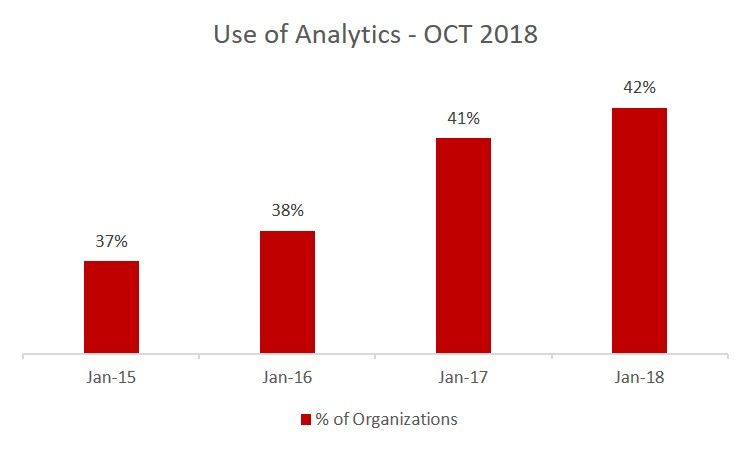
This should not be surprising given that 74% of organizations in our State of Application Delivery 2018 survey told us that analytics was important to the operation of their infrastructure. Year over year we see continued growth and use stats and analytics related capabilities, which serve to increase visibility. Survey after survey reinforces this finding with “lack of visibility” cited as an impediment and challenge to everything from cloud migration to comprehensive security.
We’ll continue to track this trend and expect to see it continue to climb steadily upward as machine learning and big (operational) data become indispensable to scaling IT operations.
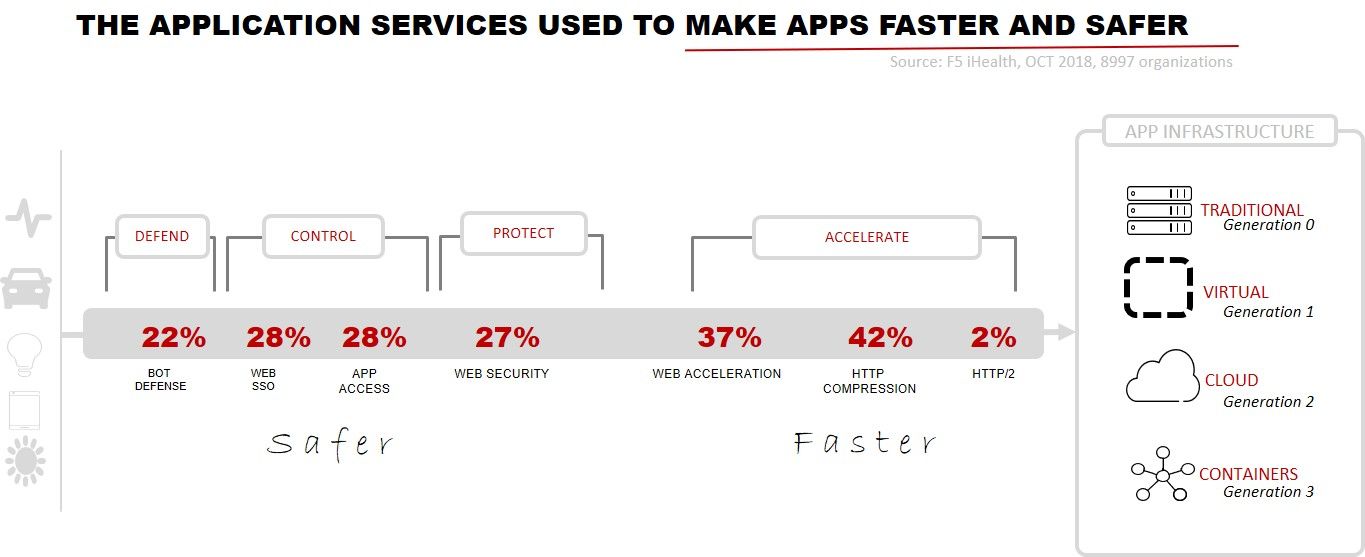
The application services represented are not all inclusive; it is a sample based on data compiled from iHealth over the course of the previous 3-month quarter.
DEFEND
BOT DEFENSE UP AGAIN
Bot defense gained 1% again over last quarter, growing from 21% to 22% of organizations employing it to defend against malicious non-human traffic.
Research from F5 Labs proposed that half of all Internet traffic originates with bots. Nearly one third (30%) of these are malicious.
CONTROL & PROTECT
SECURITY STANDS FIRM
Use of application access and web single-sign on services were steady quarter over quarter, as was web security usage.
Analysis from F5 labs revealed that applications and identities were the initial targets in 86% of breaches, making these application services critical.
ACCELERATE
REDUCING SPEED
Web acceleration and HTTP compression services each lost previous gains, dropping from 39% to 37% and 44% to 42% respectively.
HTTP/2 made no gains, remaining at just 2% of sites.
About the Author

Lori MacVittie is a Distinguished Engineer and Chief Evangelist in F5’s Office of the CTO with deep expertise in application delivery, automation strategy, and infrastructure. She is known for turning complexity into clarity whether she’s defining guardrails for AI agents, dissecting brittle multicloud architectures, or probing the limits of scalable systems. She brings more than thirty years of industry experience across application development, IT architecture, and network and systems operations. Before joining F5, she served as an award-winning technology editor. MacVittie holds an M.S. in Computer Science and is a prolific author whose publications span security, cloud, and enterprise architecture. She is also an avid tabletop and video gamer with unapologetically strong opinions about cheese.
More blogs by Lori Mac VittieRelated Blog Posts

A new path to technical excellence for F5 partners
Introducing F5 Partner Foundations, a structured learning curriculum to build F5 partner engineer expertise with a clear pathway to specialization.
Secure-by-design storage for agentic AI: Why runtime visibility plus traffic control matters
Learn how F5 is collaborating with NVIDIA to help protect agentic AI with secure-by-design AI infrastructure, runtime visibility, and traffic control.

Why sub-optimal application delivery architecture costs more than you think
Discover the hidden performance, security, and operational costs of sub‑optimal application delivery—and how modern architectures address them.
Architecting for AI: Secure, scalable, multicloud
Operationalize AI-era multicloud with F5 and Equinix. Explore scalable solutions for secure data flows, uniform policies, and governance across dynamic cloud environments.
AppViewX + F5: Automating and orchestrating app delivery
As an F5 ADSP Select partner, AppViewX works with F5 to deliver a centralized orchestration solution to manage app services across distributed environments.

F5 NGINX Gateway Fabric is a certified solution for Red Hat OpenShift
F5 collaborates with Red Hat to deliver a solution that combines the high-performance app delivery of F5 NGINX with Red Hat OpenShift’s enterprise Kubernetes capabilities.