


Enterprise AI is entering a more demanding phase. The challenge for most organizations is no longer gaining access to models or standing up GPU capacity. It is building an architecture that can reliably connect AI systems to enterprise data, expose that data as a shared service across the business, and protect it as usage scales. Dell built the Dell AI Data Platform around exactly this shift: a new data foundation for access, preparation, orchestration and preparation across the AI lifecycle.
AI is turning enterprise data into an operational dependency
AI changes what enterprise data is for. In traditional analytics environments, data often moved in batches toward reports, dashboards, and historical analysis. In AI environments, that same data is increasingly retrieved in real time, combined across structured and unstructured sources, fed into inference pipelines, and used by assistants and agents that search, reason, and act. As organizations continue to move from pilots to production, data stops being a back-end asset and becomes an operational dependency. Dell’s AI Data Platform is explicitly positioned around that reality: unified storage, data engines, and orchestration designed to support the full AI lifecycle.
A better data layer is now a business requirement, not just a technical upgrade
If AI is going to operate as a business capability rather than a collection of experiments, enterprises need more than model access and raw storage. They need a foundation that can prepare and serve data across the full AI lifecycle. Dell has developed the Dell AI Data Platform around exactly that need: PowerScale for unified file and object access, ObjectScale for enterprise S3 object storage, and data engines built to access, prepare, enrich, and orchestrate data products for analytics and AI. Dell’s broader platform messaging also emphasizes protection of sensitive and proprietary data throughout the AI lifecycle.
The path into the data platform is now a control point
A better data layer is not only about where data lives. It is also about how that data is reached. Once AI succeeds inside an enterprise, usage patterns change quickly:
- One assistant becomes many assistants.
- A prototype becomes a shared service used by multiple teams.
- A search endpoint becomes a dependency for applications and agents connected by APIs.
What looked manageable as a point-to-point connection starts to look fragile at enterprise scale. At that point, the path between users, applications, agents, and the data platform becomes a design issue. That path must absorb concurrency, handle failures gracefully, enforce policy consistently, and prevent every AI rollout from creating a new sprawl of brittle endpoints.
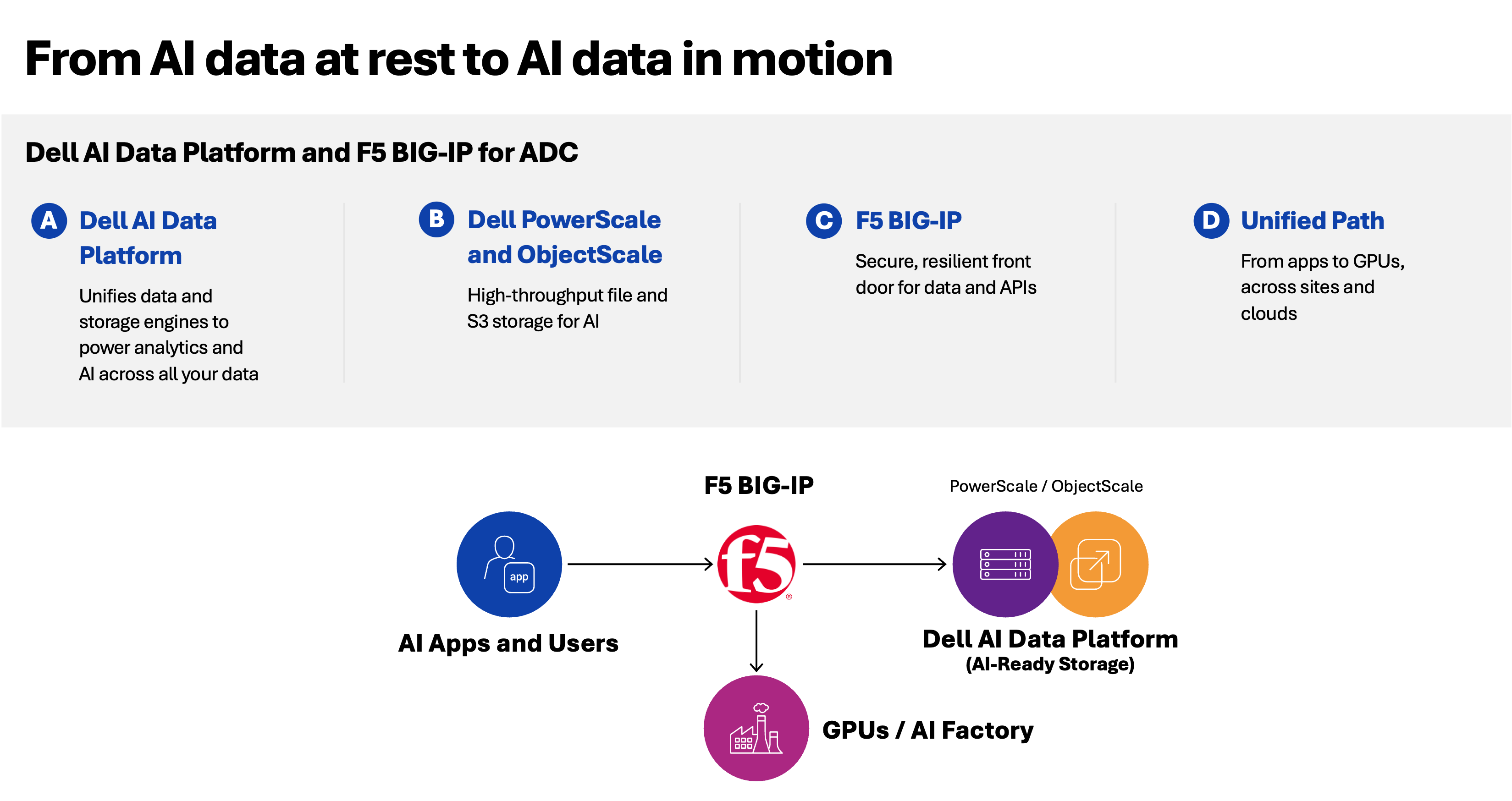
Dell addresses this inside the storage environment with PowerScale SmartConnect, which delivers connection distribution, dynamic failover, and failback so client operations can continue when nodes go down or maintenance occurs. F5 compliments that with a control point in front of the broader AI environment, applying consistent traffic management and policy across the services AI depends on.
AI data delivery reflects architectural discipline
This is where F5 becomes strategically relevant to AI conversations. At F5, we frame this challenge as AI data delivery: the discipline of making sure the path between compute and data is performant, resilient, and controllable under real-world conditions. That matters because AI systems do not just need access to data; they need predictable access to data when networks are imperfect, workloads are bursty, and demand is shared across environments.
In recent functional testing, F5 BIG-IP helped stabilize traffic flow between compute and storage under latency and jitter, improving throughput consistency for S3-compatible workloads. The larger lesson is architectural, not just benchmark-driven: when the data path is unmanaged, AI performance and efficiency are harder to sustain.
AI infrastructure is not only about compute and storage capacity. It is also about whether the enterprise has a deliberate control layer between AI workloads and the data they depend on. A strong data foundation matters. So does a front door that makes that foundation consumable and resilient in production.
AI runtime security belongs in the same conversation
The same control point matters for security. As enterprise AI matures, organizations are not only exposing data to models. They are exposing it to prompts, APIs, tools, workflows, and agents acting on behalf of users and business processes. That expands the attack surface and raises the cost of weak controls. OWASP’s current guidance for LLM and GenAI applications highlights risks such as prompt injection, insecure output handling, training data poisoning, model denial of service, and excessive agency. NIST’s Generative AI Profile likewise emphasizes trustworthiness considerations in the design, development, use, and evaluation of generative AI systems.
This is why the conversation can no longer stop at storage performance or model quality. Enterprises also need runtime controls that help govern how AI systems interact with enterprise data. Dell AI Data Platform protects sensitive and proprietary data across the AI lifecycle with integrated cyber resilience capabilities. F5 AI Guardrails is a model-agnostic runtime layer that helps protect AI applications with consistent policy enforcement, real-time inspection, protections against adversarial attacks such as prompt injection and jailbreaks, and safeguards against sensitive data leakage. F5 also pairs that with AI red teaming and broader application security capabilities (e.g., web application and API protection) so organizations can test, monitor, and enforce policy.
The next phase of enterprise AI will be won in the data layer
The next phase of enterprise AI will not be defined only by which model an organization adopts. It will be defined by whether the business can make its data usable, resilient, and protected across the full AI lifecycle. That is why enterprise AI needs a better data layer, and why the architecture in front of that data layer is becoming a strategic control point rather than a secondary implementation detail. Dell Technologies and F5 give enterprises the data foundation and the delivery and security layer needed to run AI in production. For enterprises trying to move from experimentation to production, that is the conversation worth having.
If you are attending Dell Technologies World in Las Vegas, May 18-21, visit the F5 booth to explore how we help organizations deliver and secure AI infrastructure and applications.
Also, be sure to watch our upcoming webinar, “Enhancing AI Performance with Dell Infrastructure.”
About the Authors
Hunter Smit is a senior manager of product marketing for solutions and strategy at F5. He leads solutions marketing across the F5 portfolio, including AI infrastructure and application security, and is driving F5’s entry into the emerging AI data delivery market. Hunter is a member of the Whitworth University School of Business Advisory Board and has served as an adjunct instructor for product marketing. He earned an MBA and a Bachelor of Business Administration degree in management from Whitworth University.
More blogs by Hunter SmitMark Menger is a Solutions Architect at F5, specializing in AI and security technology partnerships. He leads the development of F5’s AI Reference Architecture, advancing secure, scalable AI solutions. With experience as a Global Solutions Architect and Solutions Engineer, Mark contributed to F5’s Secure Cloud Architecture and co-developed its Distributed Four-Tiered Architecture. Co-author of Solving IT Complexity, he brings expertise in addressing IT challenges. Previously, he held roles as an application developer and enterprise architect, focusing on modern applications, automation, and accelerating value from AI investments.
More blogs by Mark MengerAdam Robyak is a Principal Engineer and serves as the Global AI Lead for Presales at Dell Technologies. He has more than 25 years of experience in the IT industry, including nine years as CEO of his own consulting firm. During his career, Adam has gained extensive experience across numerous verticals and industries. In his current role, Adam brings thought leadership across a variety of areas of focus. With a wealth of knowledge in emerging technologies such as multi-cloud ecosystems, data management, artificial intelligence, Digital Human and Digital Twin, and IoT/Edge, Adam looks to help customers solve complex business objectives and challenges. Adam is a founding member of both the Pathfinder Team and the Blockchain Steering Committee within Dell Technologies and holds roles as a Dell Technologies CTO Ambassador and CTO Ambassador Steering Group member. Adam currently holds a US Patent in blockchain and distributed ledger technology and has 5+ pending patents in the artificial intelligence industry.
More blogs by Adam RobyakRelated Blog Posts

Securing the new control points in the AI journey
AI architecture is fundamentally different than traditional IT environments and requires a different security strategy to protect critical AI workloads.
The patch window has closed. Here is how F5 is built for what comes next.
As AI models have changed software security, the industry needs to adapt.
Best practices for optimizing AI infrastructure at scale
Optimizing AI infrastructure isn’t about chasing peak performance benchmarks. It’s about designing for stability, resiliency, security, and operational clarity
Datos Insights: Securing APIs and multicloud in financial services
New threat analysis from Datos Insights highlights actionable recommendations for API and web application security in the financial services sector
Secrets to scaling AI-ready, secure SaaS
Learn how secure SaaS scales with application delivery, security, observability, and XOps.
How AI inference changes application delivery
Learn how AI inference reshapes application delivery by redefining performance, availability, and reliability, and why traditional approaches no longer suffice.