Os provedores de serviços sempre monitoraram de perto o desempenho da rede. A taxa de transferência e a latência continuam sendo importantes, mas não indicam aos operadores quanta infraestrutura é necessária para oferecer esse desempenho.
O consumo de CPU e memória afeta os requisitos de servidores, a densidade das cargas de trabalho, o consumo de energia, a refrigeração e a capacidade restante para outros serviços. Esses fatores se tornam cada vez mais importantes à medida que mais funções de rede migram para ambientes Kubernetes.
A F5 contratou o The Tolly Group para avaliar de forma independente a eficiência e o desempenho da infraestrutura do F5 BIG-IP Cloud-Native Edition em comparação com uma implantação testada de função de rede virtual, ou VNF. Ambas foram avaliadas em um ambiente Red Hat OpenShift usando duas cargas de trabalho representativas de provedores de serviços: processamento de consultas DNS e Camada 4 com NAT de nível de operadora, ou L4+CGNAT.
A Tolly mediu a taxa de transferência e a latência, além do consumo de CPU e memória. O objetivo era entender quanto trabalho útil cada implantação poderia realizar e quais recursos de infraestrutura seriam necessários para isso.
Avalie a infraestrutura por trás do desempenho
Os resultados dos testes mostram por que vale a pena analisar o consumo de recursos juntamente com as métricas tradicionais de desempenho.
Em um ambiente Kubernetes, a CPU e a memória não utilizadas podem permanecer disponíveis para que a plataforma agende outras cargas de trabalho, dependendo das políticas de recursos do cluster. Portanto, um menor consumo de recursos pode proporcionar mais flexibilidade na forma como os operadores utilizam a infraestrutura já implantada.
As duas cargas de trabalho da Tolly apresentaram perfis de desempenho diferentes, mas ambas demonstraram reduções substanciais nos requisitos de CPU do BIG-IP Cloud-Native Edition na configuração testada.
DNS: maior taxa de transferência com menos CPU
O DNS é um serviço de alto volume no qual um grande número de transações relativamente pequenas precisa ser processado rapidamente. O teste de DNS da Tolly utilizou a funcionalidade DNS Express no BIG-IP e mediu a taxa de transferência sustentada de consultas, o consumo de CPU, a eficiência de memória e a latência média.
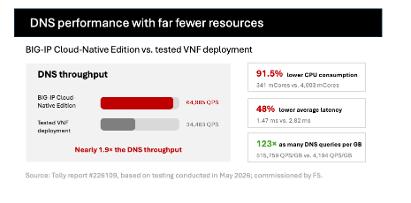
O BIG-IP Cloud-Native Edition manteve 64.985 consultas DNS por segundo, em comparação com 34.463 consultas por segundo para a VNF testada. Isso representa uma taxa de transferência de consultas DNS quase 1,9 vez maior.
Os requisitos de CPU também foram substancialmente diferentes. O BIG-IP Cloud-Native Edition consumiu 341 mCores, enquanto a VNF consumiu 4.003 mCores, praticamente todos os recursos de CPU dos quatro núcleos alocados ao teste. Portanto, o CNE usou 91,5% menos CPU na configuração testada.
A latência média de DNS foi de 1,47 milissegundo para a CNE, em comparação com 2,82 milissegundos para a VNF, uma redução de 48%.
A Tolly também normalizou o desempenho de DNS em relação ao consumo de memória. O BIG-IP Cloud-Native Edition forneceu 515.759 consultas por segundo por gigabyte de memória, em comparação com 4.194 para a VNF, resultando em 123 vezes mais consultas de DNS por gigabyte de memória no teste.
Para os operadores que executam serviços de DNS de alto volume, a consideração prática é quanta infraestrutura é necessária para dar suporte a uma determinada carga de trabalho. Requisitos menores de CPU e memória podem disponibilizar mais capacidade no ambiente Kubernetes para serviços adicionais ou crescimento futuro.
L4+CGNAT: vazão semelhante, menos recursos
O teste de L4+CGNAT apresentou um resultado diferente.
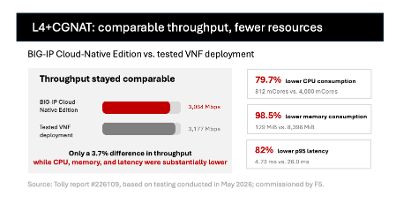
Ambas as implantações forneceram aproximadamente 3 Gbps de taxa de transferência. O BIG-IP Cloud-Native Edition manteve 3.064 Mbps, enquanto a VNF testada manteve 3.177 Mbps, tornando o resultado da VNF cerca de 3,7% superior.
A diferença no consumo de infraestrutura foi consideravelmente maior.
O BIG-IP Cloud-Native Edition usou 812 mCores, em comparação com 4.000 mCores da VNF. Isso representa um consumo de CPU 79,7% menor.
O consumo de memória foi de 129 MiB para o BIG-IP Cloud-Native Edition e de 8.396 MiB para a VNF, resultando em uma redução de 98,5% na configuração testada.
A Tolly também mediu uma latência p95 de 4,73 milissegundos para o BIG-IP Cloud-Native Edition, em comparação com 26 milissegundos para a VNF, uma redução de 82%.
No ambiente testado, a taxa de transferência apresentou uma variação de apenas 3,7%, enquanto o BIG-IP Cloud-Native Edition utilizou substancialmente menos CPU e memória e apresentou menor latência p95.
Por que a eficiência de recursos é importante
Os ambientes de provedores de serviços geralmente precisam comportar grandes volumes de tráfego em uma infraestrutura na qual os recursos de CPU, memória, energia e capacidade física são limitados.
A eficiência no uso de recursos pode afetar quantas cargas de trabalho cabem em um cluster, quanta capacidade permanece disponível para novos serviços e quanta infraestrutura é necessária à medida que a demanda aumenta.
É nesse ponto que os resultados da Tolly são mais úteis. DNS e L4+CGNAT foram duas cargas de trabalho representativas selecionadas para testes independentes. Elas não representam todas as funções disponíveis no BIG-IP Cloud-Native Edition, mas fornecem exemplos concretos de como um modelo de implantação nativo do Kubernetes pode alterar o perfil de recursos dos serviços de rede. Portanto, as conclusões devem ser entendidas como resultados referentes às cargas de trabalho e configurações testadas, e não como alegações de desempenho de outros serviços do BIG-IP Cloud-Native Edition.
Os resultados também oferecem aos operadores outra métrica a ser considerada ao avaliar a arquitetura das funções de rede. A taxa de transferência continua sendo essencial, mas CPU, memória e latência ajudam a demonstrar o custo, em termos de infraestrutura, para entregar essa taxa de transferência.
Para provedores de serviços que planejam oferecer serviços de rede baseados em Kubernetes, essas informações podem ajudar a orientar decisões sobre planejamento de capacidade, alocação de cargas de trabalho e utilização da infraestrutura.
Para saber mais, leia o relatório completo do Tolly Group para conferir uma avaliação independente da eficiência da infraestrutura de provedores de serviços com o F5 BIG-IP Cloud-Native Edition. Confira também nosso blog, Modernização nativa da nuvem para a era da IA e do 5G/6G.
Sobre o autor

Publicações relacionadas no blog

Segurança de APIs sem concessões: apresentamos novas opções flexíveis de descoberta com F5 API security
As opções ampliadas de descoberta de APIs da F5 foram desenvolvidas para oferecer o máximo de flexibilidade e atender às organizações onde quer que estejam.

Governe sua IA no presente e antecipe o futuro da sua IA
Aprenda com nosso CISO de campo, Chuck Herrin, como se preparar para o novo desafio de proteger modelos e agentes de IA.

Segurança de IA para a cadeia de suprimentos
As cadeias de suprimentos são cada vez mais impulsionadas pela IA — desde a previsão de demanda e o planejamento logístico até a análise de riscos de fornecedores e a gestão de estoque em tempo real. Essas ferramentas ajudam as empresas a reduzir custos, aumentar a resiliência e se adaptar a disrupções globais. No entanto, elas também criam novos riscos em um vasto ecossistema: nossas soluções de segurança de IA em tempo de execução protegem o setor de Cadeia de Suprimentos […]
Segurança de IA para Recursos Humanos
A IA está revolucionando o RH. As empresas estão implementando copilotos de recrutamento com IA, assistentes de integração, chatbots de suporte aos funcionários e ferramentas de análise da força de trabalho para reduzir custos e melhorar a experiência dos colaboradores. No entanto, as aplicações de RH também apresentam riscos específicos que podem expor as organizações a falhas de conformidade, alegações de viés e danos à reputação: nossas soluções de segurança de IA em tempo de execução protegem o setor de RH com […]
Equilibrando o desempenho da IA e a gestão de recursos
As organizações dependem cada vez mais de ferramentas e iniciativas de IA para impulsionar a inovação e a transformação. Cada avanço incremental na sofisticação das ferramentas de IA torna o equilíbrio entre desempenho e gestão de recursos um desafio maior e mais relevante para as equipes de TI e segurança. No entanto, esse equilíbrio é essencial para maximizar o ROI, garantir a segurança e manter a eficiência em toda a […]
Integração de APIs em IA: a base técnica
A integração de APIs é um canal essencial no ecossistema de IA, por meio do qual diferentes sistemas, plataformas e aplicações interagem. Analisamos as nuances técnicas da integração de APIs em IA, com ênfase em sua importância para aprimorar a eficiência e os recursos dos sistemas de IA. As APIs permitem a troca fluida de dados e funcionalidades entre diferentes soluções de IA […]