AI’s center of gravity has shifted from training to inference. F5 helps keep AI resilient and secure by routing inference traffic, reducing data delivery bottlenecks, and enforcing runtime security across hybrid multicloud environments.
Training happens once. Inference happens constantly, under load, and in the open, so every weakness in how data moves, traffic routes, and access is controlled becomes a production problem. The F5 Application Delivery and Security Platform sits at that control point, keeping AI fast, available, and secure under real-world demand.
of organizations now run AI inference themselves1
AI models are managed in production on average 1
of organizations have faced AI-related security challenges 1
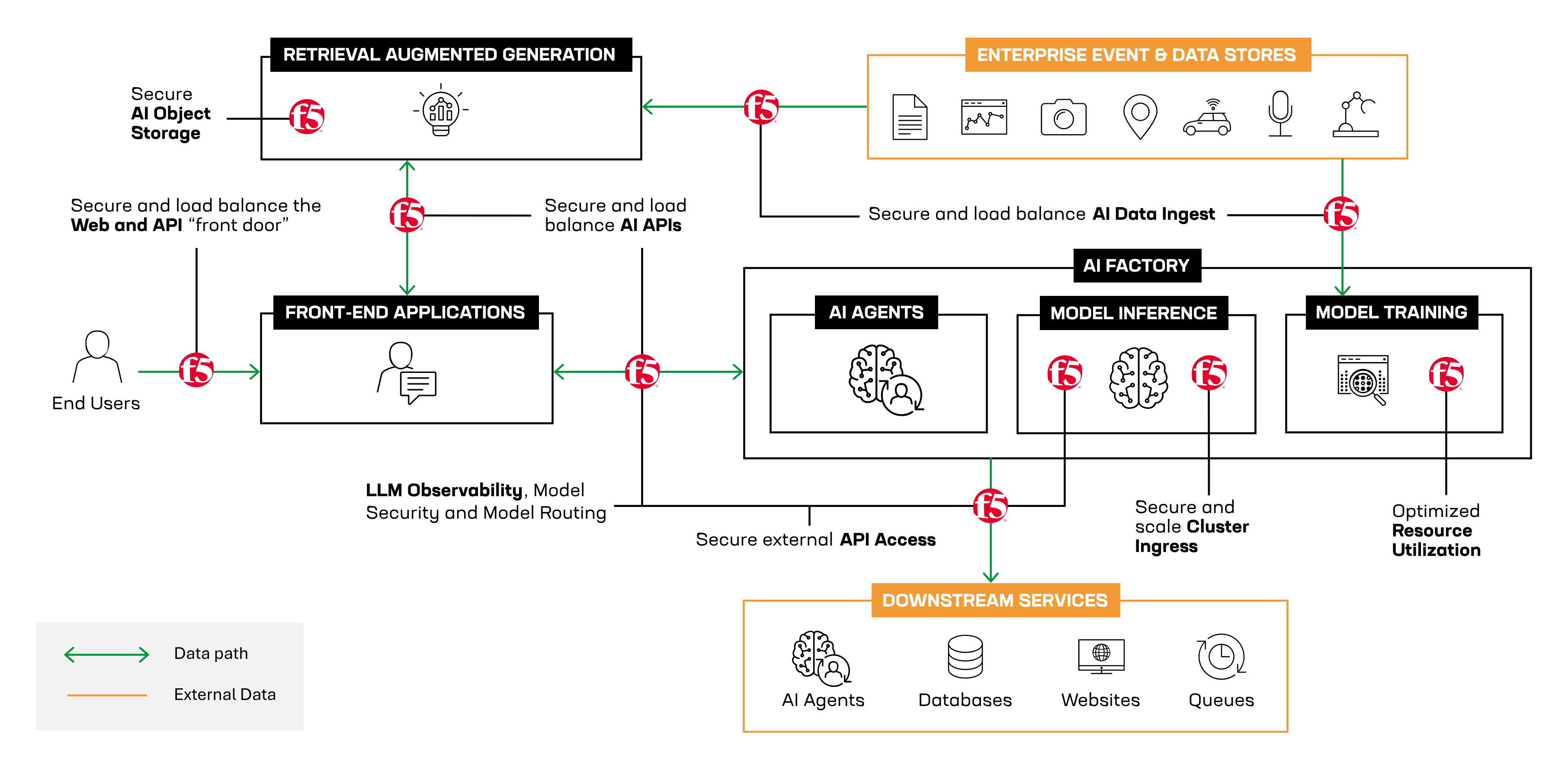
Improve the movement of data and traffic at scale. From S3-compatible storage data ingestion to distributed inference and AI factory load balancing, F5 helps reduce bottlenecks and improve GPU utilization across hybrid multicloud environments.
Explore AI infrastructure solutionsSecure and govern AI models, apps, agents, and the APIs connecting them, with a continuous cycle of risk assessment and bespoke runtime protection that keeps security teams in command.
Explore AI security solutionsJoint solutions for scaling and protecting enterprise AI applications across the full lifecycle.
Explore an interactive AI reference architecture to learn how to move data faster, protect AI traffic, and keep environments resilient across hybrid multicloud deployments.
Financial services are shifting from AI copilots to AI agents that plan and act on their own. That autonomy adds risk across the APIs, models, and data the agents touch, and regulators now expect every agent action to be traceable and supervised. F5 keeps these AI systems fast and available, inspects the prompts and responses moving through them, and gives you the visibility to prove governance. See how financial services scale agentic AI while keeping account holder trust intact.
Government AI systems span citizen services, defense, and intelligence, often crossing classified and unclassified environments. F5 ADSP optimizes AI data delivery, provides runtime security for AI models and agents, and protects inference APIs across on-premises, sovereign cloud, and air-gapped deployments.
AI is revolutionizing Healthcare, but security is getting in the way. Despite a 239% increase in hacking-related incidents since 2018, hospitals and health systems are not keeping pace. Compliance is no longer sufficient—it’s time to deploy cybersecurity best practices to protect apps and APIs while scaling to meet patient and provider needs in the AI era.
AI is reshaping how people shop, from personalized recommendations to AI agents that browse and buy on a customer's behalf. Each new use adds load and risk across your apps, APIs, and checkout flows. F5 helps you tell verified shopping agents from malicious bots, block scraping and fraud, and keep your storefront fast when traffic surges. See how retailers protect and scale AI-driven shopping without slowing the experience or opening the door to attack.
The shift that matters is moving the conversation from GPU-hour to cost per token, because the GPU is rarely the binding constraint. Most enterprise clusters run far below their capacity, and the gap is operational rather than a hardware shortfall. The largest gains come from runtime efficiency techniques like continuous batching, speculative decoding, and quantization, which extract substantially more throughput from the hardware already in place. On top of that, intelligent inference routing sends simple queries to smaller models and caches repeated answers so they are not recomputed, consolidated in a control plane in front of inference that handles routing, caching, and rate-limiting as a single policy. Feed those GPUs properly, then instrument the full stack so cost per token becomes the metric the business is managed against. It is the one measure that captures hardware, software, and real-world utilization together.
They defend different things. AI-powered threat detection points machine learning at threats, using behavioral and anomaly analytics to compress the time it takes to find and respond to attacks. AI runtime security points security at the AI system itself, embedding protection during interactions between users, agents, and AI applications so that inputs and outputs are protected against malicious threats, and interaction aligns to enterprise policies. Traditional application security focuses on code and infrastructure; AI runtime security adds the disciplines that are specific to AI, including red-teaming, model validation, data and model provenance, and runtime guardrails after deployment. The two are complementary and both sit under the broader AI trust, risk, and security mandate. Detection without AI runtime security leaves the model unguarded, and AI security without detection leaves the enterprise around it exposed.
The threats are best understood against the established frameworks, principally the OWASP Top 10 for LLMs, MITRE ATLAS, and the NIST AI Risk Management Framework. The dominant risk is prompt injection, where crafted inputs manipulate model behavior, and its impact grows sharply in agentic systems that can browse, execute code, and call other tools. Close behind is sensitive information disclosure, where models leak personal data, system prompts, or intellectual property through their outputs. Beyond those sit supply-chain and data poisoning from compromised third-party models or training data, along with model theft, adversarial inputs, insecure handling of outputs, and consumption attacks that drive up cost and degrade availability. The most pervasive operational gap is shadow AI, the unsanctioned use of AI tools outside governance. The architectural lesson for security and infrastructure leaders is that nearly all of these threats travel through the API conduit into the model, so defense belongs at a runtime control point rather than being retrofitted application by application.

Because the GPU consumes data faster than the pipeline can deliver it, leaving expensive accelerators idle while they wait. The constraint is data movement and input/output, not raw compute, and it is one of the most common reasons high-value clusters underperform. Modern training and inference demand sustained, high-throughput access that legacy storage was never designed to provide, and the problem compounds when access patterns are unpredictable, when preprocessing is handled by an overloaded CPU, and when data is scattered across silos with no fast, unified path to compute. The discipline that fixes it is treating data delivery as engineered infrastructure, using prefetching, caching, parallel loading, and high-throughput storage that places data close to the GPUs. The payoff is direct: a smaller cluster that is consistently fed outperforms a larger one that is starved.
Three forces are converging: data sovereignty, unpredictable cloud economics, and the performance demands of real-time AI, all sharpened by a more uncertain geopolitical climate. Gartner has named the pattern geopatriation, the deliberate move of data and applications out of global public clouds and into local or sovereign environments, and it has shifted quickly from a fringe consideration to a mainstream board-level priority. The drivers are familiar to any CIO. Regulated and sensitive data needs to stay under local jurisdiction, proprietary data used to train models should not be exposed externally, public-cloud and egress costs have repeatedly exceeded expectations, latency-sensitive inference benefits from sitting near the data, and unsanctioned AI use in public cloud raises real exposure. The practical consequence is that workload placement becomes a recurring, evidence-based decision rather than a one-time migration, and it is only executable when portability and a single consistent control fabric travel with the workload across on-premises, sovereign, and public environments.