Across the enterprise, the question is no longer, "Is the user experience good enough?" Now, it's, "Are we delivering the best possible experience, as efficiently as we can?" Infrastructure teams focus on latency and reliability, business leaders on cost and efficiency, and marketing leaders on whether Core Web Vitals are translating into better rankings, traffic, and revenue.
The reality: "good enough" is costing more than most teams realize. Slow pages quietly lose rankings and traffic, while origin-heavy architectures bleed compute and egress costs. Yet enabling a content delivery network (CDN) remains complex. Between vendor sprawl, contracts, integration risk, and lack of visibility into value, enabling CDN is now the infrastructure decision teams perpetually defer. Meanwhile, every request served from origin instead of the edge is a tax you're paying on every user, every session, every day.
F5 changes that with F5 Distributed Cloud CDN, which lets you see the impact before you enable it and go live in minutes once you do, unlocking faster apps, stronger SEO performance, and a more efficient cost to serve.
Application performance issues build slowly until something breaks
Most teams don't set out to "buy a CDN." They're trying to solve a much bigger problem: how to deliver fast, reliable user experiences at global scale without letting infrastructure costs spiral out of control.
As traffic grows, every request served from origin compounds the pressure, resulting in more compute, higher egress costs, and more operational overhead. Performance bottlenecks and availability risks stop being engineering problems and start becoming revenue problems.
And performance is no longer just a user experience concern. Metrics like Core Web Vitals play a direct role in SEO—Google uses them as ranking signals. Slower applications don't just frustrate users; they lower search rankings and lose organic traffic before a single person bounces.
A CDN changes that equation.
By moving delivery, caching, and security closer to users, it accelerates applications, strengthens Core Web Vitals scores, and cuts the cost of serving every user at scale.
Understand the value before making a change
Teams need to justify the change, align stakeholders, and forecast the impact before anyone approves an infrastructure modification. This is the biggest blocker to adopting a CDN.
The cacheable content tile solves that problem directly. Built directly into a Distributed Cloud HTTP load balancer performance page, the cacheable content tile reads your application's real traffic and shows how much of your request volume and data transfer is eligible for caching before you enable anything.
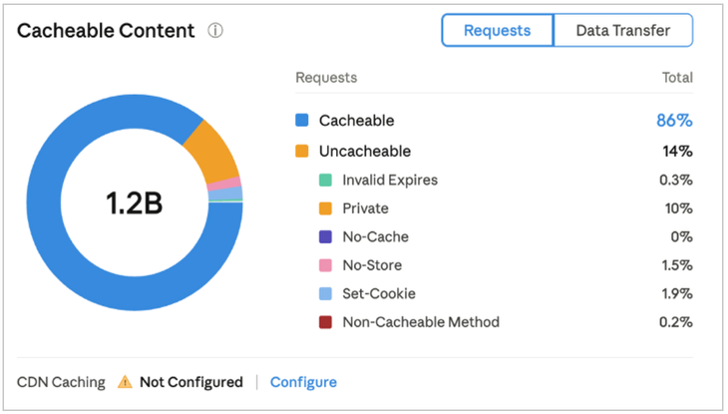
This isn't a theoretical estimate. You'll see what percentage of requests could be served from the edge instead of your origin, how much data transfer volume is cacheable, and what blockers are limiting your cache hit rates today such as cache-control headers (no-cache, private), cookie usage (set-cookie), or invalid expiration settings.
All of this translates into compute and egress costs. The tool doesn’t just show you the upside. It shows you how to unlock additional CDN value. Teams that identify and fix a single misconfigured cache-control header often see hit rates jump dramatically on the first day.
Enable CDN in minutes, not weeks
If your applications are already served by a Distributed Cloud HTTP load balancer, CDN caching is one click away. No new vendors or contracts, and no architectural changes. The cacheable content tile shows you the opportunity, and from there, all you need to do is click configure and enable CDN.
Smart default settings handle the heavy lifting so teams without CDN expertise can get started immediately. Settings can be tuned over time as cache performance data builds, but you’ll still see immediate results on Day 1.
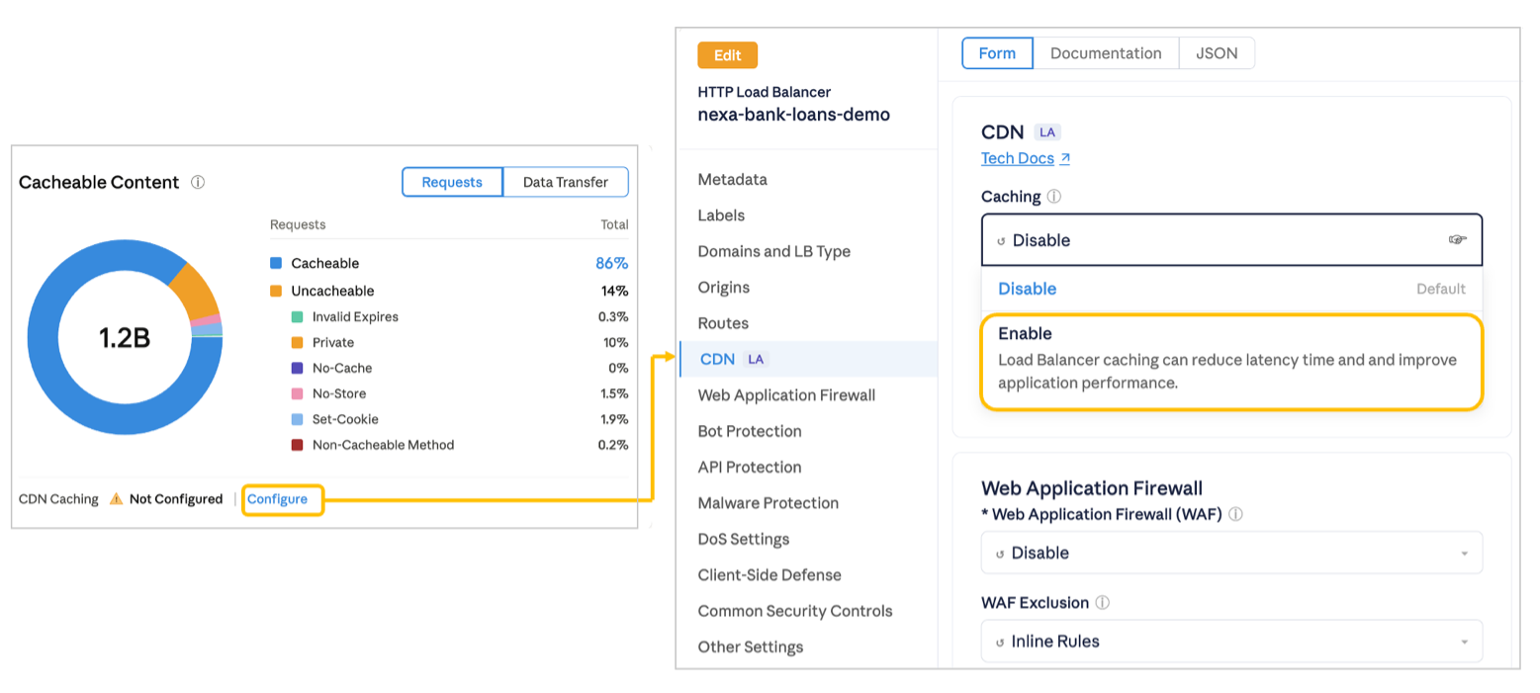
Seamlessly integrate with your security stack
One of the most persistent concerns about enabling CDN is security: Will I need to reconfigure my WAF? Will bot defenses still apply? Is there a gap at the edge?
The answer to all three is no. Distributed Cloud CDN is built directly into the F5 Application Delivery and Security Platform, meaning your existing WAF rules, bot defense policies, and DDoS protections are enforced before traffic is ever routed to the CDN layer for both cache hits and cache misses.
Your application’s security posture when you enable CDN is the security posture enforced at the edge from that moment forward. No gaps, no exceptions, and no additional configuration required.
Realize immediate, measurable benefits
Distributed Cloud CDN creates immediate measurable improvements across three key performance areas. With granular cache controls, you can tune your policies over to increase cache hit ratio, and end-to-end visibility helps you understand how requests flow through the load balancing and caching layers.
What you can expect to see:
- 50–80% faster experiences: Faster page load times for cached content served from the nearest regional edge node—an improvement users notice and engage with.
- Lower origin compute and cloud data transfer costs: Serving more traffic from the edge reduces origin load. This cuts compute requirements, autoscaling pressure, and cloud data transfer costs, directly lowering the total cost of running your application.
- Higher Core Web Vitals scores: Improved load times translate directly into better search rankings, lower bounce rates, and measurable conversion lift.
A sustainable application performance advantage
With F5, CDN becomes an ongoing optimization lever that helps you build a sustainable application performance advantage, with none of the operational overhead.
We recommend you start with one high-traffic application and use the cacheable content tile to quantify cacheable volume, expected offload, and potential cost reduction before you change anything. Finally, enable CDN caching and see how your metrics improve.
Check out our F5 Distributed Cloud CDN webpage to learn more.
About the Authors

Colin Clauset is a Senior Product Marketing Manager at F5, specializing in SaaS-based application delivery solutions. Colin is a go-to-market leader for distributed application delivery projects and services, with a particular passion for understanding how technology can make complex processes simpler, to better serve the needs of IT professionals. With a background in consulting prior to F5, Colin approaches customer challenges with an eye for holistic solutions beyond single products.
More blogs by Colin Clauset
Related Blog Posts
Cloud-native modernization for the AI and 5G/6G era
See why 5G/6G, Kubernetes maturity, and AI are accelerating cloud-native modernization, and how F5 BIG-IP Cloud-Native Edition improves efficiency.
Who can you trust in the age of AI agents?
New features for F5 Distributed Cloud Bot Defense enable organizations to distinguish between trusted and fraudulent AI traffic.
Securing F5 NGINX in the age of AI
How F5 is applying AI-driven security practices across the F5 NGINX portfolio to help deliver safer, more resilient software.

From dashboard fatigue to operational excellence: Why XOps needs F5 Insight for ADSP
Learn how F5 Insight for ADSP lays the visibility foundation for XOps—turning fragmented signals across applications and infrastructure into actionable intelligence.

Govern your AI present and anticipate your AI future
Learn from our field CISO, Chuck Herrin, how to prepare for the new challenge of securing AI models and agents.

F5 recognized as one of the Emerging Visionaries in the Emerging Market Quadrant of the 2025 Gartner® Innovation Guide for Generative AI Engineering
We’re excited to share that F5 has been recognized in 2025 Gartner Emerging Market Quadrant(eMQ) for Generative AI Engineering.