State of Application Delivery 2018: Security in the cloud, yes! Confidence, not so much.

F5 Ecosystem | February 20, 2018

Digital transformation is a forcing function, encouraging automation and orchestration across IT and driving organizations to the decision to deliver apps from the public cloud.

In fact, digital transformation permeates so thoroughly across IT that just about every aspect of our State of Application Delivery 2018 data showed signs of being impacted. Including security.

That impact is clear when we start looking at the relationship between confidence and cloud, and the drive to deploy the application services that keep apps safe – no matter where they might be.

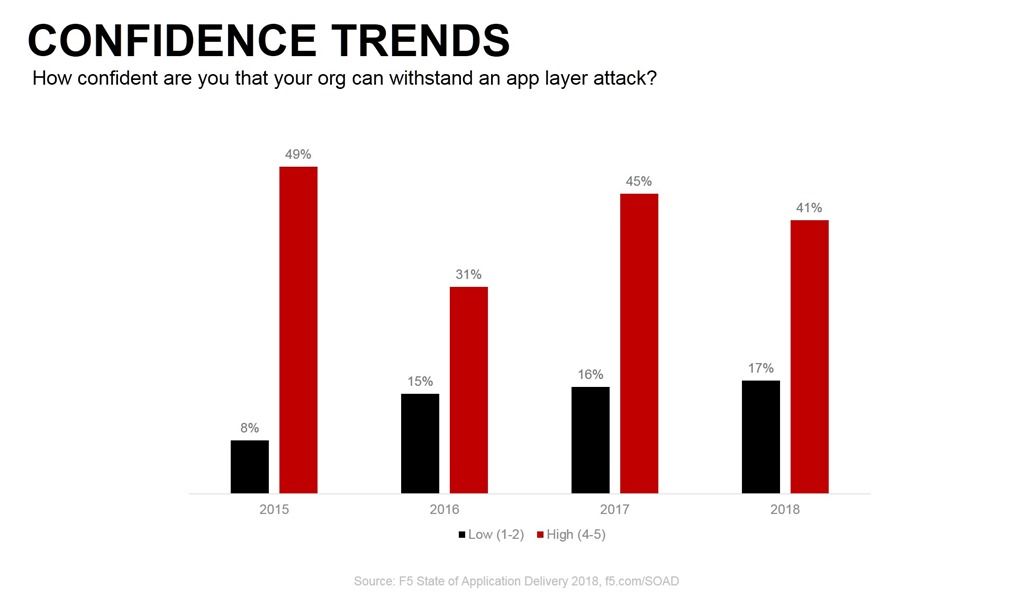
Now to be fair, in general, confidence has been trending downward over the four years we’ve conducted this survey.

conf trends soad18

In 2015, nearly half of organizations (49%) had high confidence in their organization’s ability to withstand an application layer attack.

This year we saw that drop to 41%. Conversely, the relatively minor percentage of respondents with low confidence in 2015 – a mere 8% – has more than doubled to 17% in 2018.

The “we’re neither confident nor lack confidence” crowd has remained largely static.

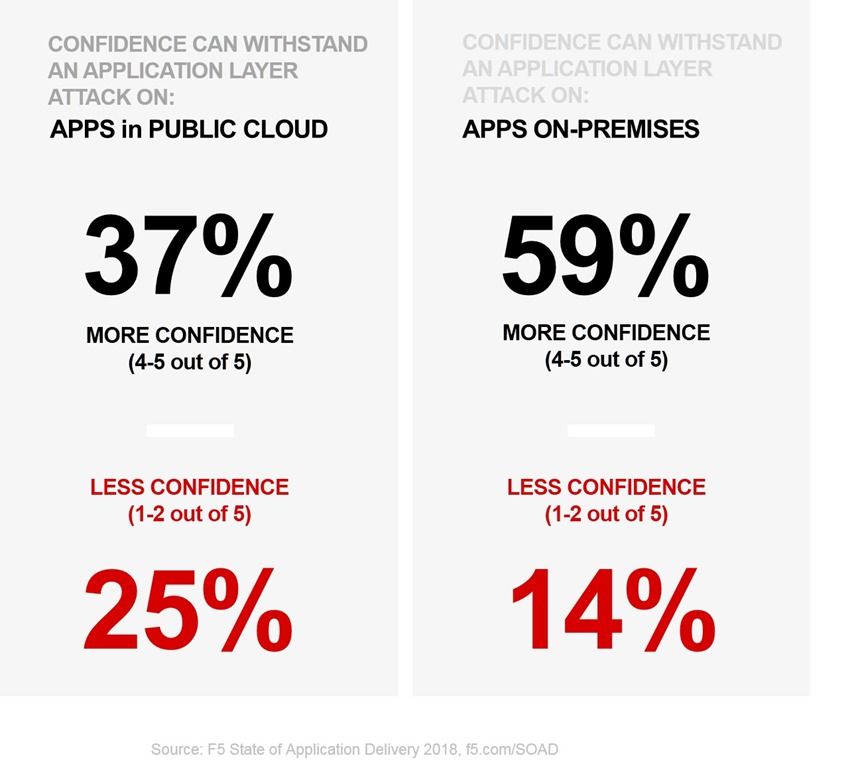
What makes this statistic even more disconcerting is the breakdown of confidence when public cloud is introduced into the picture.

conf cloud onprem soad18

There is a significant difference between respondents with high confidence in their security fu between protecting apps on-premises (59%) and in the public cloud (37%). Low confidence shows the same relationship – fewer respondents have low confidence with respect to on-premises (14%) compared to those with respect to public cloud (25%).

Now, it would be easy to blame the difference on cloud, but fundamentally the majority of public cloud environments have little to no impact on application security. Certainly infrastructure and network security is a factor that can lead to the compromise of an application, but for the most part the protection of applications - regardless of location - lies squarely on the shoulders of its owner. So we looked at other factors such as the technologies and application services organizations deploy in both environments to protect and defend applications. Perhaps it wasn’t the location but a difference in approach to protecting them.

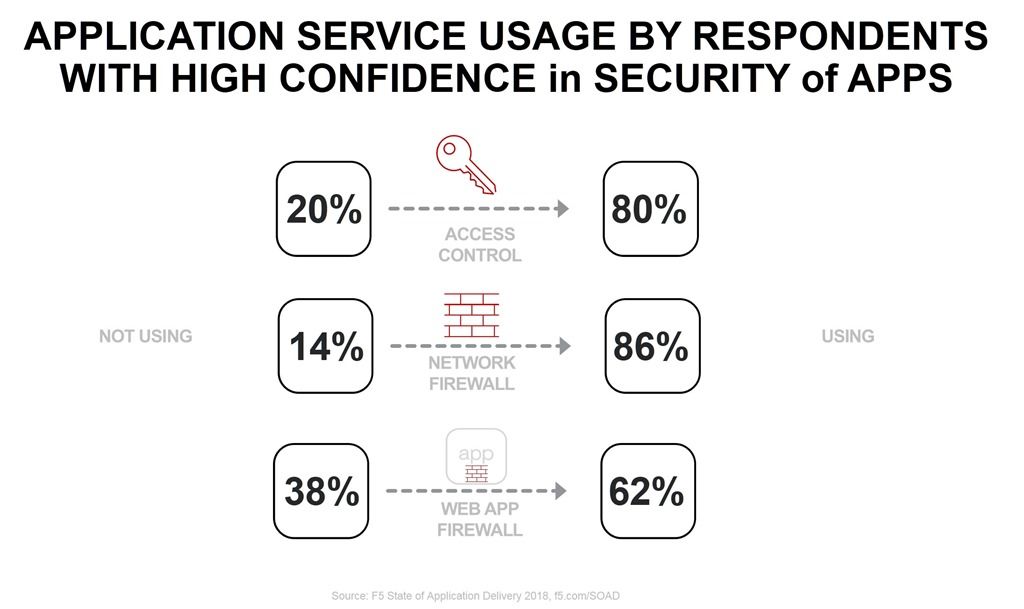
We found that the majority use three different application services to protect and defend applications: network firewall (83%), application access control (75%), and web application firewall (57%). Just over one in four (26%) also use user-behavioral analysis.

conf by service soad18

It’s a good mix of application services – watching the network, controlling access, and filtering/scrubbing for malicious content. So perhaps the use (or lack thereof) of these services was contributing to waning confidence levels.

What we discovered is that yes, the application services you rely on to protect applications against attack do have a positive impact on confidence to withstand an attack.

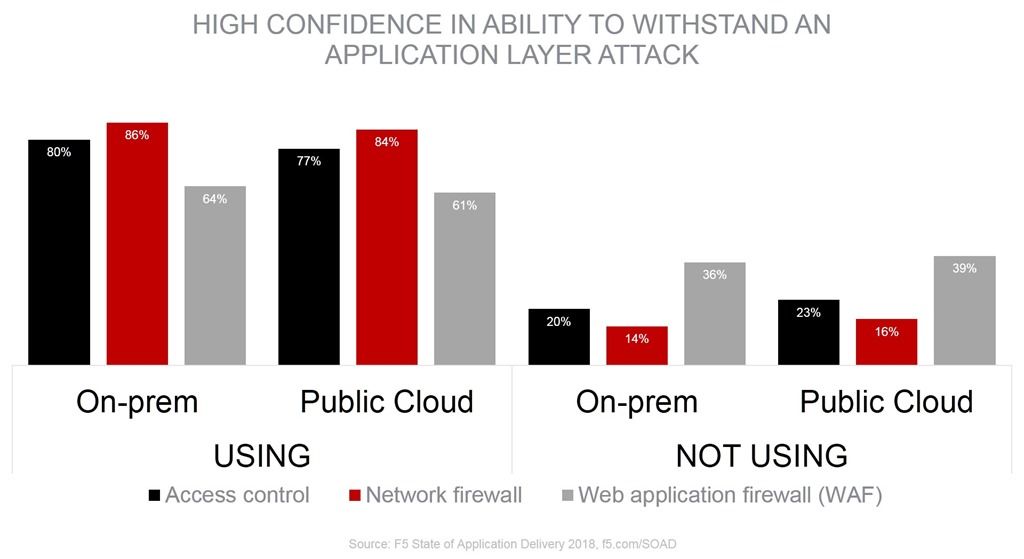
In the case of the top three, there were dramatically positive gains in confidence by those who employed the service. Then we looked at the impact of those same service deployments in the context of public cloud versus on-premises.

confidence use cloud onprem soad18

Two things stand out in this comparison: clearly, those using application services are far more confident than their counterparts that eschew their valuable protections.

The second is the slight differences – about 3% consistently – in confidence between on-premises and public cloud but not enough to explain the significant gap between general confidence levels to protect apps in the different environments. One concludes, then, that the environment (cloud) is a contributing factor to decreasing confidence with respect to withstanding application layer attacks.

The reason why may be found in the resurgence of complexity of security solutions as a top security challenge for 2018. The challenge had been decreasing – dropping out of the top three in 2017 with only 30% tagging it as a top challenge – but reared back up this year with 34% to reclaim its spot. Cloud necessarily introduces some of that complexity, with a dizzying array of foreign services and APIs. Cloud is not a traditional environment, and adapting to new architectures and new services contributes to complexity. Atop that is the reality that application services in the cloud may or may not achieve parity with the protection offered by on-premises services.

For example, a basic web application firewall service from a cloud provider may not provide the same robustness of protections as a web application firewall service on-premises. The difference in capabilities could be a contributing factor to confidence. As we did not dive into whether the application services on-premises were the same as those in the public cloud, we can’t definitively point to differences in capabilities as a source of declining confidence, but it seems one of several likely culprits.

Security is definitely moving to the cloud along with the applications it strives to protect, but the confidence to do so is not.

And with this, we wrap up our initial series on the State of Application Delivery 2018. For more insights on digital transformationmulti-cloudapplication services, security, automation, and the continuing NetOps transformation, feel free to grab your own copy of our 2018 State of Application Delivery report and follow along on the Twitters with @f5networks and/or the hashtag #soad18.

Share
Tags: 2018

About the Author

Lori Mac Vittie
Lori Mac VittieDistinguished Engineer and Chief Evangelist

More blogs by Lori Mac Vittie

Related Blog Posts

SaaS-first strategies reshape cloud-native application delivery
F5 Ecosystem | 12/03/2025

SaaS-first strategies reshape cloud-native application delivery

F5 NGINXaaS empowers cloud and platform architects to unify operations, reduce complexity, and deliver exceptional digital experiences at scale.

F5 ADSP Partner Program streamlines adoption of F5 platform
F5 Ecosystem | 11/19/2025

F5 ADSP Partner Program streamlines adoption of F5 platform

The new F5 ADSP Partner Program creates a dynamic ecosystem that drives growth and success for our partners and customers.

Accelerate Kubernetes and AI workloads with F5 BIG-IP and AWS EKS
F5 Ecosystem | 11/17/2025

Accelerate Kubernetes and AI workloads with F5 BIG-IP and AWS EKS

The F5 BIG-IP Next for Kubernetes software will soon be available in AWS Marketplace to accelerate managed Kubernetes performance on AWS EKS.

F5 NGINX Gateway Fabric is a certified solution for Red Hat OpenShift
F5 Ecosystem | 11/11/2025

F5 NGINX Gateway Fabric is a certified solution for Red Hat OpenShift

F5 collaborates with Red Hat to deliver a solution that combines the high-performance app delivery of F5 NGINX with Red Hat OpenShift’s enterprise Kubernetes capabilities.

F5 Silverline Mitigates Record-Breaking DDoS Attacks
F5 Ecosystem | 08/26/2021

F5 Silverline Mitigates Record-Breaking DDoS Attacks

Malicious attacks are increasing in scale and complexity, threatening to overwhelm and breach the internal resources of businesses globally. Often, these attacks combine high-volume traffic with stealthy, low-and-slow, application-targeted attack techniques, powered by either automated botnets or human-driven tools.

Phishing Attacks Soar 220% During COVID-19 Peak as Cybercriminal Opportunism Intensifies
F5 Ecosystem | 12/08/2020

Phishing Attacks Soar 220% During COVID-19 Peak as Cybercriminal Opportunism Intensifies

David Warburton, author of the F5 Labs 2020 Phishing and Fraud Report, describes how fraudsters are adapting to the pandemic and maps out the trends ahead in this video, with summary comments.

Deliver and Secure Every App
F5 application delivery and security solutions are built to ensure that every app and API deployed anywhere is fast, available, and secure. Learn how we can partner to deliver exceptional experiences every time.
Connect With Us
State of Application Delivery 2018: Security in the cloud, yes! Confidence, not so much. | F5